
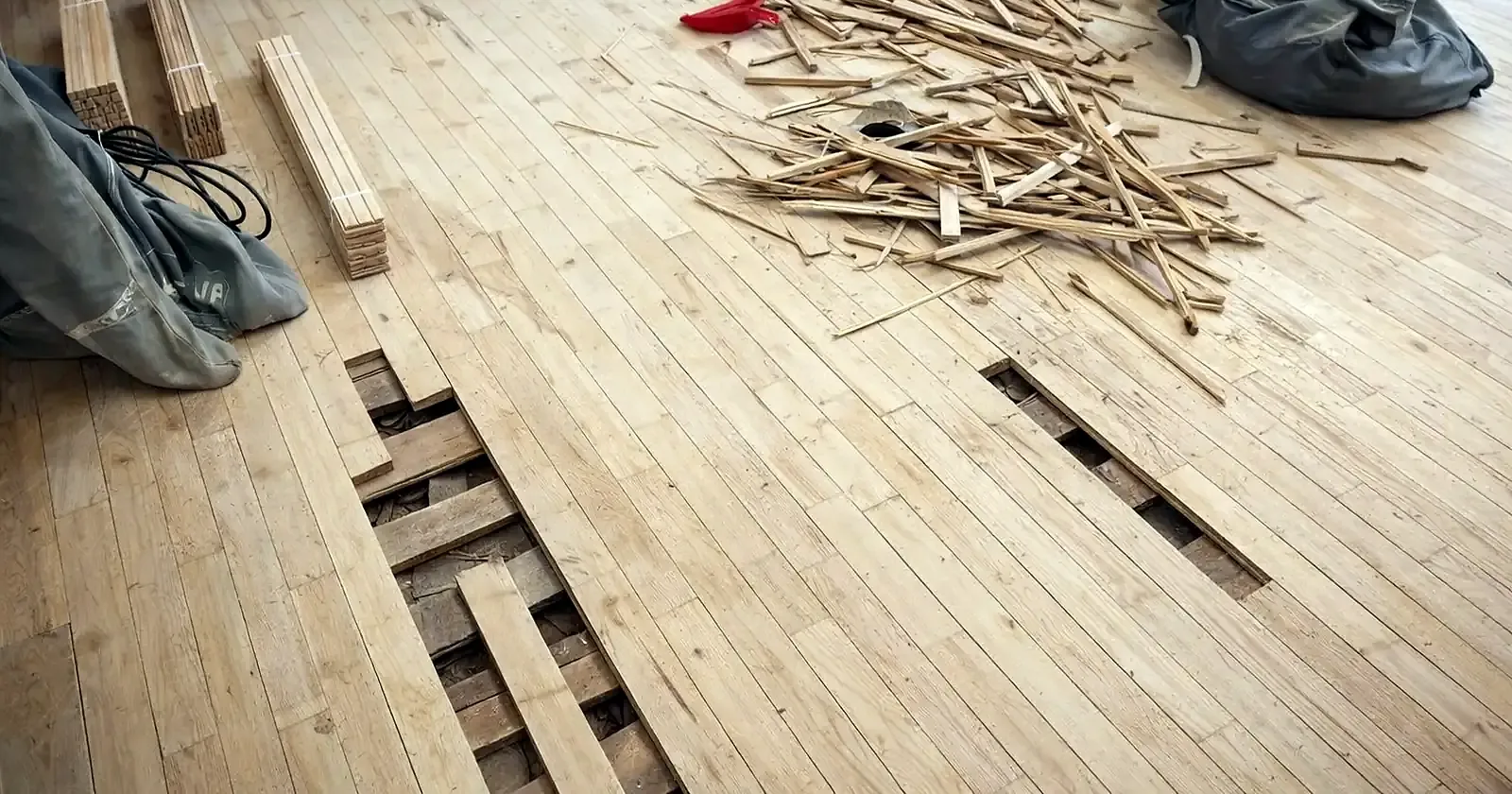
Short answer: yes, an old wood floor can be saved as long as it has usable wood left. Sunken battens and broken boards get replaced. Dark, worn varnish does not count: sanding takes it off.
What decides it is checked on site: measuring the usable wood that is left, seeing what state the subfloor is in, working out how much wood is missing and finding any damp. Six floors in Salamanca, Chamberí and Los Jerónimos were kept:
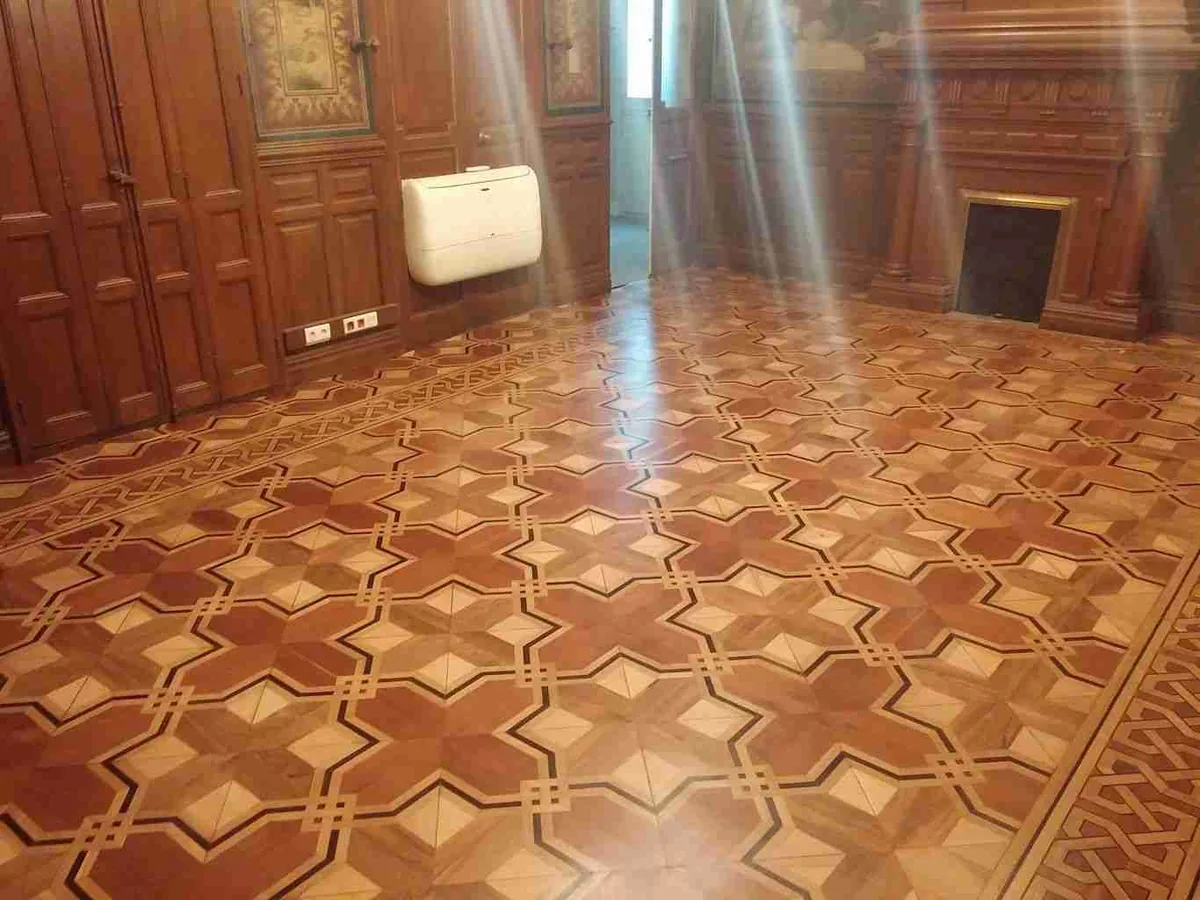
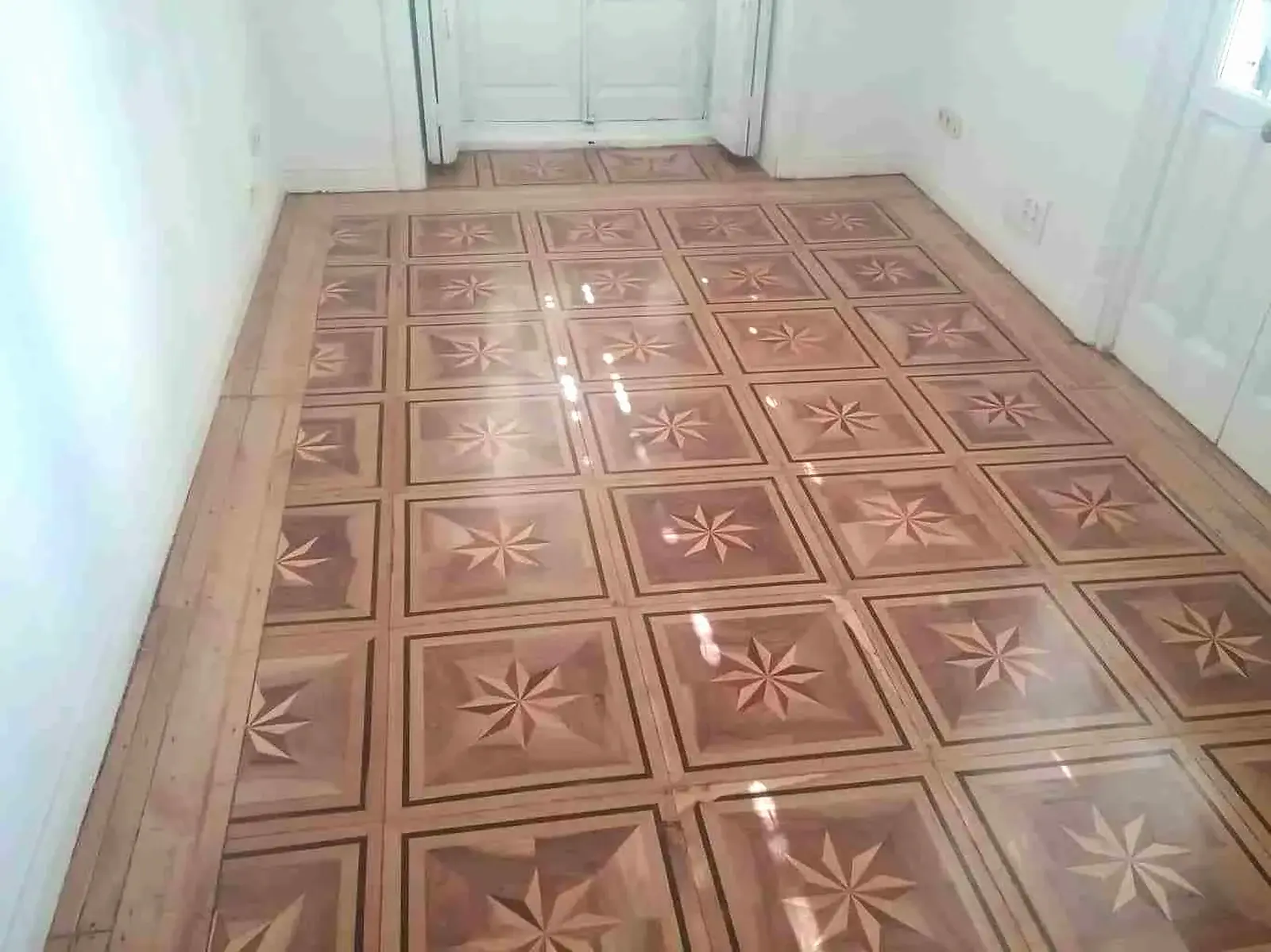
- Velázquez (Salamanca): marquetry parquet tiles in three adjoining living rooms and old pitch pine boards.
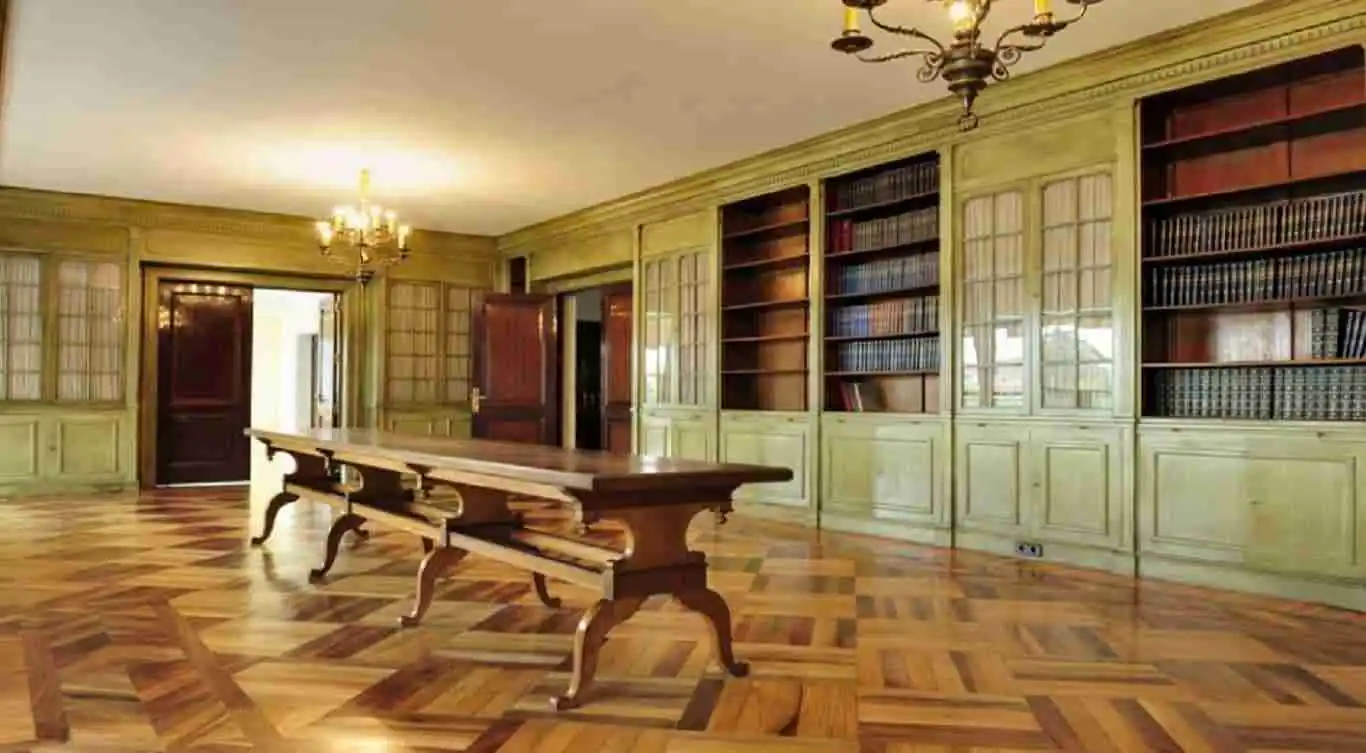
- Serrano (Salamanca): Spanish walnut and chestnut boards in a checkerboard pattern.
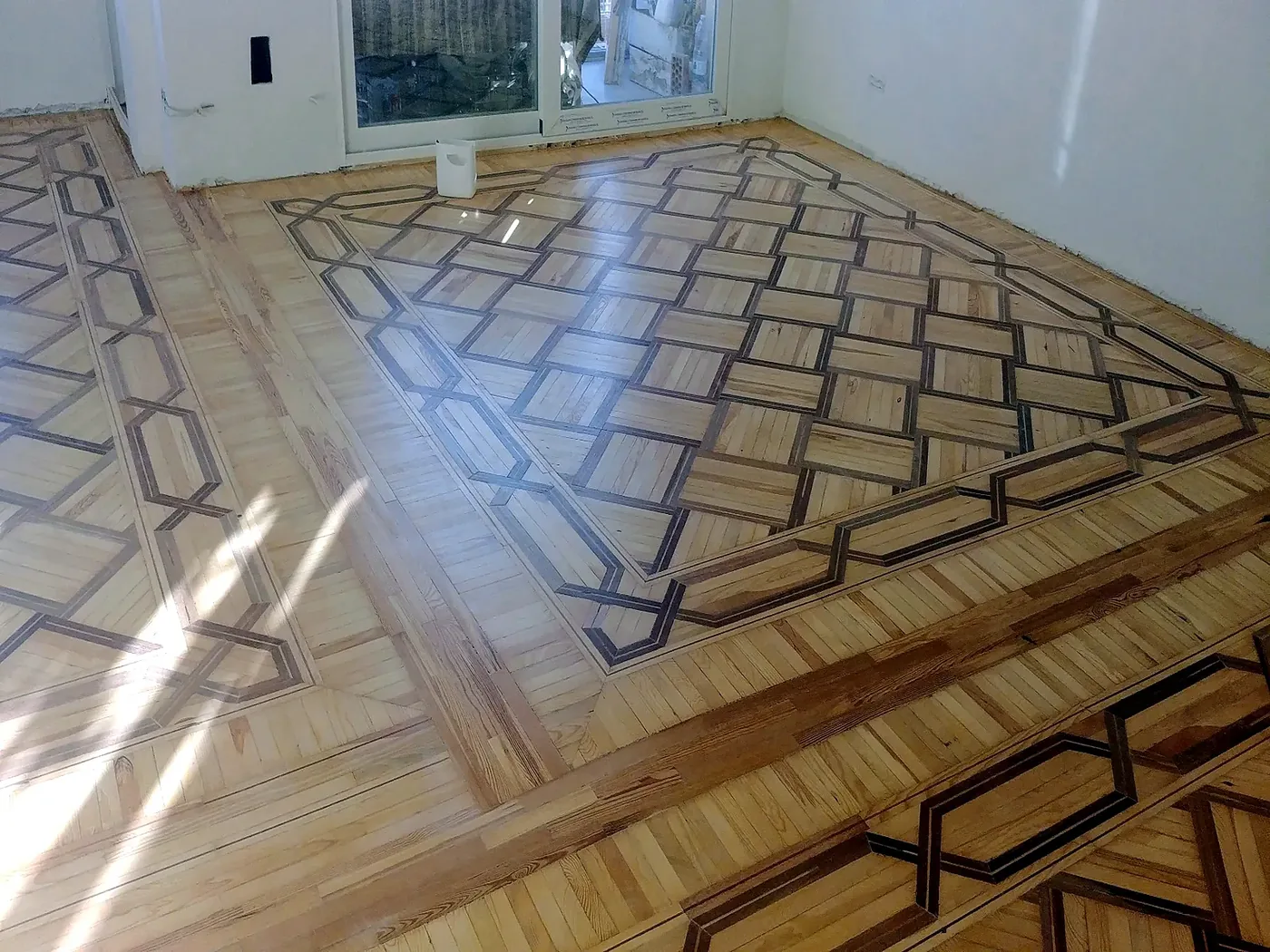
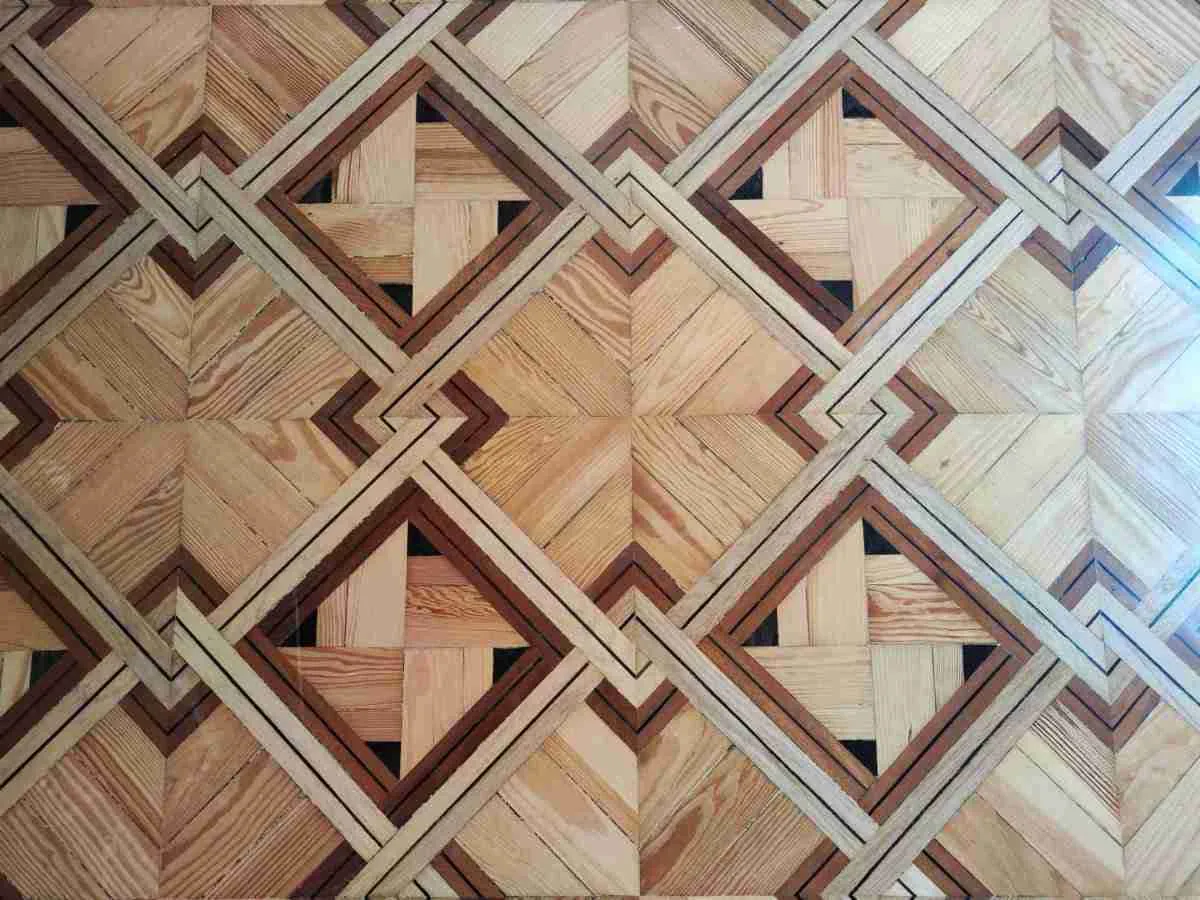
- Valenzuela (Los Jerónimos): old pitch pine with walnut and oak bands and decorative fret borders.
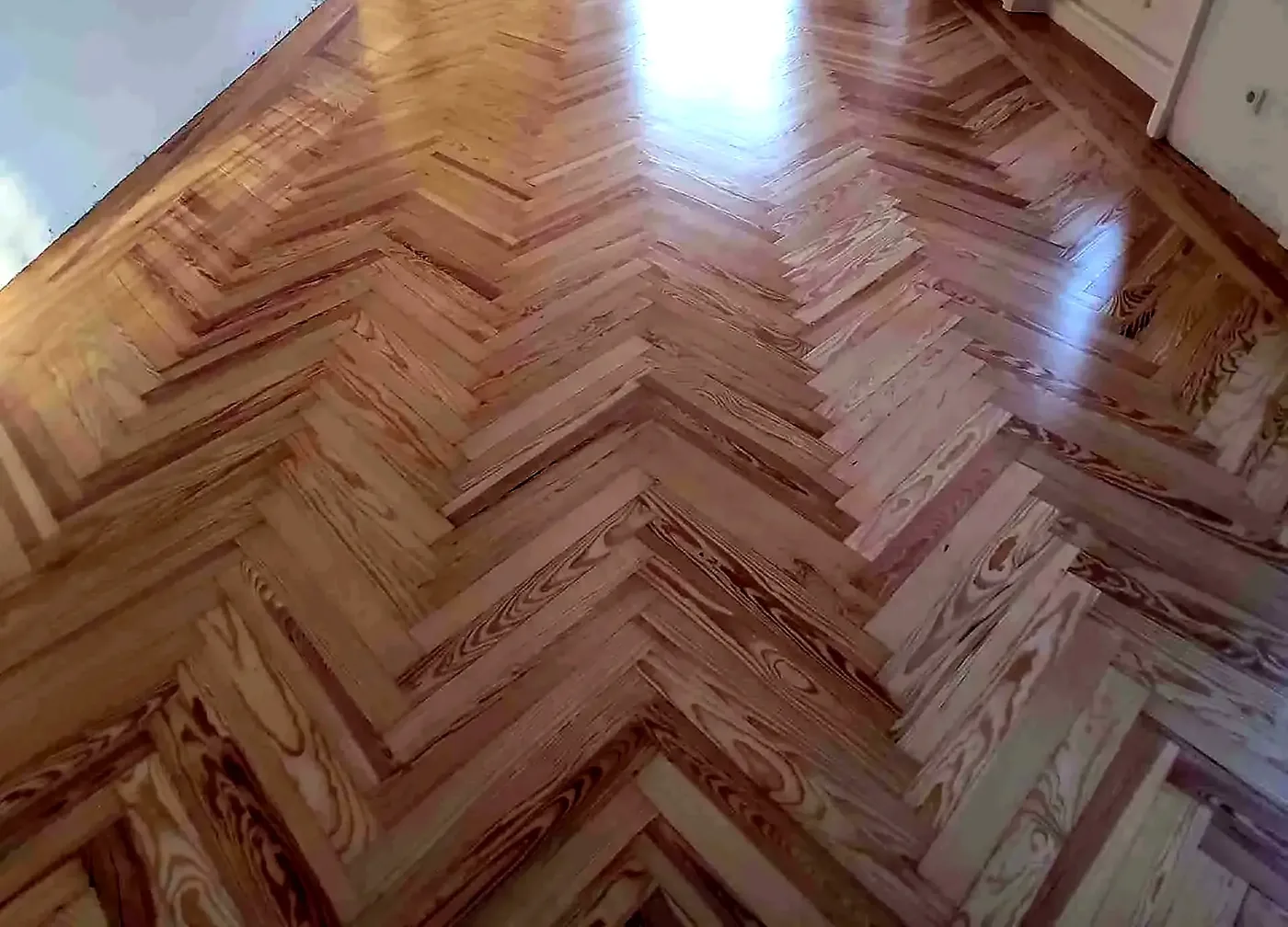
- Montalbán (Los Jerónimos): old pitch pine boards and parquet, in herringbone with a band and in straight lay: the boards nailed to battens and, in one room, glued parquet.
- Galileo (Chamberí): old pitch pine boards.
- Monte Esquinza (Chamberí): century-old pitch pine boards, in herringbone with a band, nailed to battens.
The usable wood
Usable thickness is the wood between the surface and the nearest obstacle. In a nailed board floor, that obstacle is the tongue, the ridge each board uses to lock into the next, or the nail head. In a glued parquet or a marquetry tile, the limit is not the tongue but the wear layer on top of the base. A solid wood board is usually 22 mm thick, although they range from 18 to 30 mm.
How much a sanding takes off depends on the species and on how flat the floor is. On a flat floor it is about 0.8 mm; with ridges or uneven boards, 3 mm or more. Below 2–3 mm of wood above the tongue, restoring is barely viable. The nails are set below the surface before the machine goes over them. If the heads are already flush with the wood, the floor has reached its sanding limit and we advise against sanding. The thickness is always checked. How many sandings each format can take is explained in “How many times can a parquet or a solid wood floor be sanded?”.
The subfloor
The subfloor is what holds the boards up: the battens, wooden strips the boards are nailed to, and the floor structure, the structure that forms the floor of each story. On five of the six jobs we had to work on the battens or on how the boards were fixed: Velázquez, Serrano, Montalbán, Galileo and Monte Esquinza.
Outside private homes, at the Ministerio de Justicia (Ministry of Justice) on Calle San Bernardo, the chestnut board floor rests on wooden battens over an old floor structure. There the boards were secured with concealed fixing to the battens.

At Montalbán and Serrano the loose boards were fixed down. At Monte Esquinza there was play in the battens that caused squeaks, and the concealed fixing of the boards was reinforced to stop the noise underfoot. At Galileo the base battens were repaired.
At Velázquez, woodworm tunnels turned up in the supporting battens. We checked that the woodworm was old and no longer active, and even so the affected battens were replaced.
The missing wood
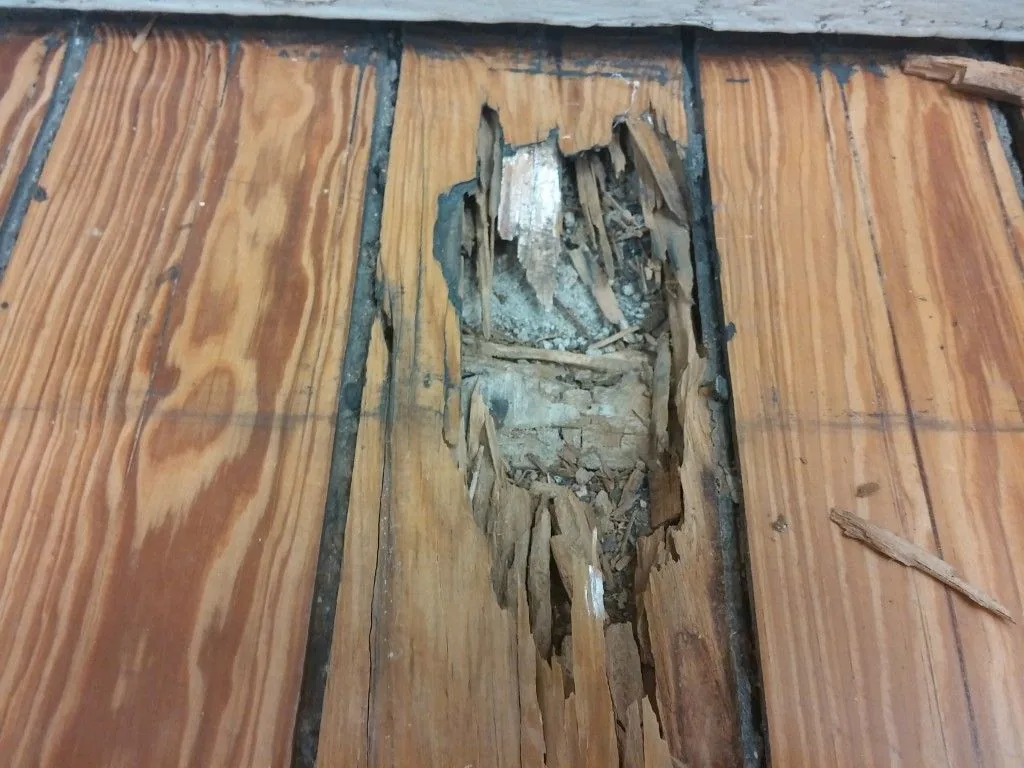
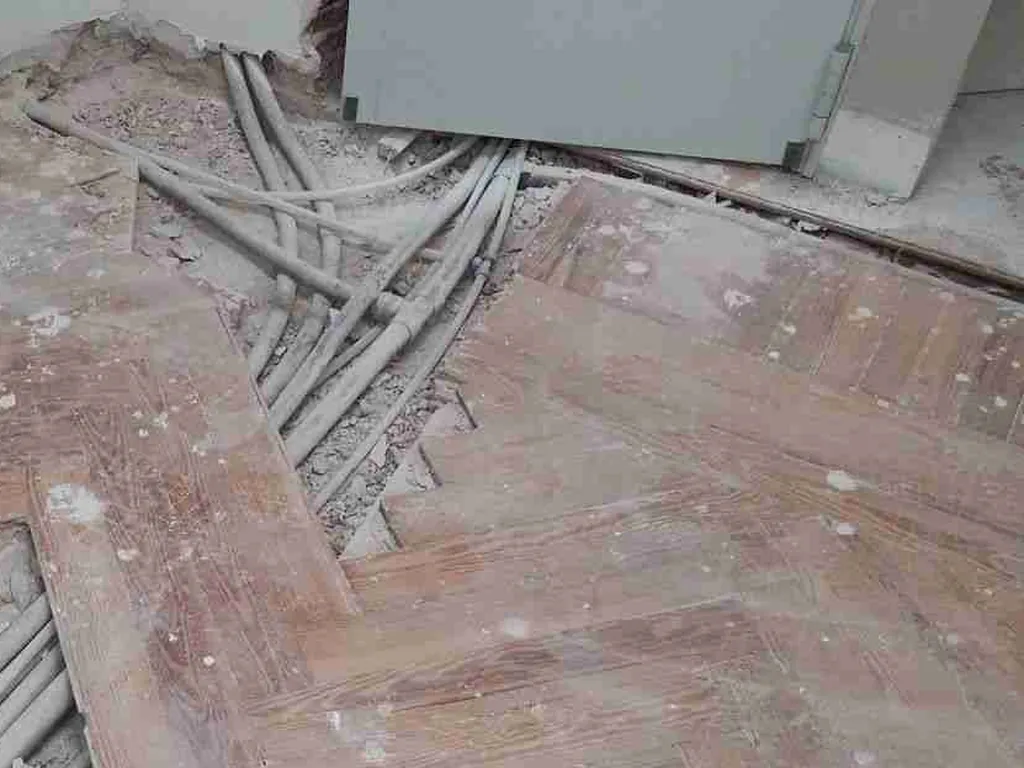
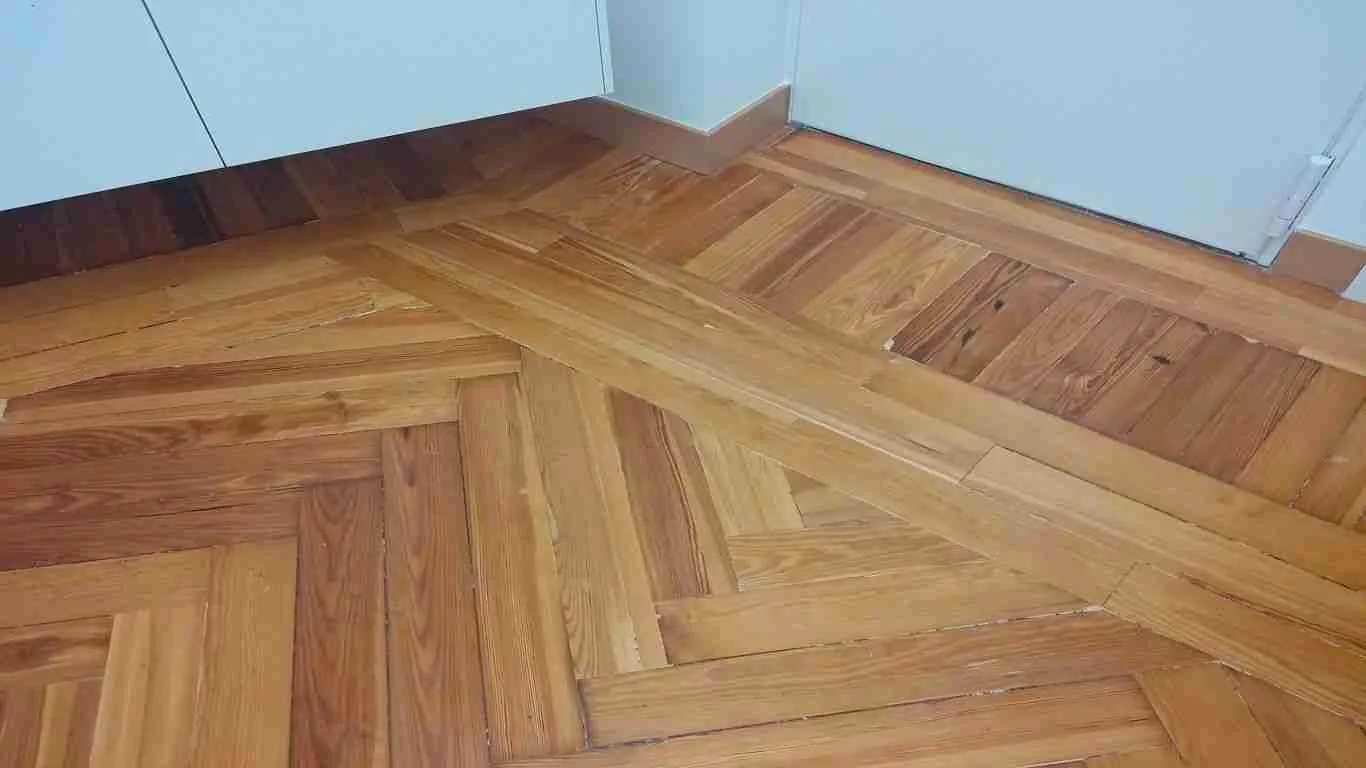
Old anchors and service runs leave gaps with no wood. Monte Esquinza had been a dental clinic, and the floor had holes from anchors and plumbing runs. At Galileo, running new heating and electrical lines meant lifting whole sections, and the floor was left with ragged cuts and broken boards.
Missing pieces are replaced with salvaged wood from the same period, from our own stock. In pitch pine we choose wood with similar density and grain orientation, so that it moves at the same pace as the floor that was kept. An ordinary pine dents sooner underfoot, and the patch shows under the varnish, as we explain in the old pitch pine guide.
Damp
Old damp leaves pieces weakened: at Velázquez the damaged ones were replaced. At Valenzuela, changes in moisture opened the angled joints of the fret borders, the decorative borders of the floor, and they were reset with spot elastic fixing.
A recent leak is a different case. Water under the boards lifts the edges, and before sanding a drying protocol is needed, which we describe in water damage in parquet and board floors.
Nor should water be confused with the gaps any board floor opens in winter, from 1 to 3 mm. With the heating on, the relative humidity of a Madrid apartment drops to around 30% and the wood shrinks.
Dark varnish
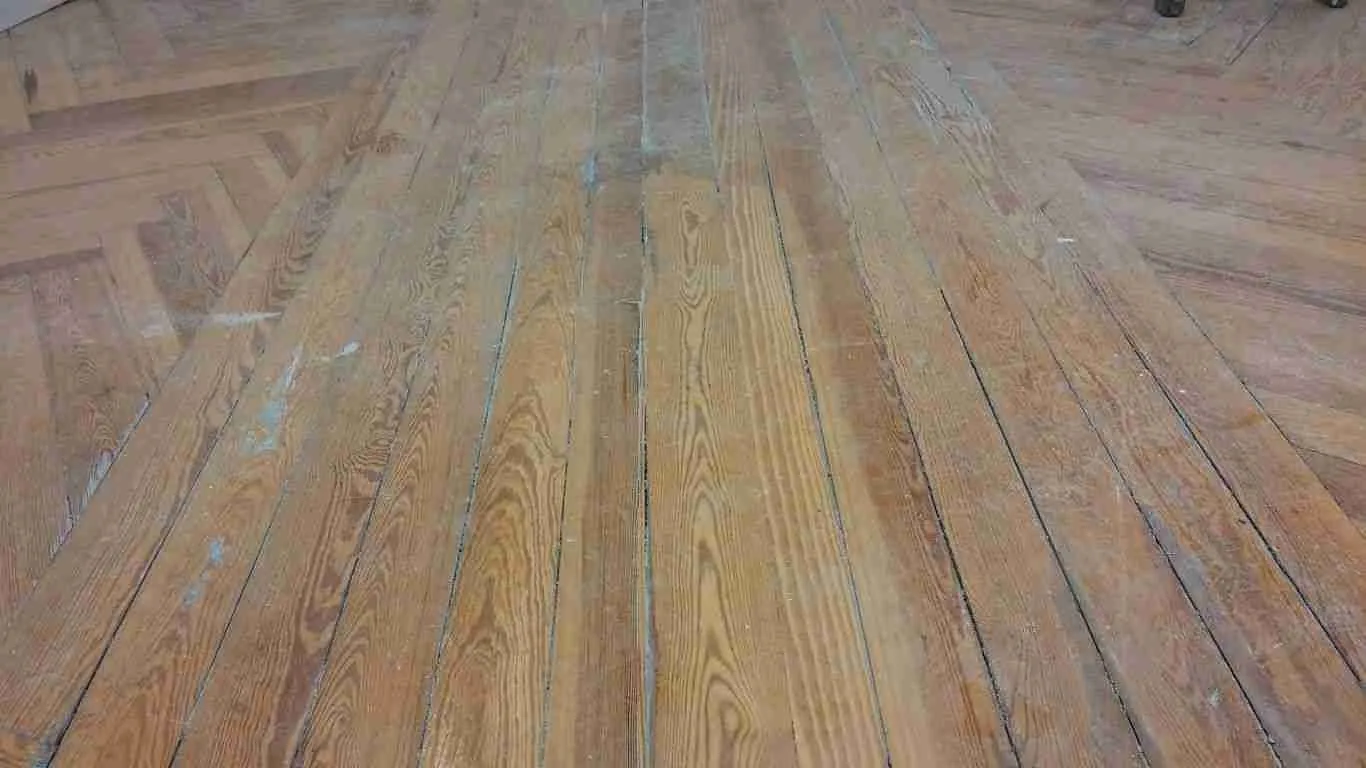
At Monte Esquinza the varnish had darkened through oxidation, and at Montalbán there were old layers of darkened synthetic varnish. Sanding removes the old varnish, and we do it with continuous extraction built into the machine. What changes from one job to the next is the waterborne finish: ultra-matte at Monte Esquinza and satin at Montalbán, Velázquez and Serrano.
On old pitch pine, a primer that blocks the tannins and resins in the wood goes on before the varnish, as at Galileo and Monte Esquinza. Each primer leaves a different tone.
When it is not worth it
If the floor still has thickness, stability and historical value, keeping it is usually the better choice. Replacing it only makes sense in three cases:
- The subfloor is lost. The floor structure needs structural work. Even then, the wood can sometimes be lifted and relaid afterward.
- The damp is still active. As long as it is active, the floor is not sanded: it has to be dried first.
- The wood no longer allows a safe intervention. It is a floor worn down to its sanding limit: in a nailed board floor, with less than 2–3 mm of wood above the tongue.
Price and timing
As of October 2026, sanding and finishing, on jobs from 40 m², starts at €25/m² + VAT with Deva Transit Plus 2K waterborne finish. With a Deva natural or ultra-matte finish, from €29/m² + VAT. Between 40 and 90 m² it takes 2 to 5 days, depending on the level of restoration and the state of the floor. For comparison, a new solid wood floor, supplied and installed, starts at €235/m² + VAT on battens and €200/m² + VAT glued down. In old pitch pine on battens it is €350/m² + VAT.
The final price depends on the state of the floor, the pieces that need replacing and whether furniture has to be moved. Also on special finishes, such as extra coats, stains or custom finishes. It is settled after seeing the floor.
The order of work
The decision to keep the floor is made before demolition. When the floor is going to be reused, we usually take it up ourselves before the plumbers and electricians come in, and we call it technical removal.
Sanding and varnishing come after the masonry and the base coat of paint, and paint touch-ups are left for the end. The full order is in sanding and painting: which comes first.
In a heritage-listed building, the Normas Urbanísticas de Madrid (Madrid planning regulations) and the building’s catalog entry rule. How to look them up is in wood floors in protected buildings in Madrid.
Reference projects


Have you been told to rip out your apartment’s floor?
Before deciding, ask us for a site visit: we measure the wood that is left and tell you whether keeping the floor is worth it. We work in the city of Madrid and Pozuelo, on jobs from 40 m². A similar case: Restoration of a solid old pitch pine board floor – Monte Esquinza.