
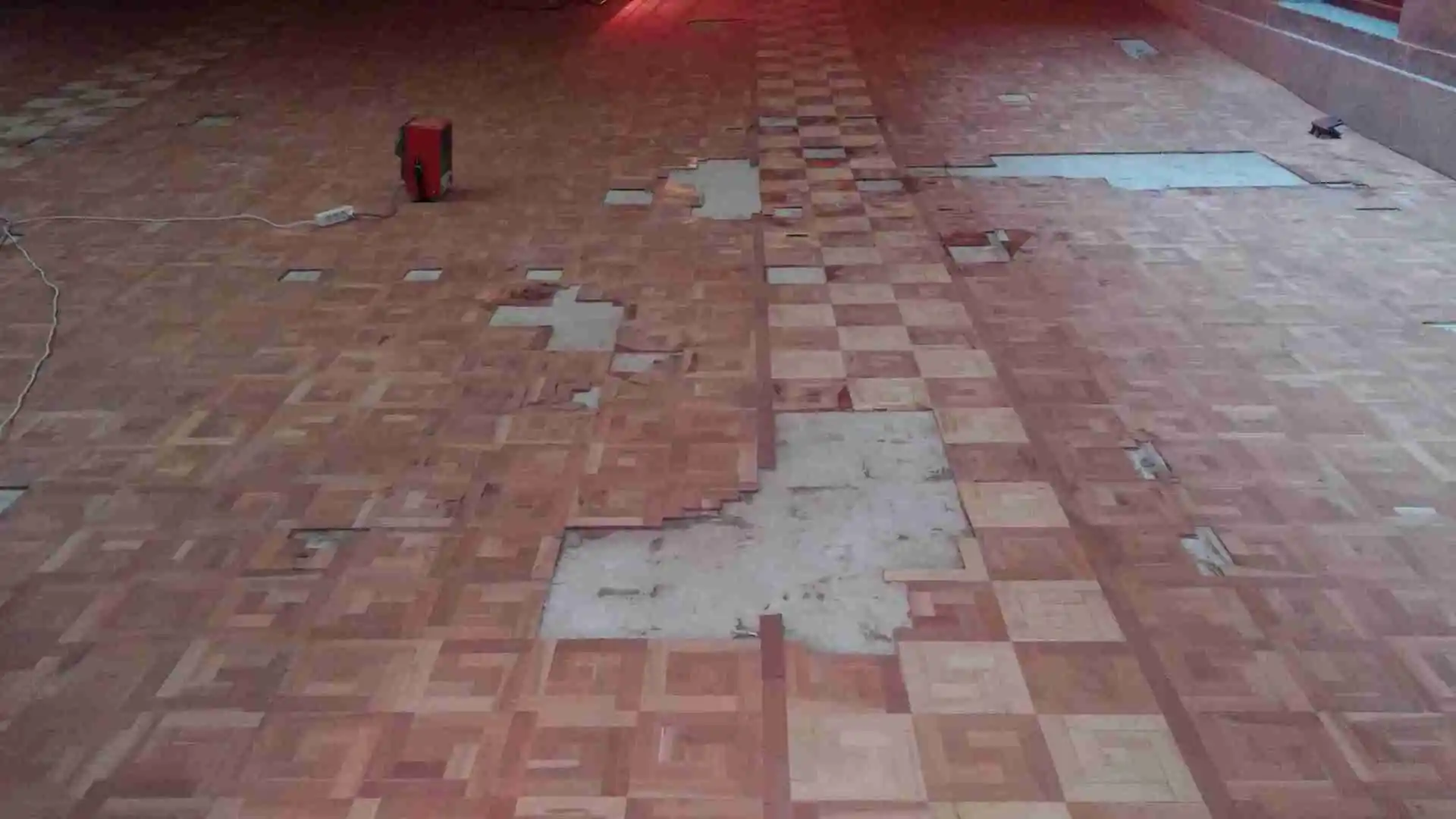
After a plumbing leak or a burst heating pipe, sanding the parquet right away does the most damage. The first job on site is to free the perimeters so the swelling wood does not push against the walls. Only once that tension is relieved and the screed has really dried can you think about repairing boards and finishing.
The physics of lifting: lateral thrust and ridge formation
Wood absorbs water and grows across the width of the board far more than along its length. In a living room with several meters of solid wood flooring, a major leak produces a thrust that quickly exceeds the expansion gap we leave along the walls. With the dry air from heating the opposite happens: the wood shrinks and gaps open, as we explain in our guide to cracks and shrinkage gaps.
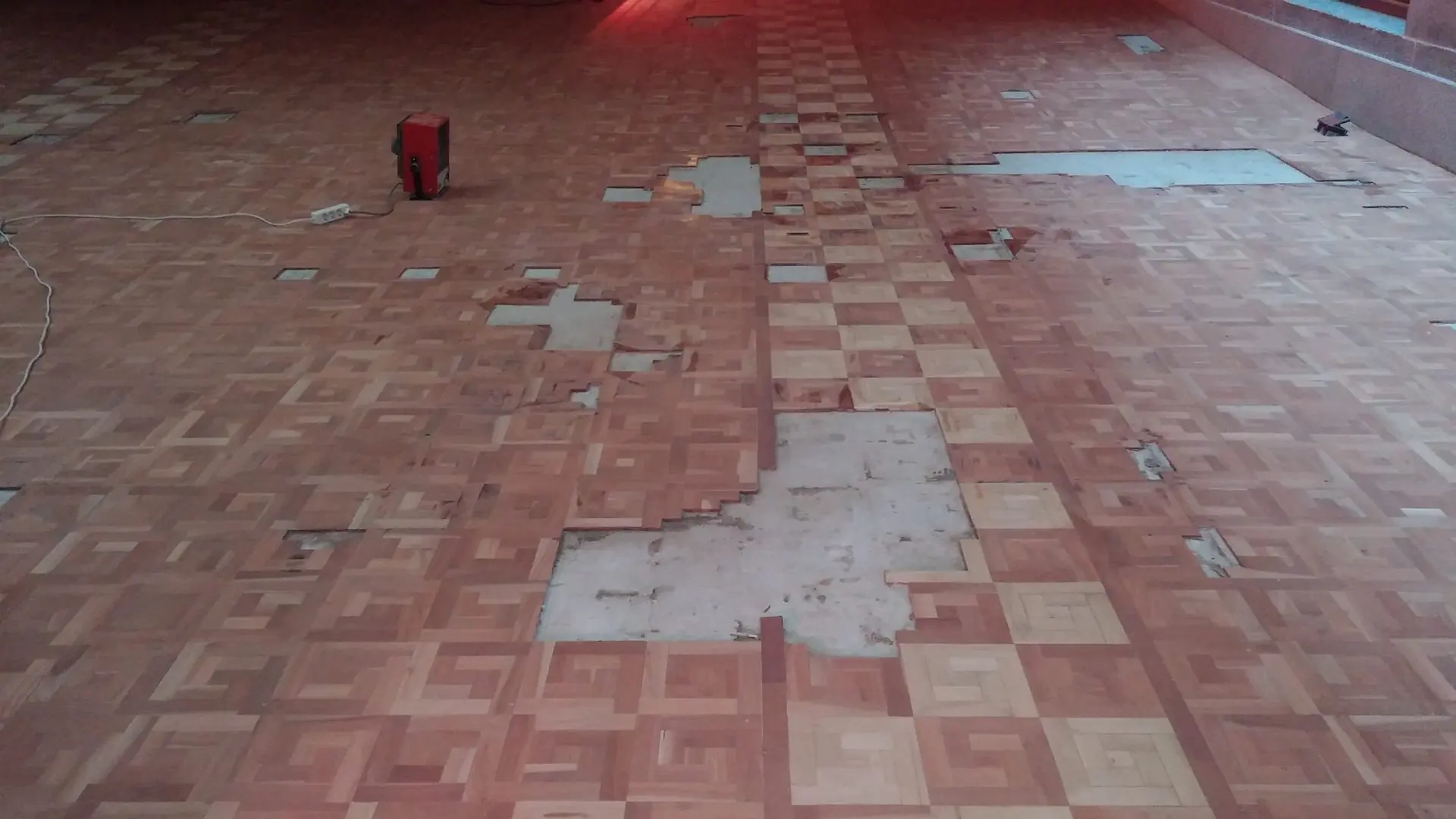
When it meets walls and partitions, the confined floor pushes against them. With nowhere to stretch, the flooring lifts into ridges or comes unglued in whole sections, as happened at the Seminario Conciliar. The first emergency measure is to open the perimeter along the walls so the wood can expand.
Tenting and crowning from drying in solid wood flooring
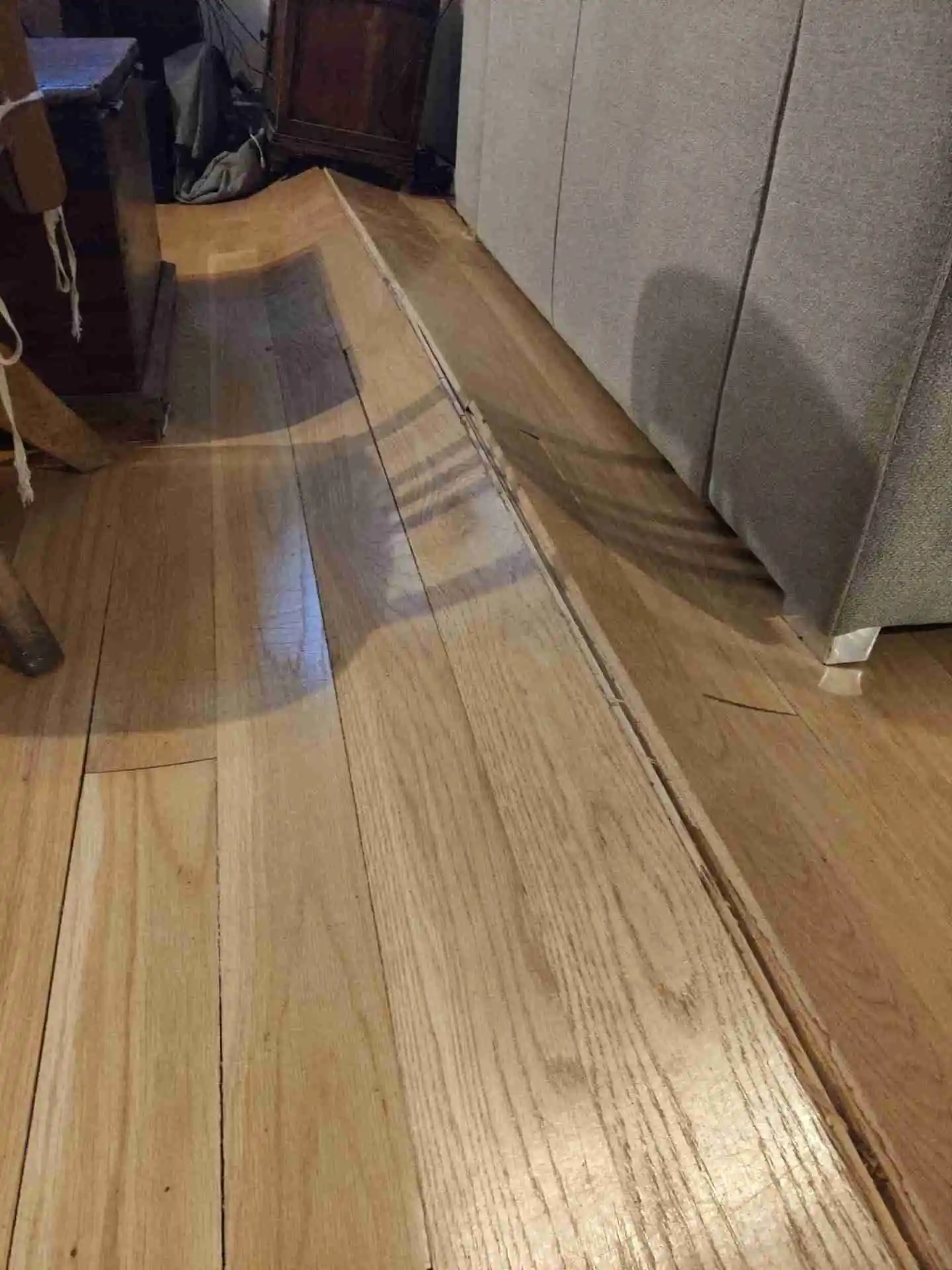
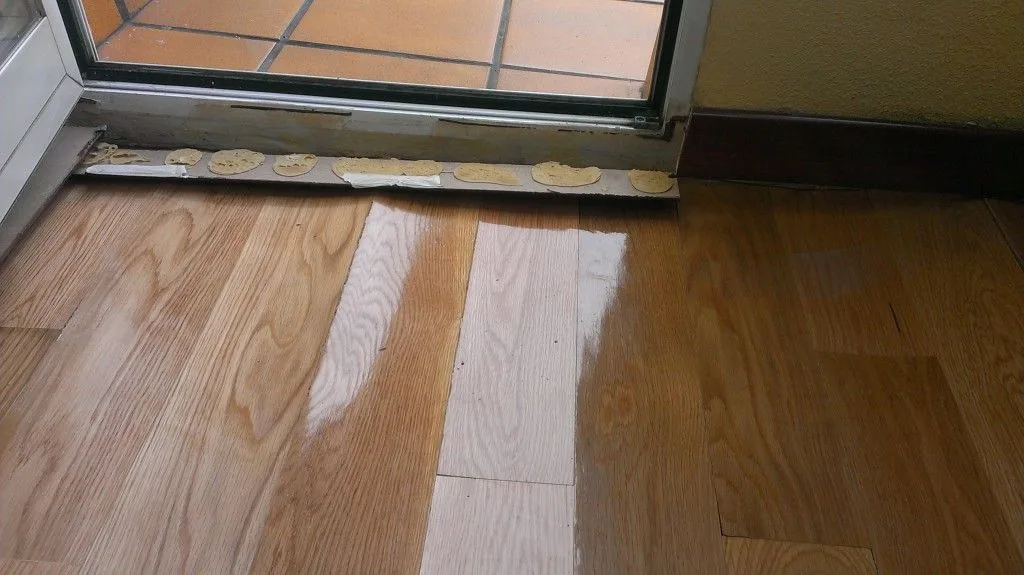
When water runs under the floor, the underside of the boards saturates with moisture while the top face dries out in the air. That difference swells the base and bends the edges upward: the classic tenting effect. If a machine comes in at that point to sand down the raised edges, the damage is irreversible.
Months later, when the screed and the wood finish drying, the sanded areas shrink and the center of the board is left crowned like a curved ridge. If there is no wood left to sand it flat again, the affected boards have to be replaced. That is why a flooded floor is never sanded until the screed drops below 2.0% CM and the wet wood reads the same as a dry area of the same floor, measured with the same instrument.
How long the screed takes to dry
There is no fixed time: it depends on the thickness of the screed, the ventilation and how wet it got. As a reference, a freshly poured cement screed takes about two to three months to dry, and even then it is checked by measuring. Dehumidifiers shorten it, but the top layer dries before the bottom one; that is why it is left to rest and measured again with carbide before sanding or gluing. In basements and ground floors, moisture from the ground can reach the screed, so it pays to measure more times before installing.
Four-phase rescue protocol from the workshop
To save a flooded parquet without tearing it all out, the work follows an order: first the pressure against the walls is relieved, and the sanding and finishing come last.
As a workshop rule for water damage, never turn the heating or the underfloor heating up full to try to dry a flooded floor faster. A blast of heat dries the top face of the board while the underside is still on the wet screed, and that deforms it further. The water comes out slowly, with dehumidifiers and measuring.
- Urgent perimeter decompression: we remove the baseboards and open the perimeter along the walls to release the tension, so the wood settles back and does not push the partitions.
- Drying with technical dehumidification: we set up air movers and condensation dehumidifiers, measuring the real drying of the screed with calcium carbide (CM) samples.
- Repair and selective replacement: we replace only the damaged or unglued pieces with wood of the same species, dimensions and grain direction. In glued parquet, the new pieces are glued with elastic silane adhesive onto the dry screed; in solid wood flooring on battens they are nailed, and battens that are damp or sunken are replaced.
- Dustless sanding and two-component (2K) finish: once the moisture has stabilized, we sand with continuous dust extraction and apply three coats of high-resistance two-component waterborne finish.
A real case: the Seminario Conciliar de Madrid
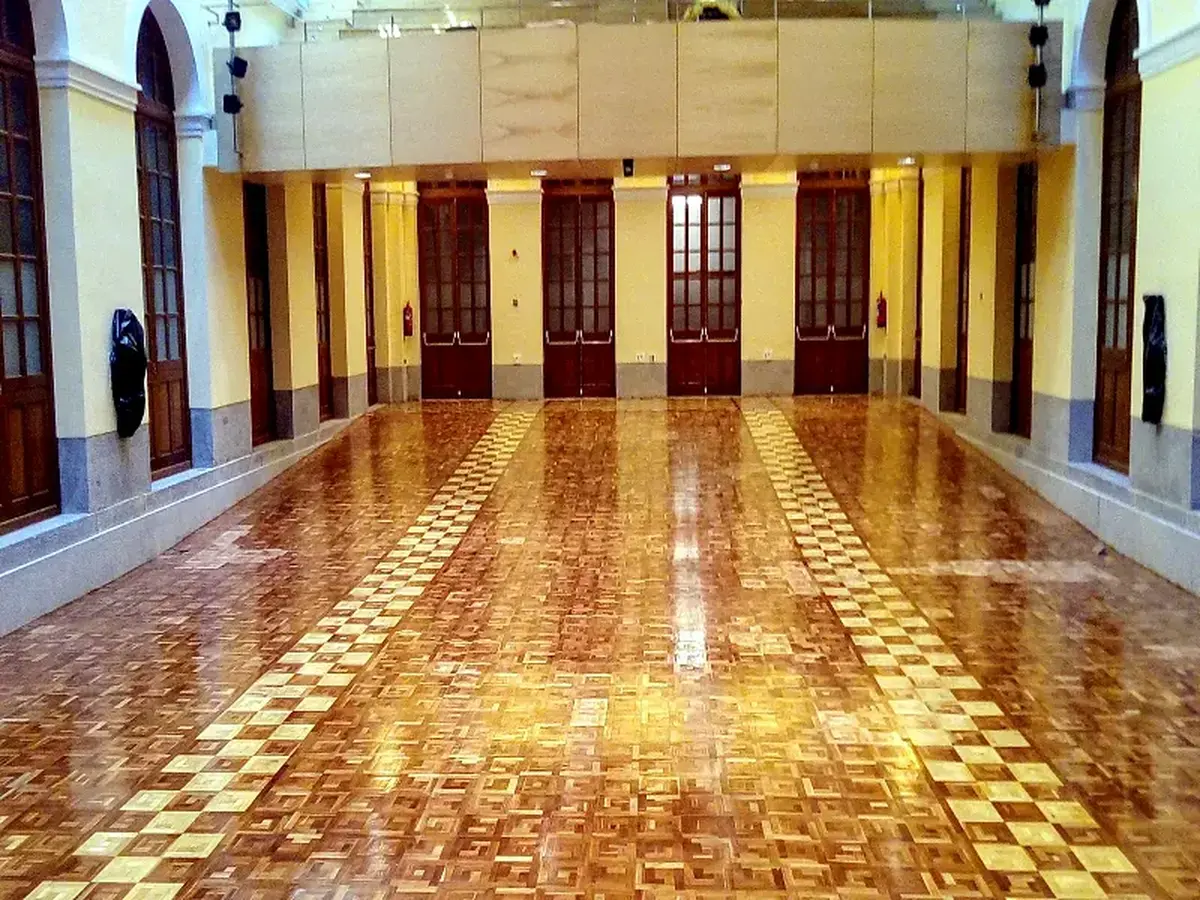
In the assembly hall of the Seminario Conciliar, in La Latina, a burst pipe flooded a red and white eucalyptus strip parquet (lamparquet) glued to the screed. The swollen wood came unglued and arched in whole sections, as the photo of the removed strips above shows. We opened the perimeters to release the tension, forced the drying of the screed and measured it with carbide until it reached 1.8% CM. The strips that could not be saved we replaced with new eucalyptus of the same format, glued with elastic silane adhesive. At the end we sanded the floor flat and applied three coats of two-component waterborne finish. The job, with more photos, is on its project page.
Frequently asked questions about water damage in wood floors
Why should parquet not be sanded immediately after a flood?
Because sanding wet wood takes down the swollen edges. When the floor finishes drying months later, the center of the strip crowns upward in a convex shape. If there is no wood left to sand it flat again, the affected boards have to be replaced.
How do you check that a screed is dry enough to reinstall?
The only conclusive test under the UNE 56810 standard is the calcium carbide (CM) method. The sample, chipped from 2–3 cm inside the screed, must read below 2.0% CM in cement and below 0.5% CM in anhydrite.
What do you do with tented solid wood flooring after a leak?
First it is dehumidified slowly, until the wood returns to its normal moisture content. Only then do you decide which boards are saved and which are replaced; sanding them while they are still tented is what leaves them crowned once they dry.
Has your parquet or solid wood floor suffered a water leak?
If the floor in your home has got wet, call us before sanding: we measure the screed’s moisture with carbide and assess which boards can be saved. We also work for homeowners’ associations and professional spaces. Phone: +34 91 543 90 62.