
Shigeru Ban’s Paper Pavilion: when pine wood flooring makes sense
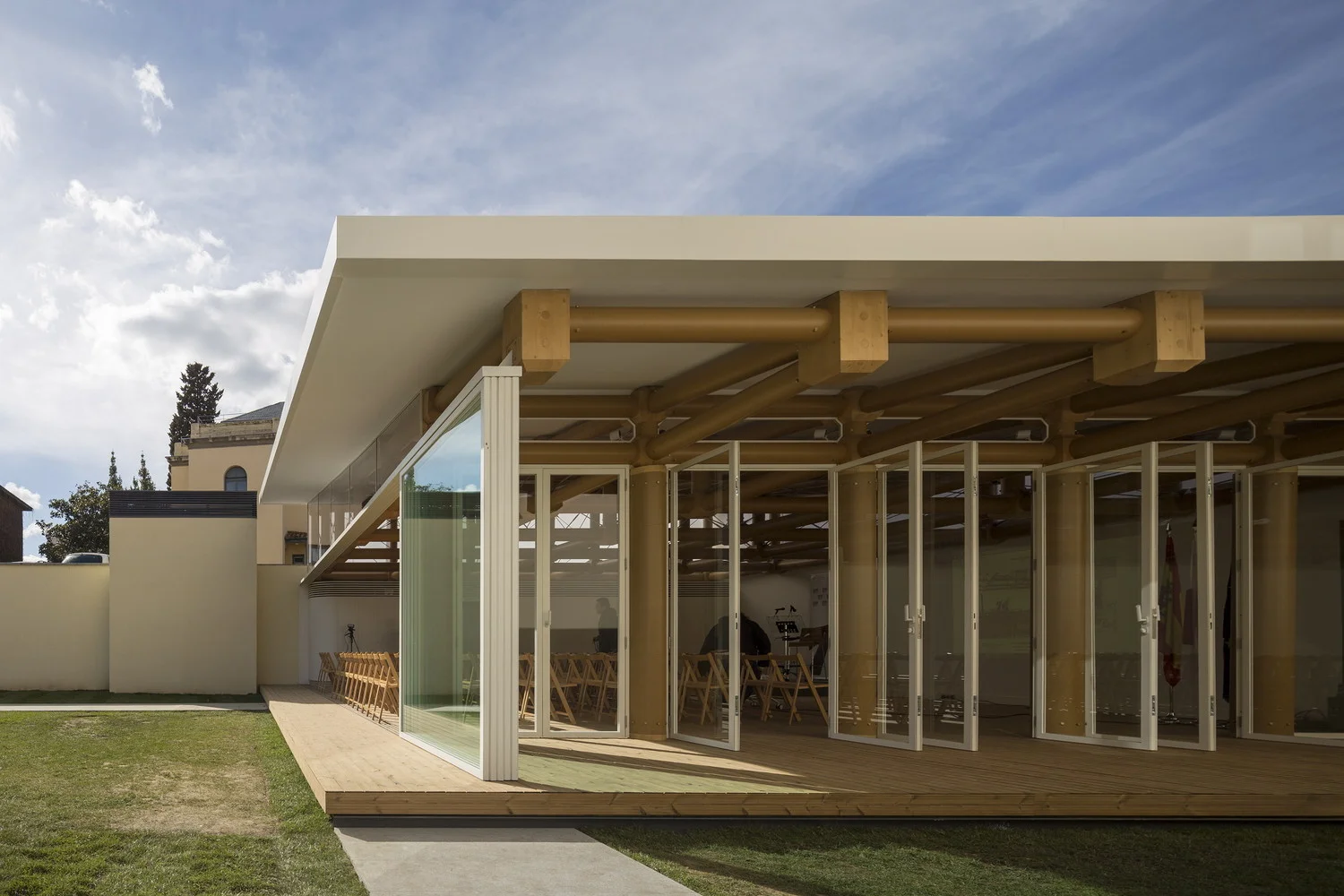
In December 2014 we went to IE, on Calle María de Molina in Madrid, to inspect a wood floor: we were asked to assess its condition and propose how to maintain it. It was an ordinary work visit; ParkSinta had not installed that floor. While we were there, the structure of the building covering it caught our attention, so we asked the person in charge. He told us it was the work of Shigeru Ban, the Japanese architect who had just received the 2014 Pritzker Prize.
It was the Paper Pavilion, which IE Business School had opened in March 2013 for events and other activities. According to IE’s opening announcement, it is 173 cardboard tubes joined with wooden pieces, it was put up in two weeks and it was conceived as a temporary building. Shigeru Ban’s studio describes it like this: an existing L-shaped concrete wall, 6 columns of cardboard tubes and a roof of tube trusses on top.
The project’s wood: solid pine, 22 × 120 mm
For the flooring, the specification was knotty solid pine wood flooring, in boards 22 mm thick and 120 mm wide, installed both in the covered gallery and on the outdoor porch.
At the visit, the floor showed what happens to a softwood under heavy traffic:
- Heel marks: inside you could tell that high heels were worn often, with many dents in a relatively soft pine. A thin stiletto heel puts more pressure on the floor than a tank track, as we explain in the article on heels and parquet.
- Wear from chairs and meetings: chair use and frequent meetings had left a central area and a side area of the interior quite worn by abrasion.
- Sun and worn treatment on the porch: outside, the sun had affected the look of the boards. The maintenance treatment was quite deteriorated after barely 12 months of use. It is not a product we work with on outdoor decking, but we believe it was a type of wood stain (lasur).
What we recommended
Our recommendation was one product for each area: Bona Deck Oil on the outdoor porch and Bona Traffic HD finish inside. The oil renews the protection of the outdoor boards against water and sun without sanding them. The waterborne polyurethane leaves a film inside that stands up to the rubbing of chairs and footsteps.
With two products, the inside and outside floors were going to end up looking different, and that could affect the look of the pavilion. So we also proposed oiling the whole floor, with a warning: oil gives no abrasion resistance. In a knotty pine, one of the softest woods on the Brinell scale, adding resistance mattered.
It is a basic principle of our trade: no varnish or oil increases the intrinsic hardness of the wood. If the fiber gives way under point pressure, the finish follows the deformation.
Did it make sense to use pine in this pavilion?
For a permanent teaching or commercial space, knotty pine is rarely the first recommendation. Oak flooring or another harder hardwood stands up much better to wear and marks.
However, in Shigeru Ban’s Paper Pavilion the choice of pine was consistent with the principles of the project:
- Ephemeral nature: the pavilion was conceived with a limited service life, not as a permanent building.
- Budget and construction consistency: pine brought warmth, quick machining and a contained cost within an architecture meant to be solved with measured resources.
The pine did the job it was specified for. The key with wood floors is to set expectations correctly: do not ask a softwood for high-hardness performance, and do not rule out a material when it fits the logic of the project precisely.
In permanent projects in Madrid, whether homes or spaces open to the public, choosing solid wood flooring should take into account the type of traffic, the furniture, the footwear and the humidity and climate-control conditions before defining the species, the format and the protection system.
Wood Flooring for Unique and Professional Projects
In institutional projects, auditoriums, corporate headquarters and demanding homes in Madrid, at ParkSinta we choose the species, the format and the fastening system according to the traffic the floor will take and the humidity of the building.