
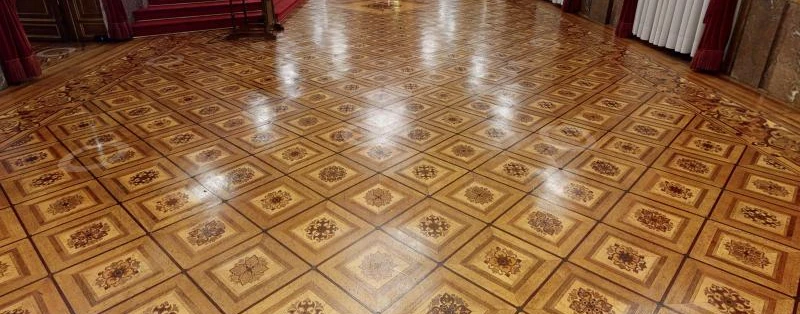
The whole floor of the Throne Room in the Palacio de Navarra (Navarre Palace), in Pamplona, is a marquetry wood floor. Marquetry is a design made from pieces of woods of several colors, inlaid side by side. It has more than 500 diamonds with plant and decorative motifs and a fret border that runs along the edge of the room. It was made by the firm M. Laurent of Paris and laid in 1862, according to the Gobierno de Navarra (Government of Navarre). It is one of the cases among the best parquets in Spain.
A blank room
The Diputación (provincial council) held its first session in the palace in December 1851, with the Throne Room still undecorated. The decoration was taken on in 1860, when it was announced that Isabella II would stop in Pamplona on the tour of Spain she had planned for September and October. The queen never came, but the work went on, as recorded by the Heritage Chair of the Universidad de Navarra.
The Diputación commissioned the project from Maximiano Hijón, who in 1861 proposed a medieval-inspired decoration. The project sought to bring together in the room the historical memories of the old Kingdom.
Numbered pieces from Paris
The floor traveled to Pamplona taken apart in numbered pieces, according to the palace’s virtual tour. Once in the room, the pieces were assembled until they reproduced the plant designs, with fine woods in their natural colors. The laying was done by the carpenter Lázaro Peruchena.
The wood species are not known. In 2021, when the palace’s new logo was presented, Noticias de Navarra singled out the floor as the most valuable element of the room, a “marquetry of fine woods.” In the close-up photo you can see that each diamond has a light wood frame and, in the center, a rosette of darker leaves and petals.
Diamonds, fret border and medallion
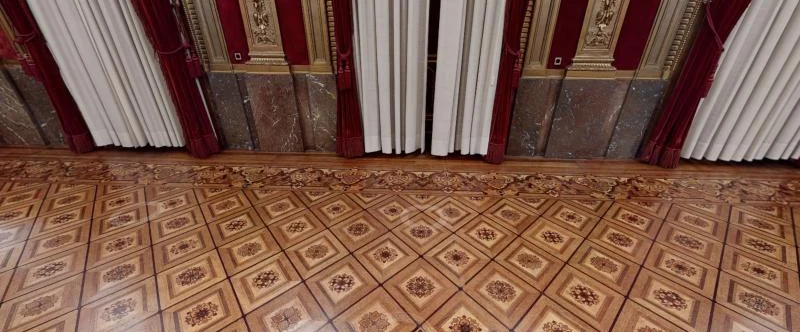
The diamonds are squares set on point relative to the walls, and the dark fillets separating them cross the room on the diagonal. The rosette changes from one diamond to the next: there are several models alternating throughout the room.
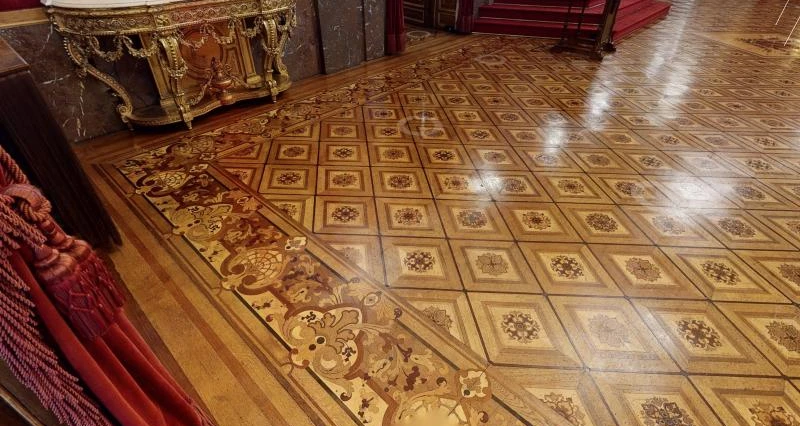
Between the last row of diamonds and the marble plinth runs the fret border, a strip of interlaced plant motifs that frames the room. The virtual tour also points out, in the center of the room, a medallion with the coat of arms of Navarre surrounded by oak and beech leaves. At the far end of the room, the marquetry reaches the throne dais, a three-step platform covered with red carpet.
From the canopy over the platform hang twelve links which, according to the Gobierno de Navarra, come from the chains Sancho VII the Strong brought back from Las Navas de Tolosa in 1212. They are the chains of the coat of arms of Navarre, the same one the floor medallion carries.
The floor for ceremonies
The Throne Room is the room for the major ceremonies of the Comunidad Foral (the Foral Community of Navarre): receptions of officials, Navarre Day and award presentations. In the photos, the marquetry is exposed, with no rugs on top.
In the antechamber leading into the room, by contrast, a rug woven at the Real Fábrica de Tapices (Royal Tapestry Factory) covers another wood floor to protect it. The room is also part of the guided tours organized by the Gobierno de Navarra.
Woods in their own color
In a floor whose design depends on the natural color of each wood, any stain changes how the diamonds read. In our workshop, to match a replaced piece we use alcohol- or water-based stains only at that spot, and we never lighten the wood with peroxides. Since the species in this marquetry are not known, the tone is tested beforehand on the actual wood: each species responds differently. A similar case: Marquetry parquet restoration – Palacio de Zurbano.
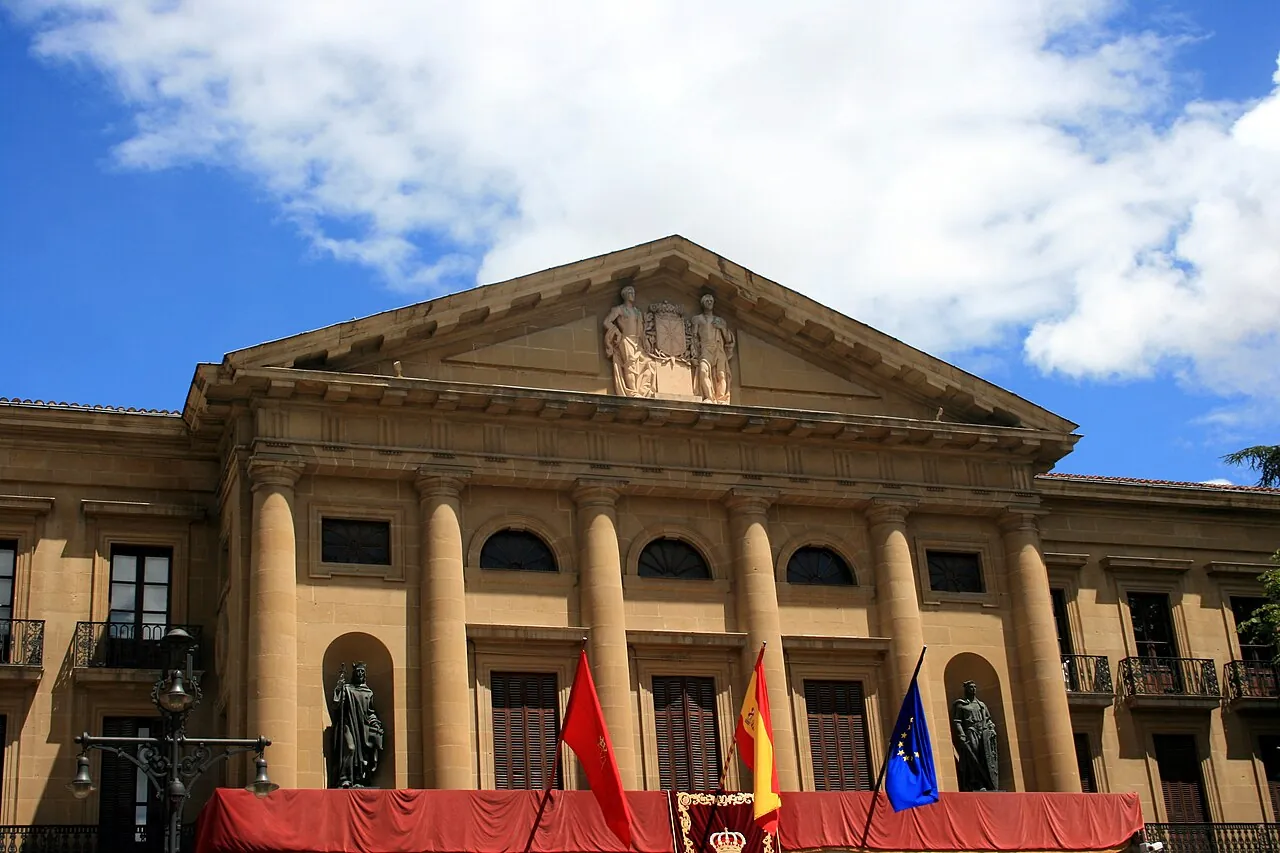
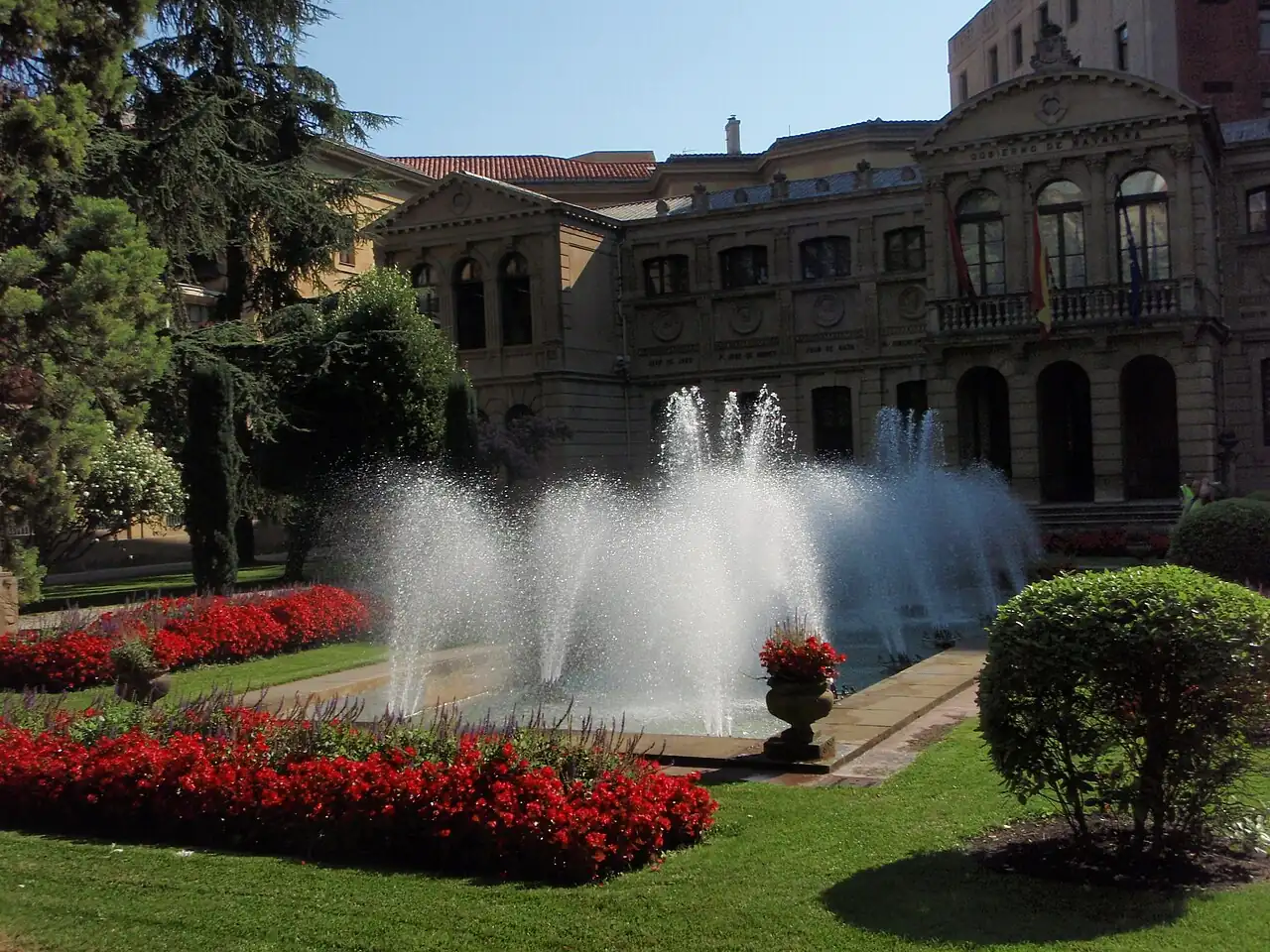
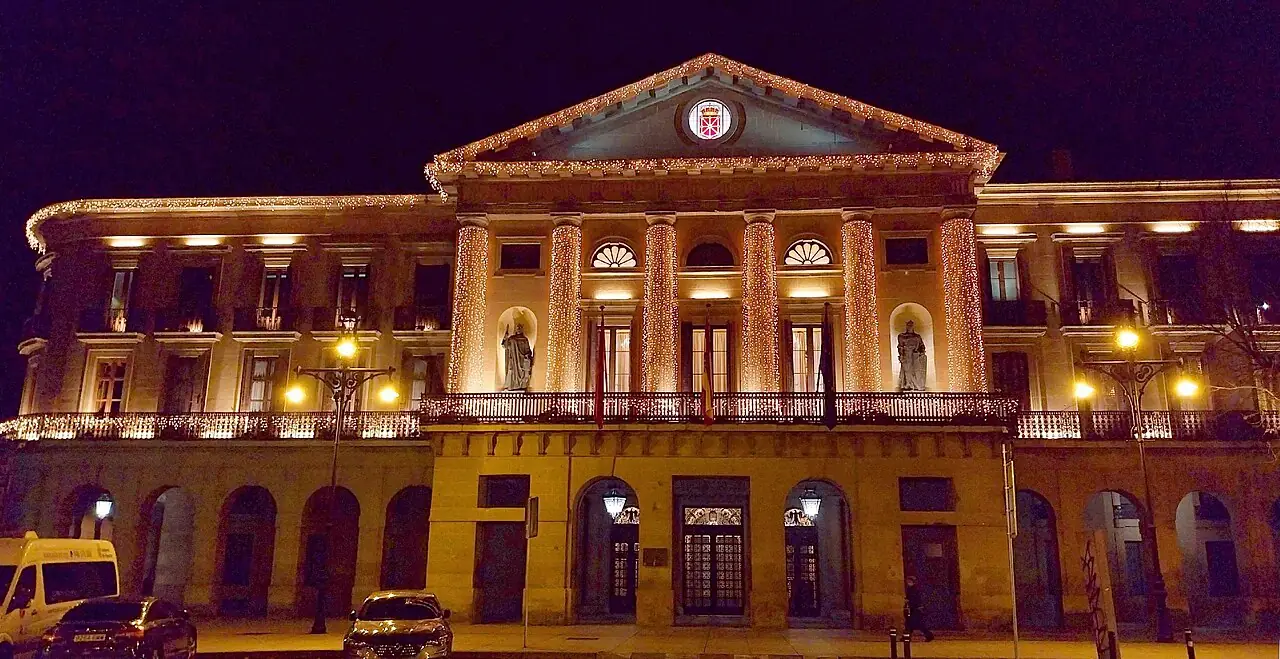
The Palacio de Navarra in pictures
Historic parquet restoration
A marquetry floor with a fret border and medallion is examined piece by piece before deciding which ones are replaced and which are restored. More on floors with a history in Historic parquet.
Sources
- Screenshot of the virtual tour of the Palacio de Navarra (Tantatic), license not recorded.
- Screenshot of the virtual tour of the Palacio de Navarra (Tantatic), license not recorded.
- Screenshot of the virtual tour of the Palacio de Navarra (Tantatic), license not recorded.
- Abir Anwar from Sydney, Australia, Wikimedia Commons, CC BY 2.0.
- Alberto Grazi from Milan, Italy, Wikimedia Commons, CC BY-SA 2.0.
- Zarateman, Wikimedia Commons, CC0.


