
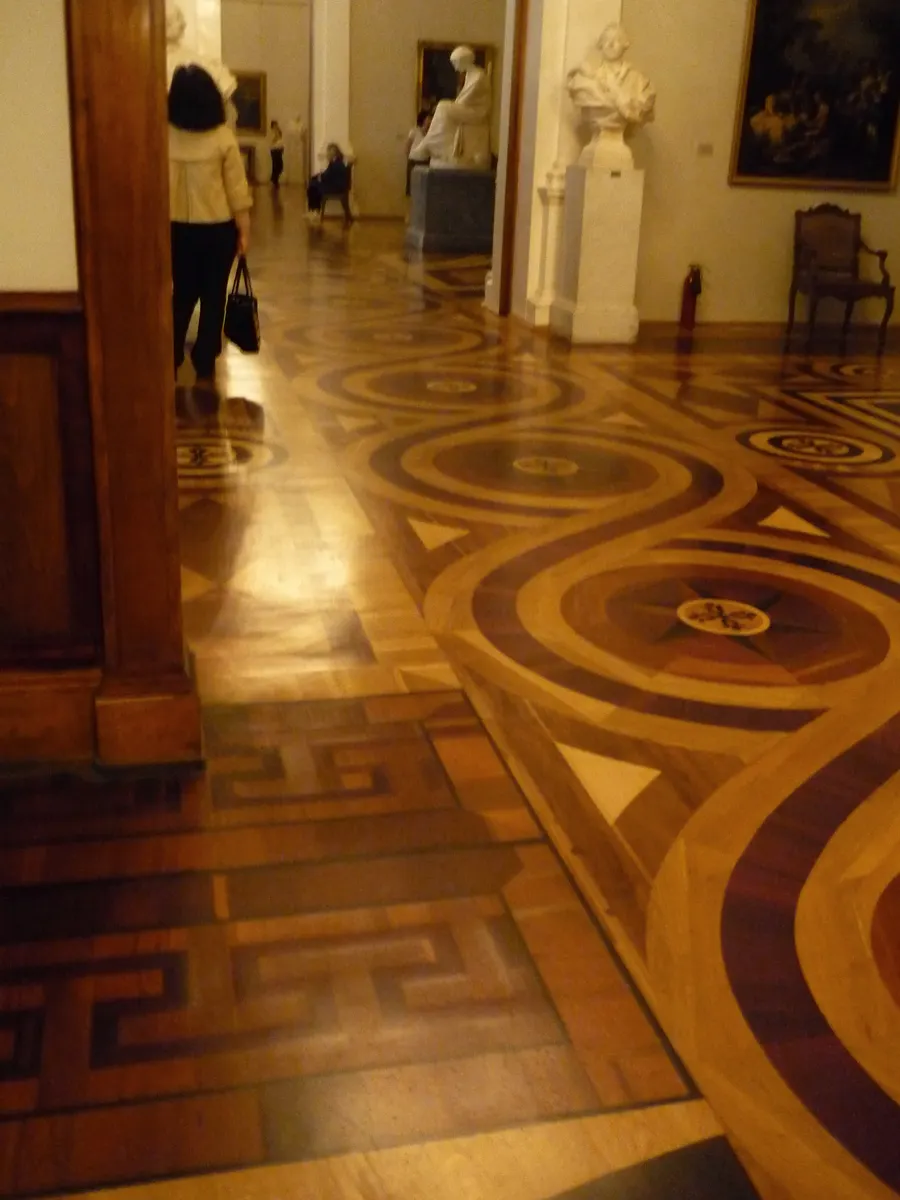
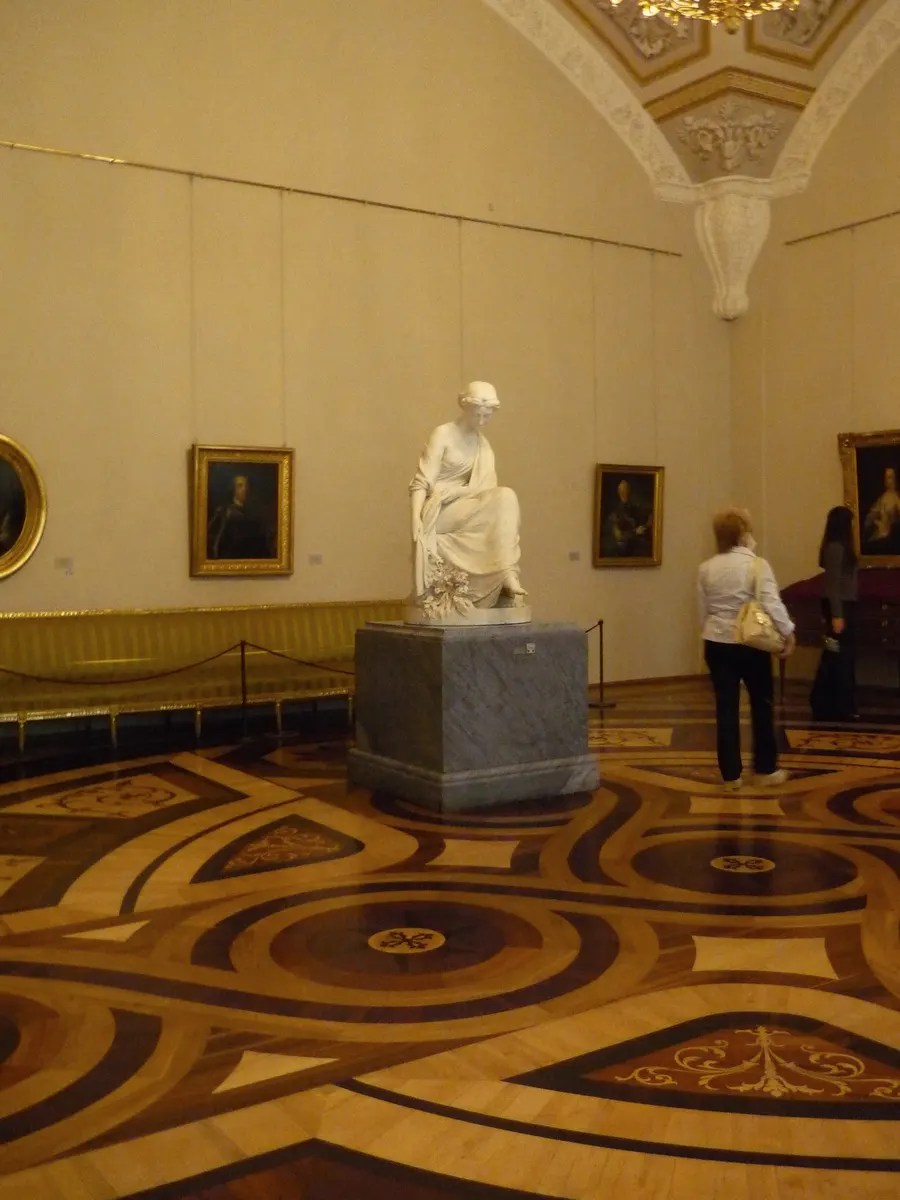
The Hermitage keeps wood floors in rooms of the Winter Palace and its adjoining buildings. They are not all the same: there is art parquet, marquetry, floors laid in geometric fields, rosettes, borders, rebuilt floors and areas restored over successive campaigns.
Today the museum counts some 26,000 m² of marquetry parquet, according to its 2010 annual report, and that year it restored 2,831 m². In 2001 the figure had been 2,826 m², according to the museum’s foundation. It is one of the 16 cases in the best parquet floors in the world.
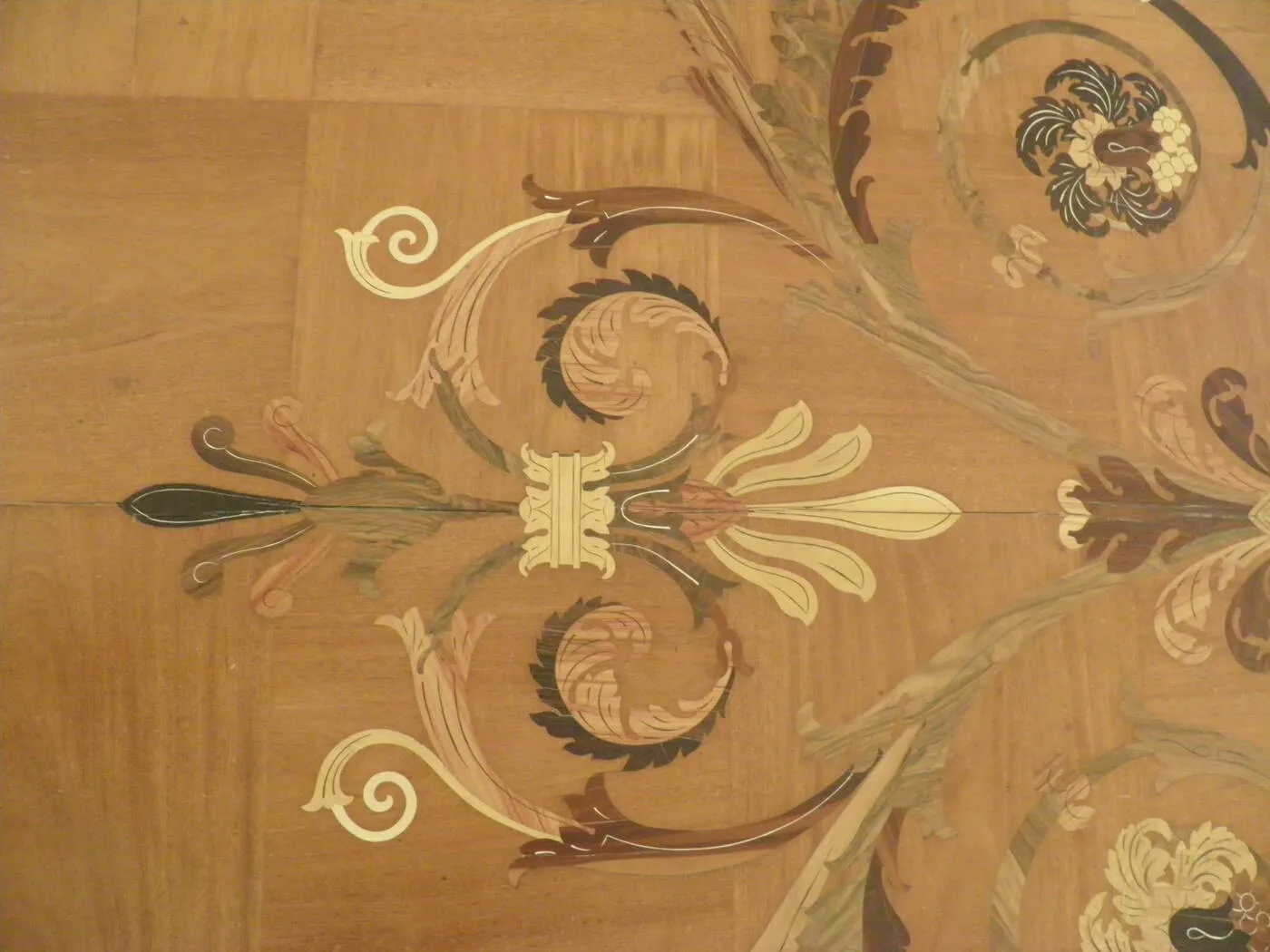
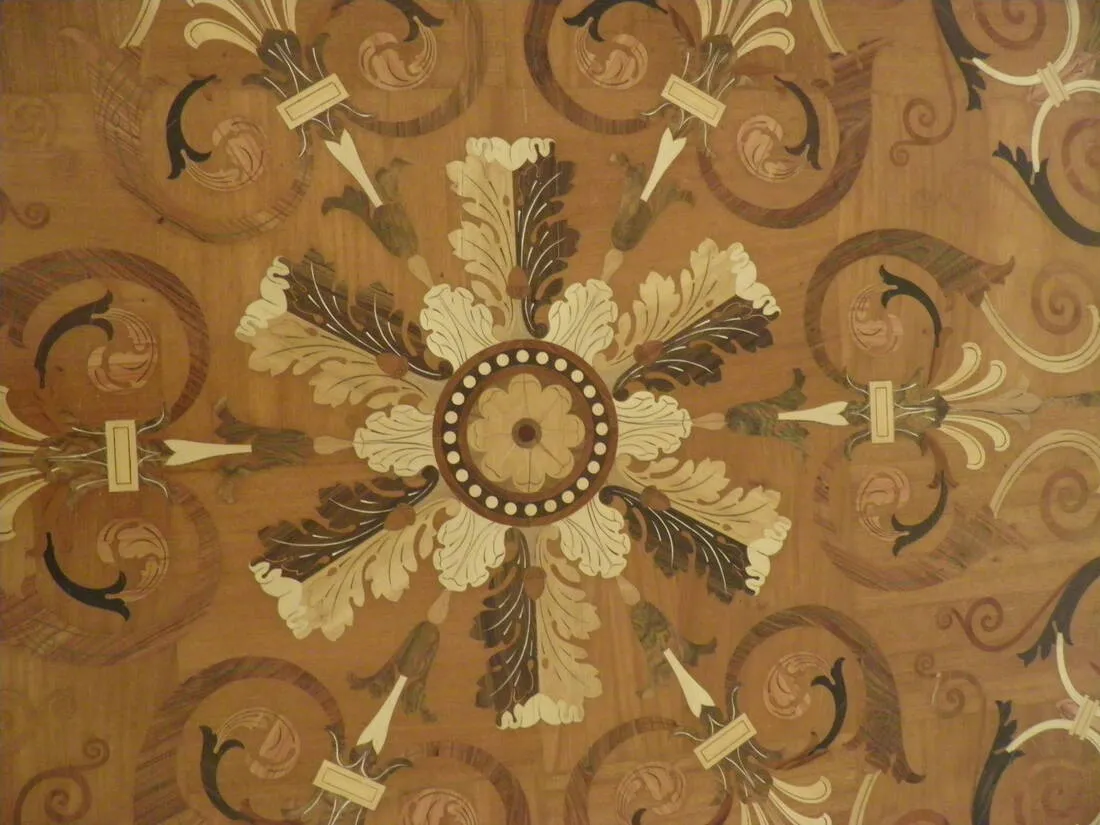
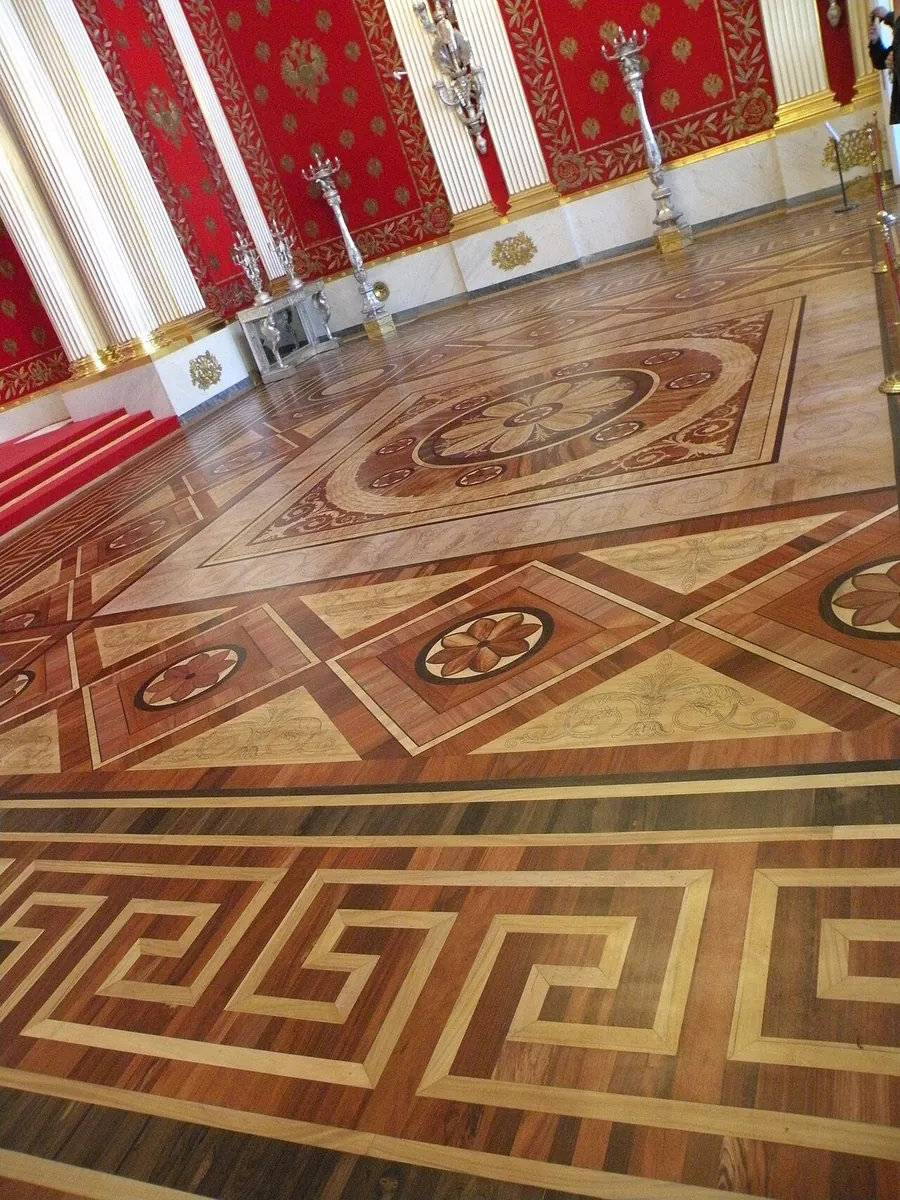
St. George Hall: parquet in 16 species
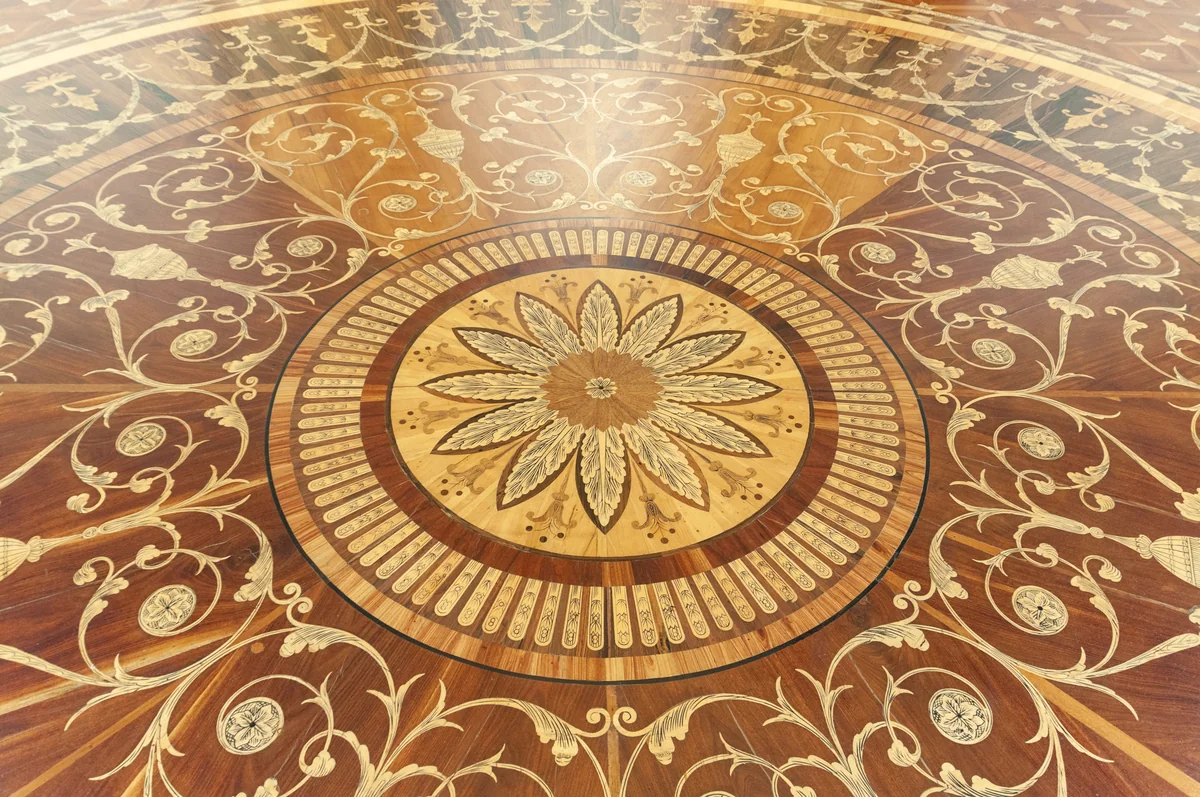
St. George Hall, or the Great Throne Hall, is one of the main rooms of the Winter Palace. The Hermitage’s record documents a parquet made with 16 varieties of wood. The photos show the marquetry up close: rosettes, scrolls, acanthus leaves and contrast between species.
In 1915 a 1,000-bed military hospital for the seriously wounded was set up in the Winter Palace, and it ran until October 27, 1917. According to the Hermitage, every state room except St. George Hall was handed over to the hospital, the decoration was removed and the floors were covered with linoleum.
The 1837 fire and the rebuilt floors
On December 17, 1837, smoke was coming out from under the baseboard of the Field Marshals’ Hall, which Montferrand had decorated in 1833. The firemen began to open up the parquet next to an air vent. At the first stroke of the crowbar a false mirror door fell on them, and behind it was the fire. V. M. Glinka, a Hermitage researcher, tells the story from the commission that investigated the fire. The museum puts the origin down to a faulty flue in the palace pharmacy. The Field Marshals’ Hall and the Peter the Great Hall were the first victims.
Montferrand wrote in 1838 that he had been ordered to finish the two halls in five months and that the parquet marquetry was done “in six weeks.” He argued that the haste and the low budget forced a timber structure, as Glinka records.
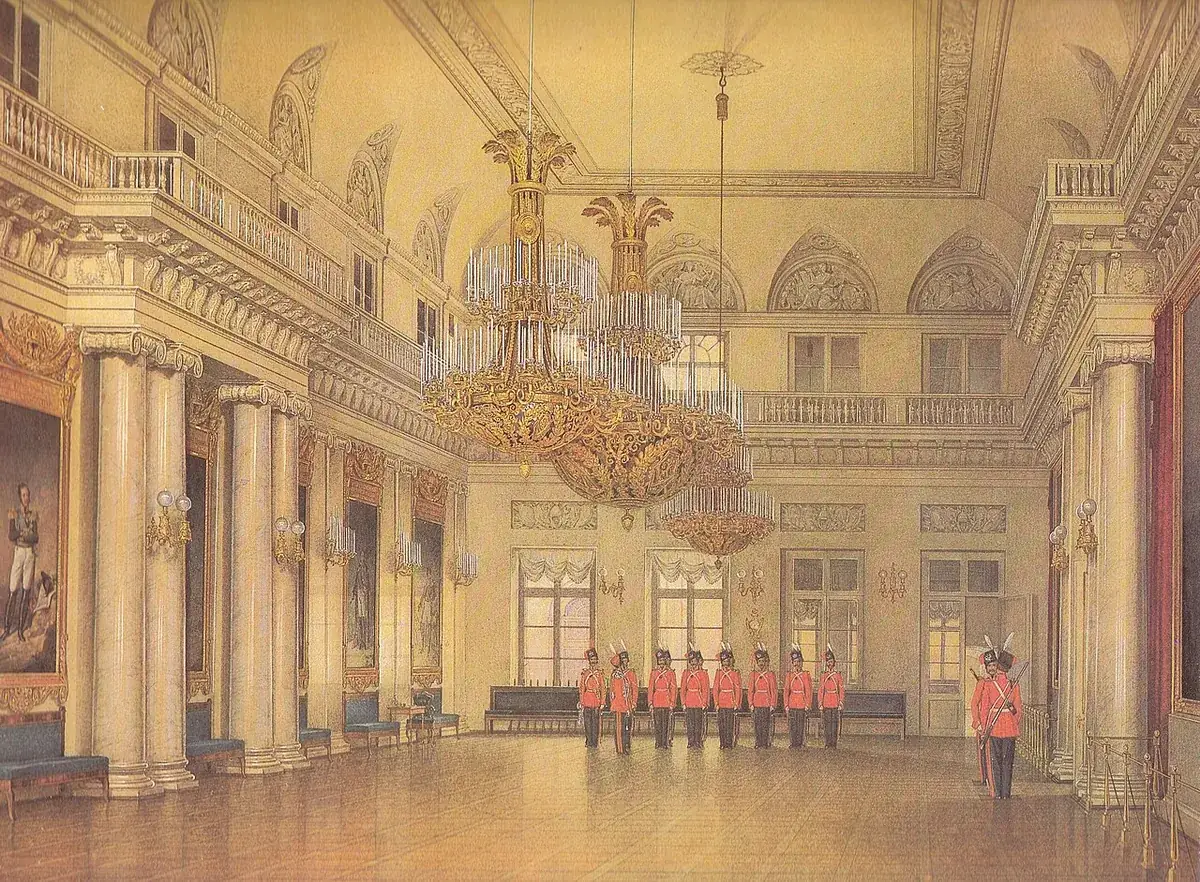
The rebuilt palace was blessed at Easter 1839, some fifteen months after the fire. According to the historian Igor Zimin, ten coke stoves were kept burning day and night in the basement to dry the halls, and the average temperature rose to about 36 °C. On Easter night the craftsmen who had rebuilt the palace were gathered in the White Hall for a banquet for 3,000 people.
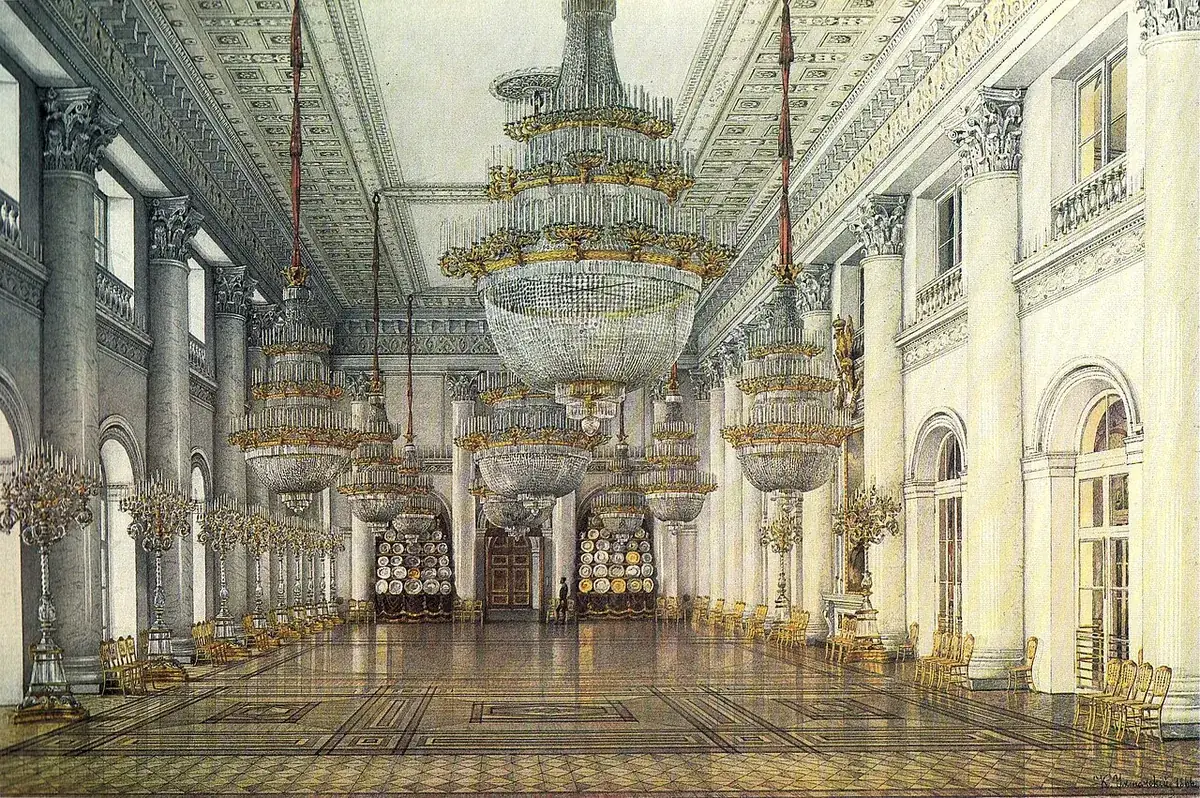
White Hall: 384 m² and up to 2,000 pieces per square meter
The White Hall parquet was created by the architect Aleksandr Briullov after the 1837 fire. The room measures 384 m², and some areas hold up to 2,000 pieces per square meter, according to the museum. It is laid in oak squares with a central rosette of floral motifs. The museum lists rosewood, amaranth, maple, sandalwood, birch, boxwood, walnut, oak and other decorative woods.
The restoration took four months and was carried out by the firm Parquet-Hall. It did not start with the finish: first the subfloor was repaired, which is pine boards laid on battens. Then details were reinstated, defects were filled with color-matched fillers and the surface was protected with a waterborne finish. If the pine base and the battens are not stable, sanding the visible layer does not fix the problem. In marquetry, the substrate decides whether the repair lasts.
Malachite Room: 17,000 pieces under the finish
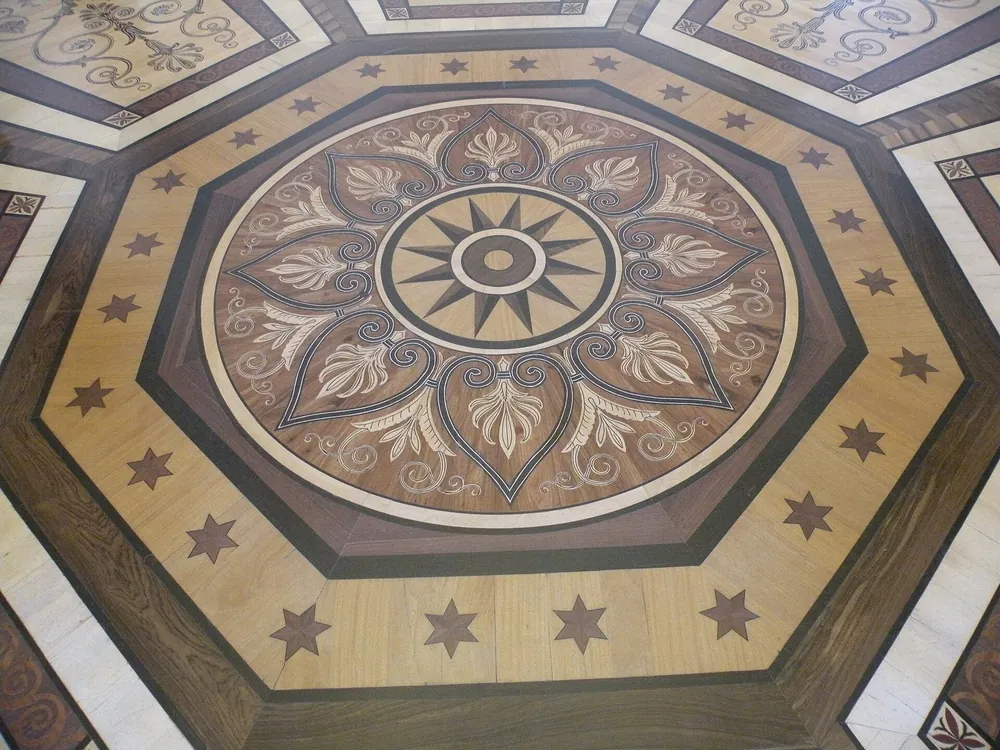
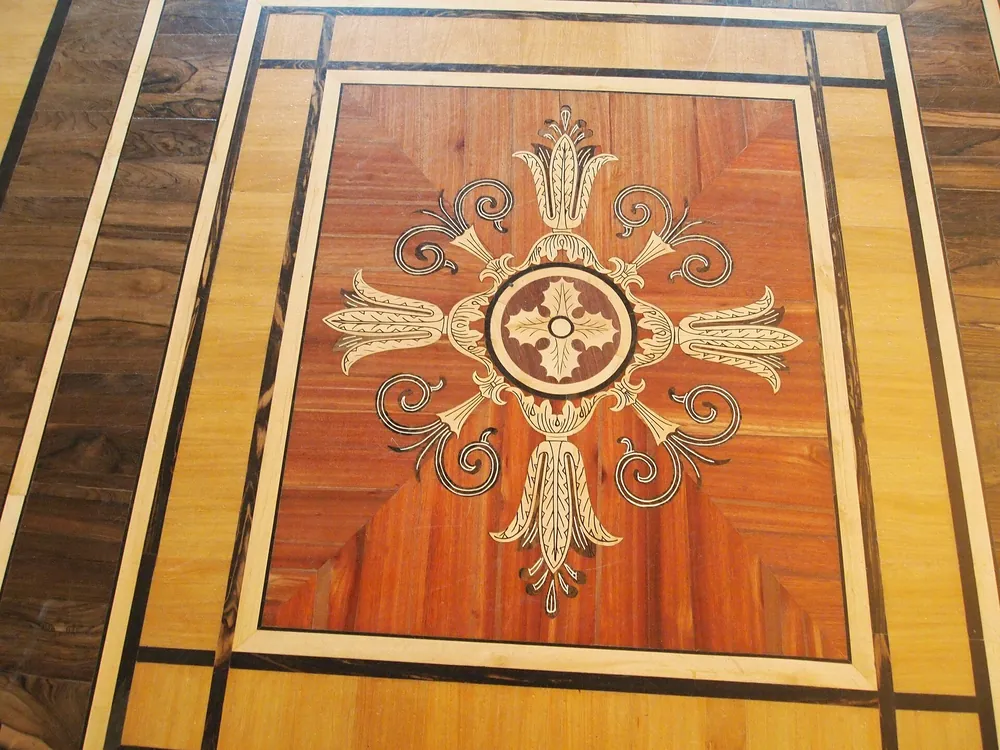
The Malachite Room parquet has some 17,000 pieces in 14 varieties of wood. In 1978 it was given a waterborne lacquer, and with the coats that followed the finish built up so much that the design could barely be made out. In 2004 it was removed, the base was repaired (again pine panels on battens), the losses were replaced and the engraving was redone. According to the museum’s news item, the restoration took three months and the parquet received six coats of waterborne lacquer.
In 2008 the room was worked on again, with 210 m² of floor. This time the engraving had to be cut again, because the old filler in it had changed color over the years. The engraving is black and white.
Apollo, Alexander and Greuze: a layer as thin as a veneer
In the Apollo Hall, restored in October and November 2007 (160 m²), the museum notes that a very thin layer of the parquet was left. It was polished with great care and with as little removal as possible. The parquet was designed by N. E. Yefimov in the reconstruction after the fire. The lost elements were replaced with others having the properties of the original, and a complex engraving was added as close as possible to the original.
In the Alexander Hall (565 m², from July to October 2007), the parquet next to the windows on the square was worn down to the thickness of a veneer. The pieces that could not be used were reproduced from archive documentation.
The Greuze Room, formerly the Horse Guards Room, had its decorative parquet down to strips between 0.5 and 2 mm, when new pieces measure 9 mm. In 2002 it was decided not to restore it but to recreate it entirely on a new base, and the monuments inspectorate approved it. It came to 103 m² of glued marquetry, with no fasteners, with a final wear layer of 15 mm, according to the Hermitage Museum Foundation. The Hermitage had not recreated an area of decorative parquet that size for 120 years.
Rotunda and Dark Corridor: 648 m²
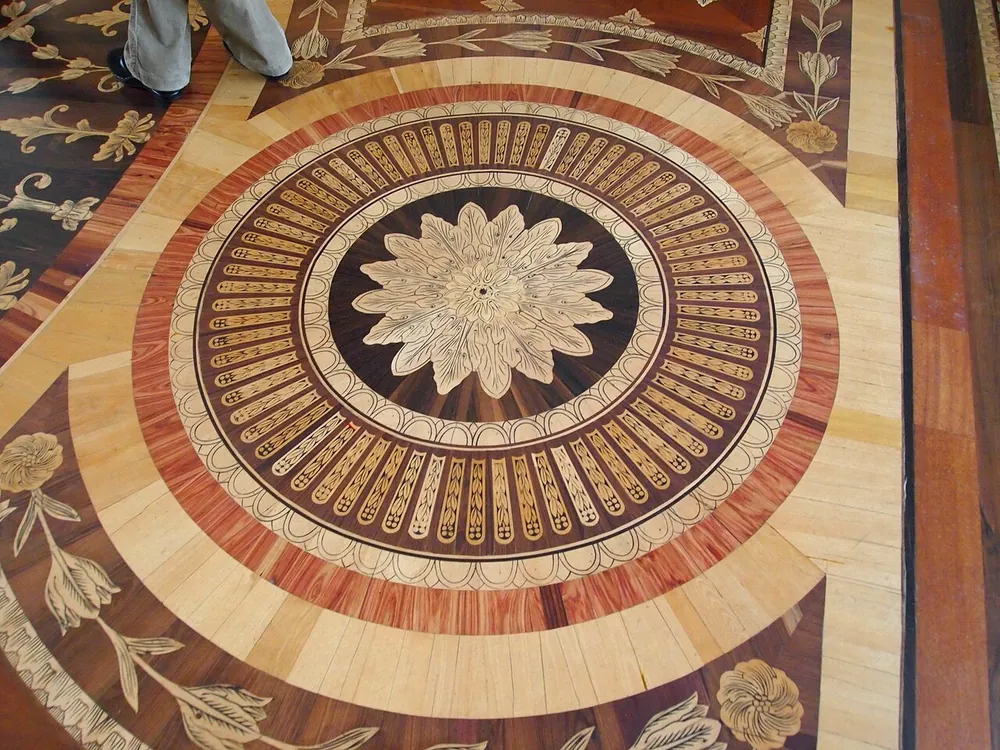
The Rotunda and the Dark Corridor add up to 648 m². The work ran from November 2003 to May 2004, and the rooms reopened on May 18. The museum says it took particular care with the base: there were 35 base panels in the Rotunda and more than 50 in the Dark Corridor. They were shimmed with wedges between the supports and the boards, and moisture-resistant plywood and a water-based dispersion adhesive, Bon D 720, were used.
The lost pieces were replaced with rare woods: amaranth, boxwood, sandalwood, rosewood, walnut, ebony and tulipwood. After polishing, master parquet makers redid the art engraving by hand. When the base is degraded, support, adhesion and missing pieces have to be corrected before cleaning, sanding or finishing.
2010 restoration: 2,831 m² of parquet restored
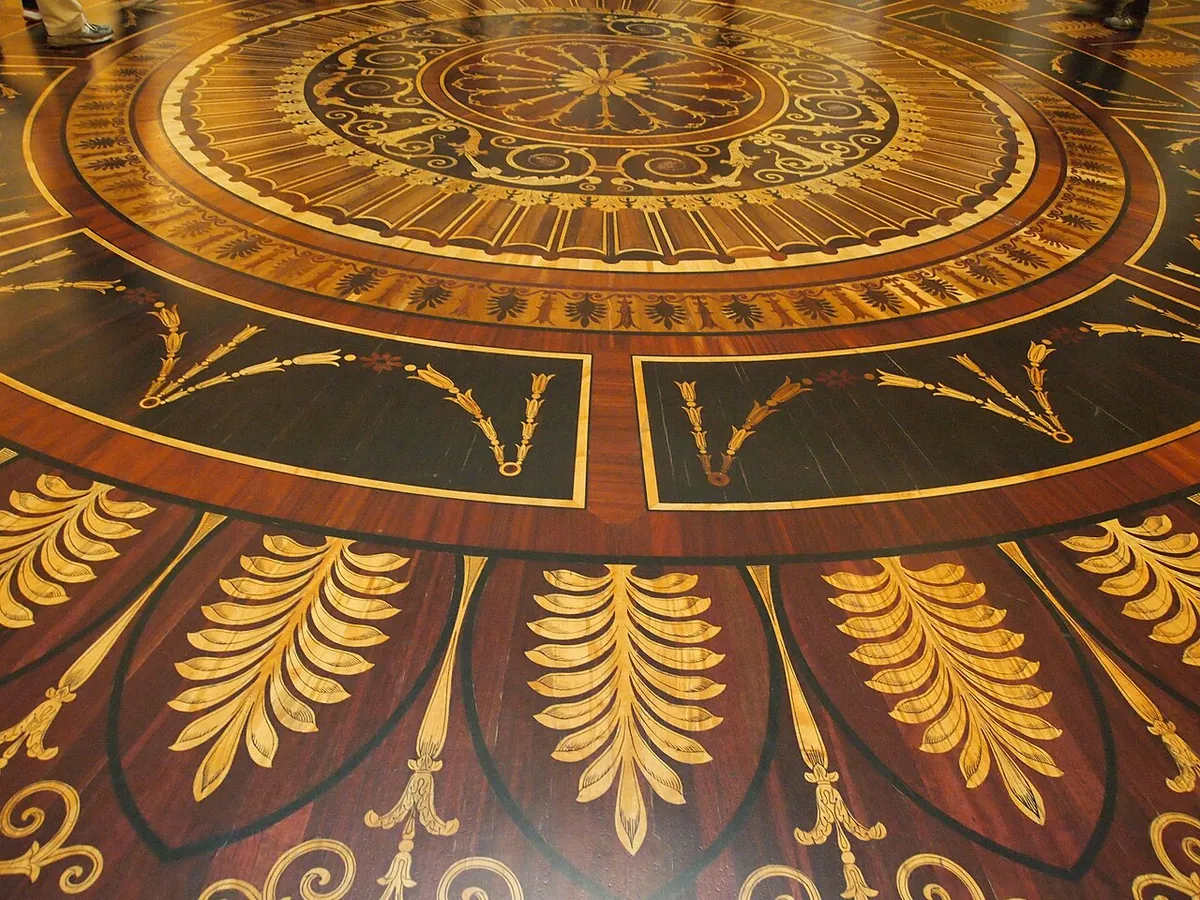
The Hermitage’s 2010 annual report documents a campaign of 2,831 m² of restored parquet. It covered the Rembrandt Room, the Russian rooms of the second half of the 18th century and the Knights’ Hall. It also included the Numismatics Gallery, the Oriental Gallery and the rooms of French art.
In the Rembrandt Room, 80% of the art parquet, in beech, ash and amaranth, was damaged by wear of the protective finish. In rooms 168–173 there was a complex geometric parquet in ten species, among them ebony, oak, mahogany, boxwood and rosewood. In places it was worn down to a thickness of 0.5 mm. The Knights’ Hall showed cracks in a mosaic parquet of birch, maple, plane, mahogany, satinwood, ebony and merbau.
The repair included the substructure, sleepers, base boards, added supports, filling joints with thin strips of wood, reinstating geometric elements and a wear-resistant finish. Pieces that were not fit for use were reproduced in the dimensions and wood species of the original.
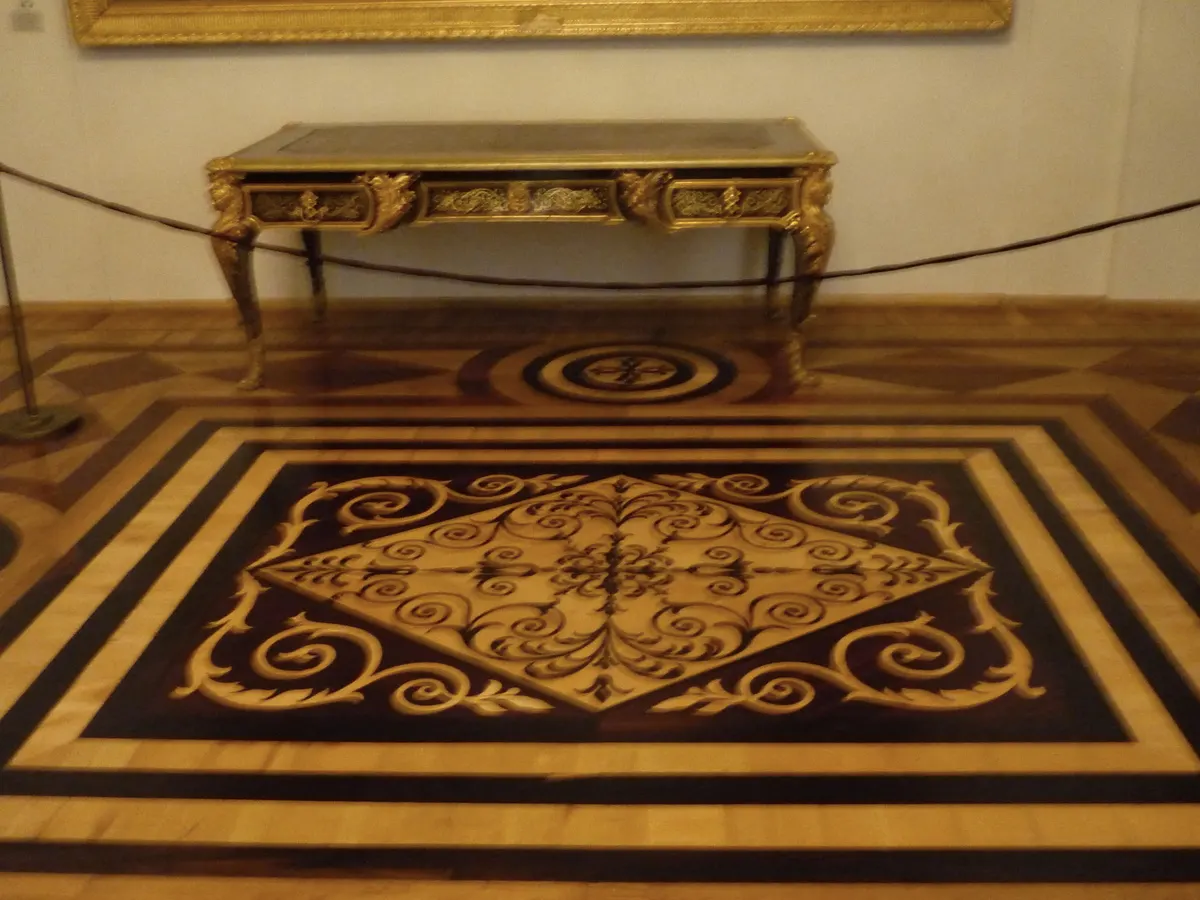
In 2014 the annual report mentions the exedra of the Peter the Great Hall, with marquetry parquet in nine rare wood species. In room 174 the panel parquet was recreated with new battens and a new subfloor.
Areas restored by ArtParquet
ArtParquet, a contractor for the museum, provides job data that does not always appear in the museum records. In the German halls it cites a restored area of 300 m². The difficulty was the thickness: at the start, the floor was no more than 10 mm.
In the Cathedral Hall, 450 m² were restored over four months. The parquet was worn down to 2–3 mm in some areas, with losses, later inserts of other species and a badly damaged sub-base. Beams and base panels were restored and reinforced, and some sections were rebuilt almost from scratch. The documentation states a 95% reconstruction.
In the Predsoborny Hall, the anteroom to the Cathedral, 185 m² were restored. The parquet had never been restored before, it was covered with carpet and it had losses of more than 35% in curved art elements. The job used old boards kept in the Hermitage basements, stored for some 200 years, and 14 species. Wood Floor Business featured this job in 2013 as the best restoration of the year.
In rooms 258, 272 and 281, 590 m² were restored in one week. First the substrate was made sound (battens, beams and base boarding, following the historic models). On top of it the panel parquet was restored, with 70% re-gluing and replacing missing pieces. In the French halls, 1,000 m² are reported restored in two weeks.
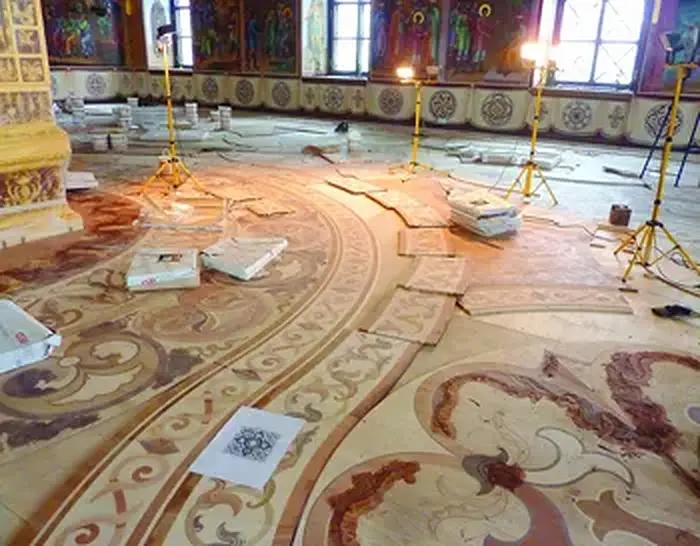
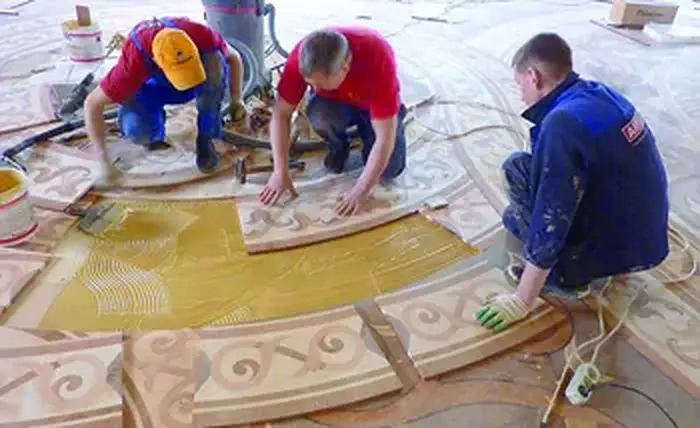
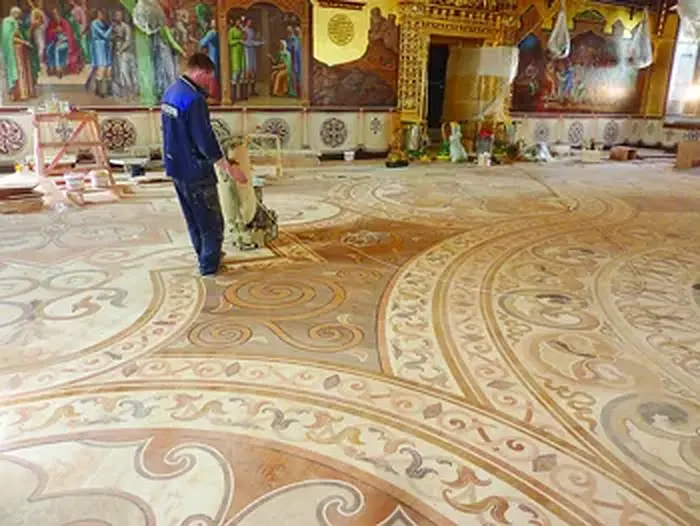
Raphael Loggias and other restored areas
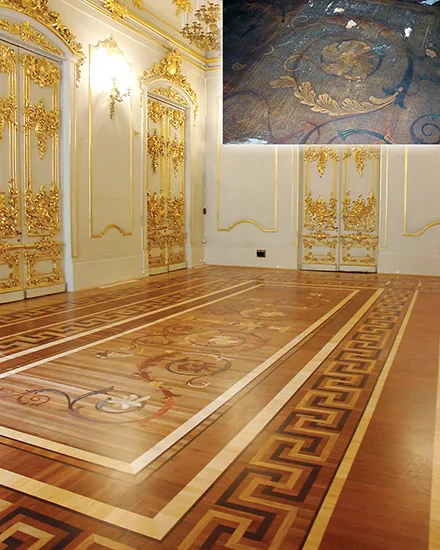
In 2000, according to the Hermitage Museum Foundation, the Petersburg Restoration Company restored 360 m² of parquet in the Raphael Loggias. The foundation also cites 300 m² restored in the Dutch painting rooms, 431 m² in the Great Church of the Palace and 130 m² in the Theater.
In a later job in the Raphael Loggias, the source explains that the total thickness of the finish was not increased and its transparency was not changed. The damaged, dirty layer was replaced. On a historic floor that has already been restored, adding coats of finish without control can change the thickness and the way the wood reads. Sometimes it is enough to remove and replace the altered layer.
Hall of Twelve Columns: damaged finish and rebuilt elements
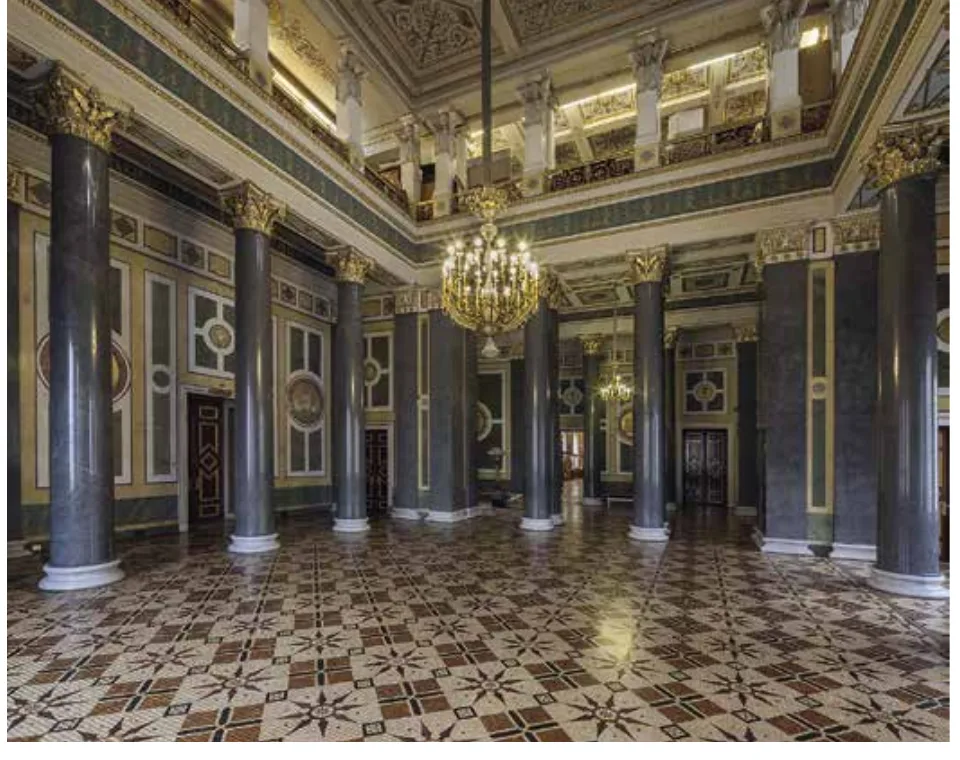
The Hermitage’s 2015 annual report includes the mosaic parquet of the Hall of Twelve Columns, in birch, maple, plane, mahogany, satinwood, ebony and merbau. The damaged finish was removed, the cracks were filled, art parquet elements were rebuilt and it was finished with a wear-resistant waterborne finish. The report describes it as routine repair work, between September and November 2015.
The 1880 bomb under the tsar’s dining room
On February 5, 1880, a bomb lifted the parquet of the tsar’s dining room in the Winter Palace. The emperor’s private dining room was on the second floor, above the guardroom, and below that there was a basement. Dinner was at six and was put back until Prince Alexander of Hesse arrived by train.
In that basement Stepan Khalturin, hired at the palace as a carpenter and carrying a false passport, had been stockpiling dynamite. It went off just after six, under the soldiers of the Finland Regiment who were in the guardroom. The official Government report, published in the Pravitelstvenny Vestnik, notes that in the dining room, on the second floor, “the parquet is lifted.” On the floor below, much of the floor caved in.
Wickham Hoffman, secretary of the US legation, reported that the explosion had caved in the dining room floor (“blowing in the floor of the dining-room”). The room was empty and the table was set: the china and glassware were blown to pieces. Casualty figures vary from report to report, from five to eleven dead, and the later official report gives ten soldiers killed.
Restore or replace
In the Hermitage marquetry, the margin for sanding is the visible layer left on top of the base board, not a tongue. When that layer runs out, as in the Greuze Room, the floor is remade; if there is still some left, as in the Apollo Hall, it is polished as little as possible.
The marquetry of the White Hall and the Malachite Room rests on pine and battens, and on a floor like that the battens that have sunk, taken on moisture or been damaged are replaced. If the floor squeaks, the noise is stopped with expanding polyurethane injections, or by replacing the battens when the damage is serious. A similar case: the star marquetry with loose joints in the Palacio de Zurbano.
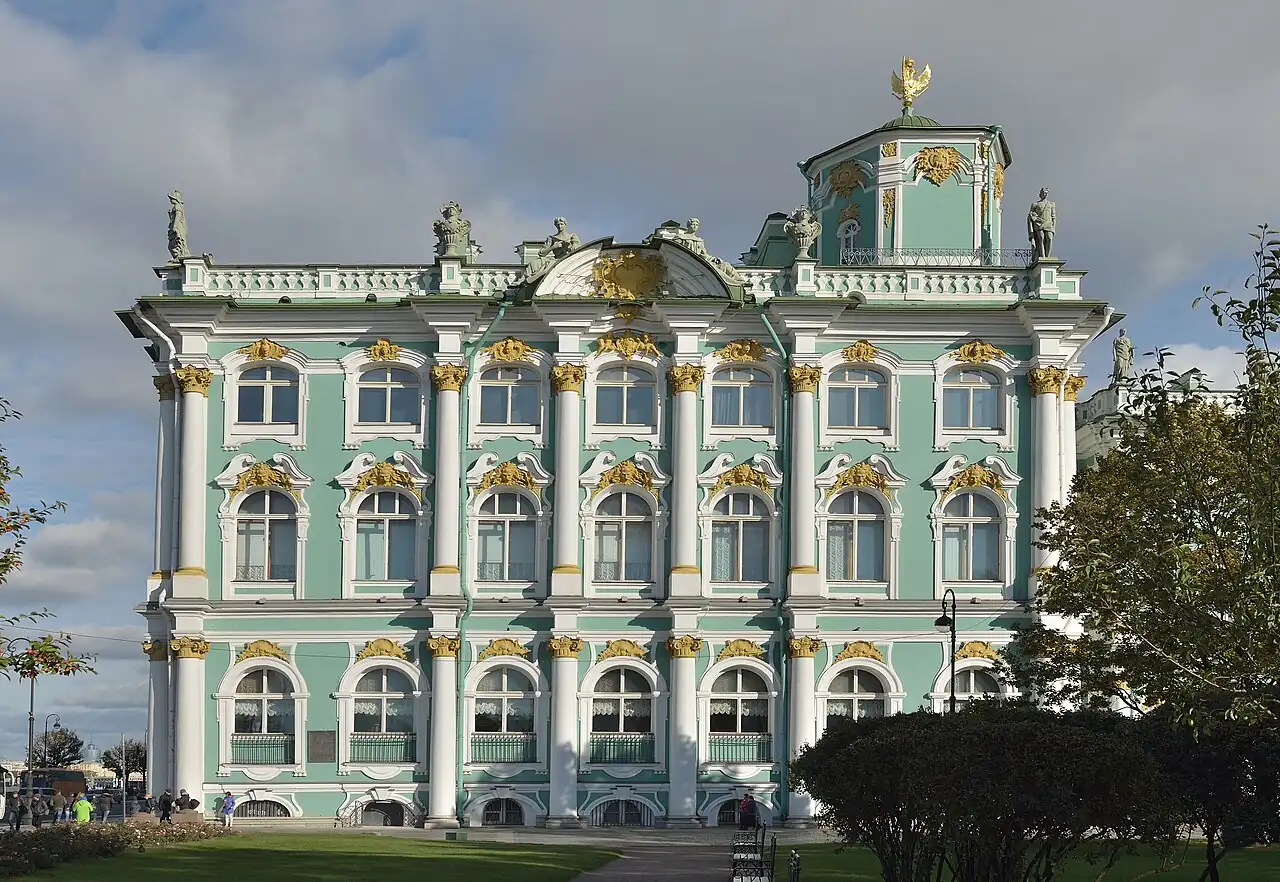
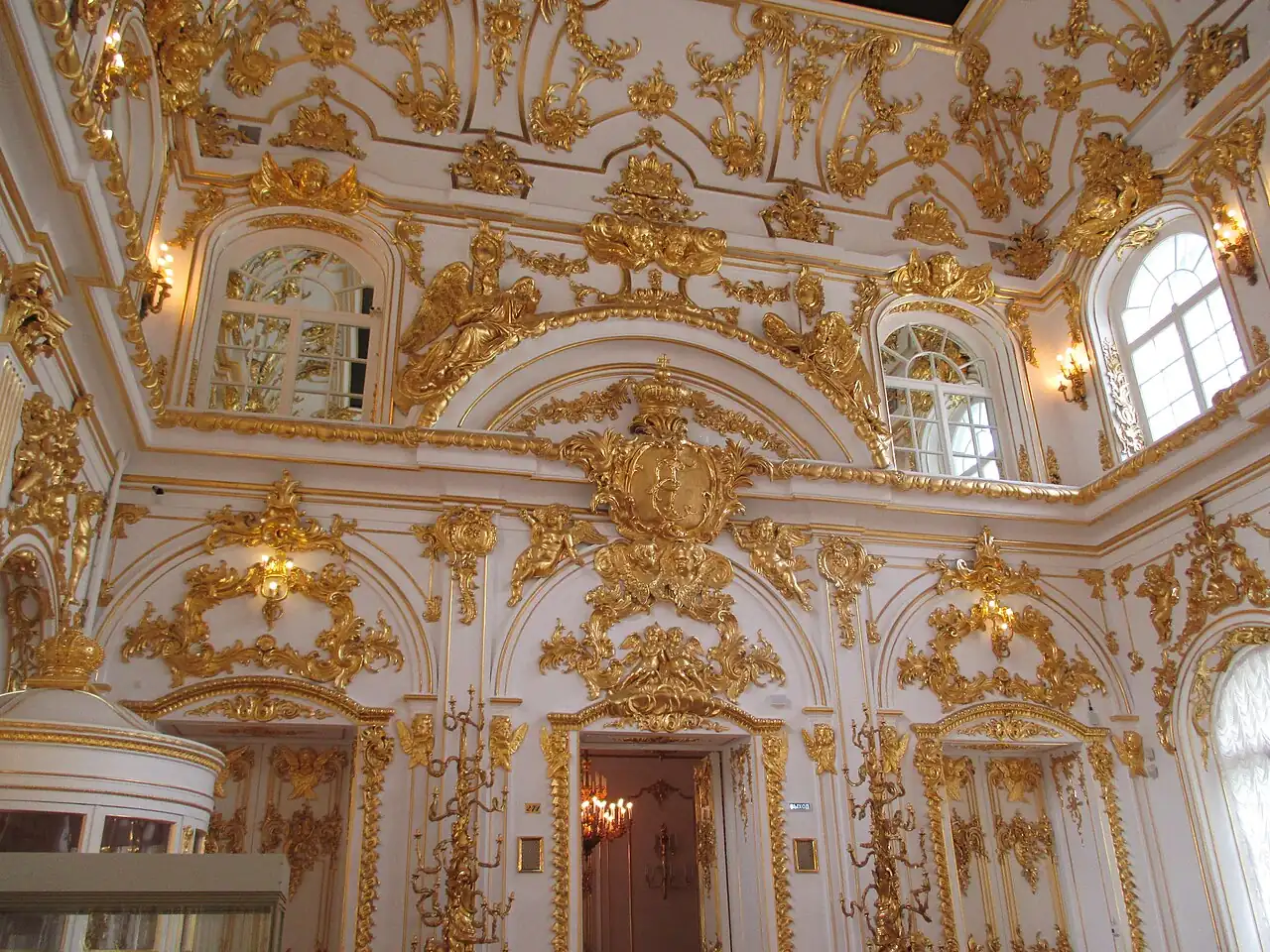
The Hermitage in pictures

Historic parquet, marquetry and loose pieces
A marquetry of many species, like those of the Hermitage, is repaired by replacing each missing piece with the same wood. More on floors with history in Historic parquet.
Sources
- Gzen92, Wikimedia Commons, CC BY-SA 4.0.
- Gzen92, Wikimedia Commons, CC BY-SA 4.0.
- Eduard Hau (1866), Wikimedia Commons, public domain.
- Konstantin Ujtomski (1866), Wikimedia Commons, public domain.
- Zmorgan, Wikimedia Commons, public domain.
- Zmorgan, Wikimedia Commons, public domain.
- Chatsam, Wikimedia Commons, CC BY-SA 3.0.
- Sandra Cohen-Rose and Colin Rose, Wikimedia Commons, CC BY-SA 2.0.
- Don-vip, Wikimedia Commons, CC BY-SA 4.0 (crop).
- Sandra Cohen-Rose and Colin Rose, Wikimedia Commons, CC BY-SA 2.0.
- Sandra Cohen-Rose and Colin Rose, Wikimedia Commons, CC BY-SA 2.0.
- Zmorgan, Wikimedia Commons, public domain.
- Chatsam, Wikimedia Commons, CC BY-SA 3.0.
- Yantarnaya Pryad-Parquet (ArtParquet), in Wood Floor Business, “Big Winners: Wood Floor of the Year 2013” (“Royal Restoration” section).
- Yantarnaya Pryad-Parquet (ArtParquet), in Wood Floor Business, “Big Winners: Wood Floor of the Year 2013” (“Royal Restoration” section).
- Yantarnaya Pryad-Parquet (ArtParquet), in Wood Floor Business, “Big Winners: Wood Floor of the Year 2013” (“Royal Restoration” section).
- Yantarnaya Pryad-Parquet (ArtParquet), in Wood Floor Business, “Big Winners: Wood Floor of the Year 2013” (“Royal Restoration” section).
- State Hermitage Museum, 2015 annual report (© The State Hermitage Museum).
- Florstein, Wikimedia Commons, CC BY-SA 4.0.
- Wolfgang Moroder, Wikimedia Commons, CC BY-SA 3.0.
- Januarius-zick, Wikimedia Commons, CC BY-SA 4.0.
- Januarius-zick, Wikimedia Commons, CC BY-SA 4.0.


