
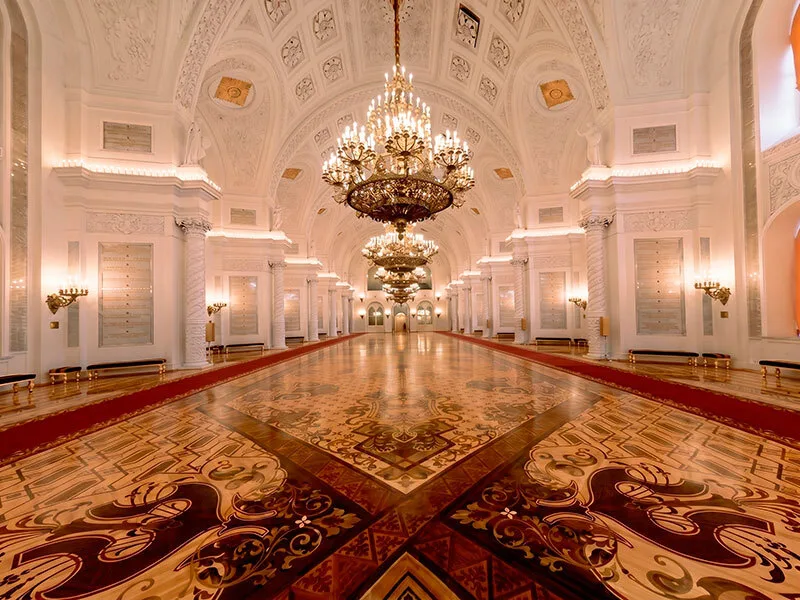
The parquet of St. George’s Hall, the great state hall of the Kremlin, was made in 1845 by the firm of Georg Müller and laid in 1848. It survived a bomb in 1941 and several restorations, but by 2018 it had hardly any wood left to sand. Between 2018 and 2019 it was replaced with a copy, and a piece of the original was kept. It is one of the 16 cases in the best parquet floors in the world.
A tender won with the cheapest bid
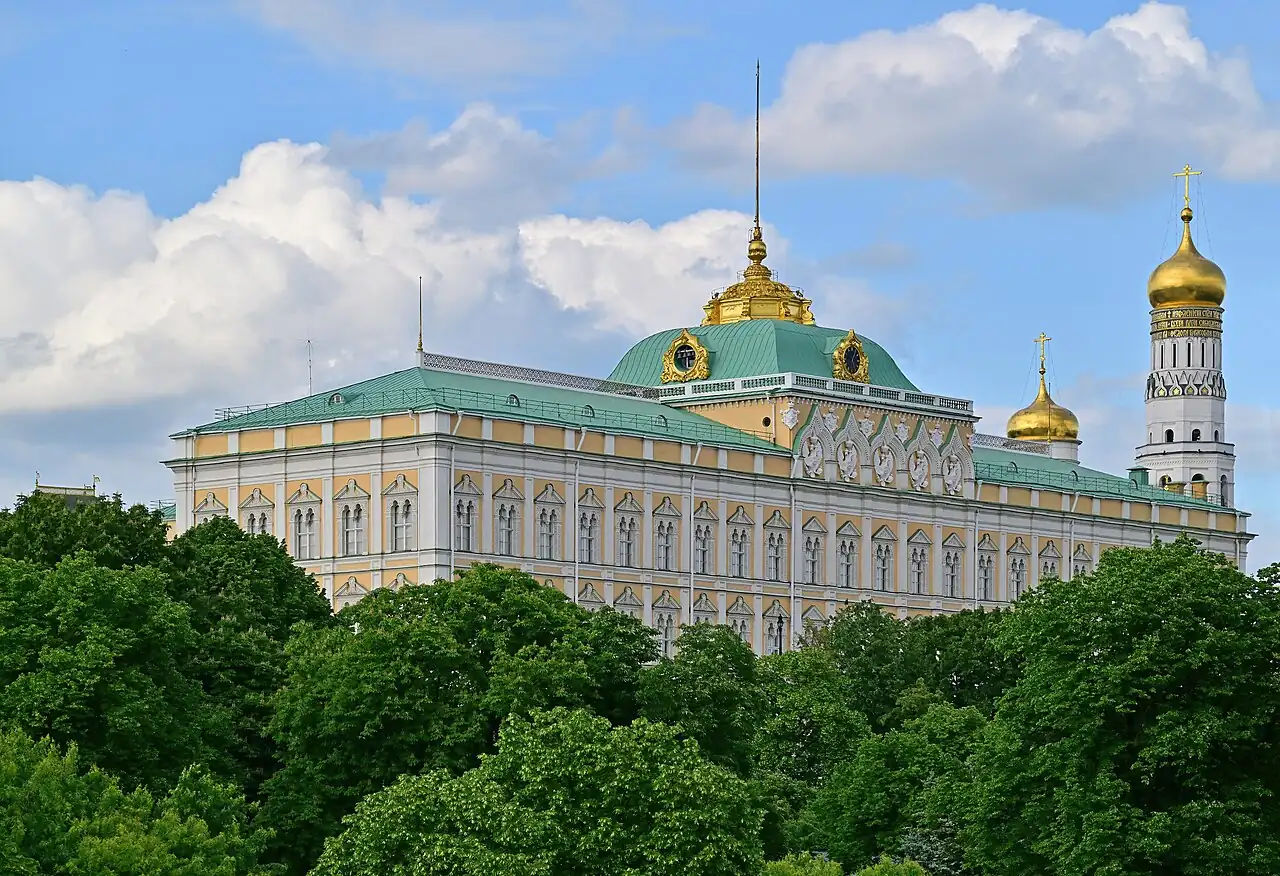
The palace was commissioned by Nicholas I, and St. George’s Hall (Георгиевский зал) is its largest room. Its parquet is signed: next to the wall of the anteroom there is a seal made of tiny pieces of wood that reads, in French, “1845. George Muller jun. Fabrique de parquets,” as AiF and Rossiyskaya Gazeta reported in 2019.
The newspaper Izvestia told how the contract was awarded. In August 1843 Georg Müller, a St. Petersburg manufacturer, won the tender with the cheapest bid. He asked about 32 rubles per square meter, against the 38 to 44 of his competitors. He committed to delivering it in two years and four months.
Later, under pressure from workers and timber merchants, he raised it to about 36 silver rubles per square meter. On top of that, a fire at his factory burned wood and the drying kiln, and he had to ask for five more months. The floor was laid in 1848.
A carpet of woods in a room 61 meters long
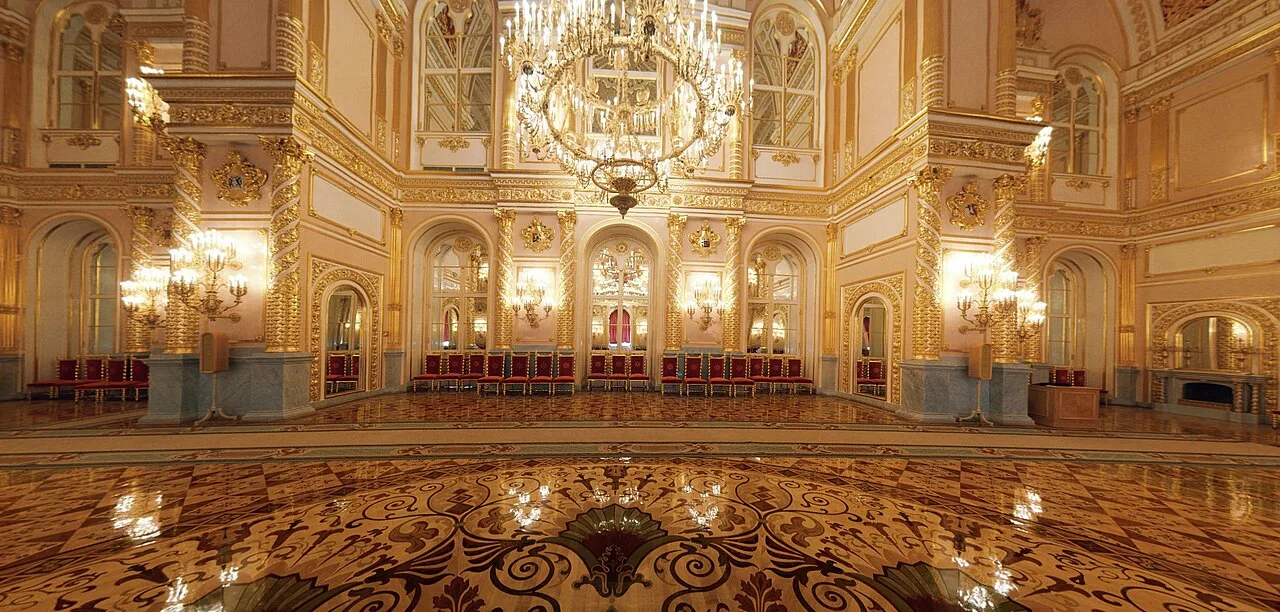
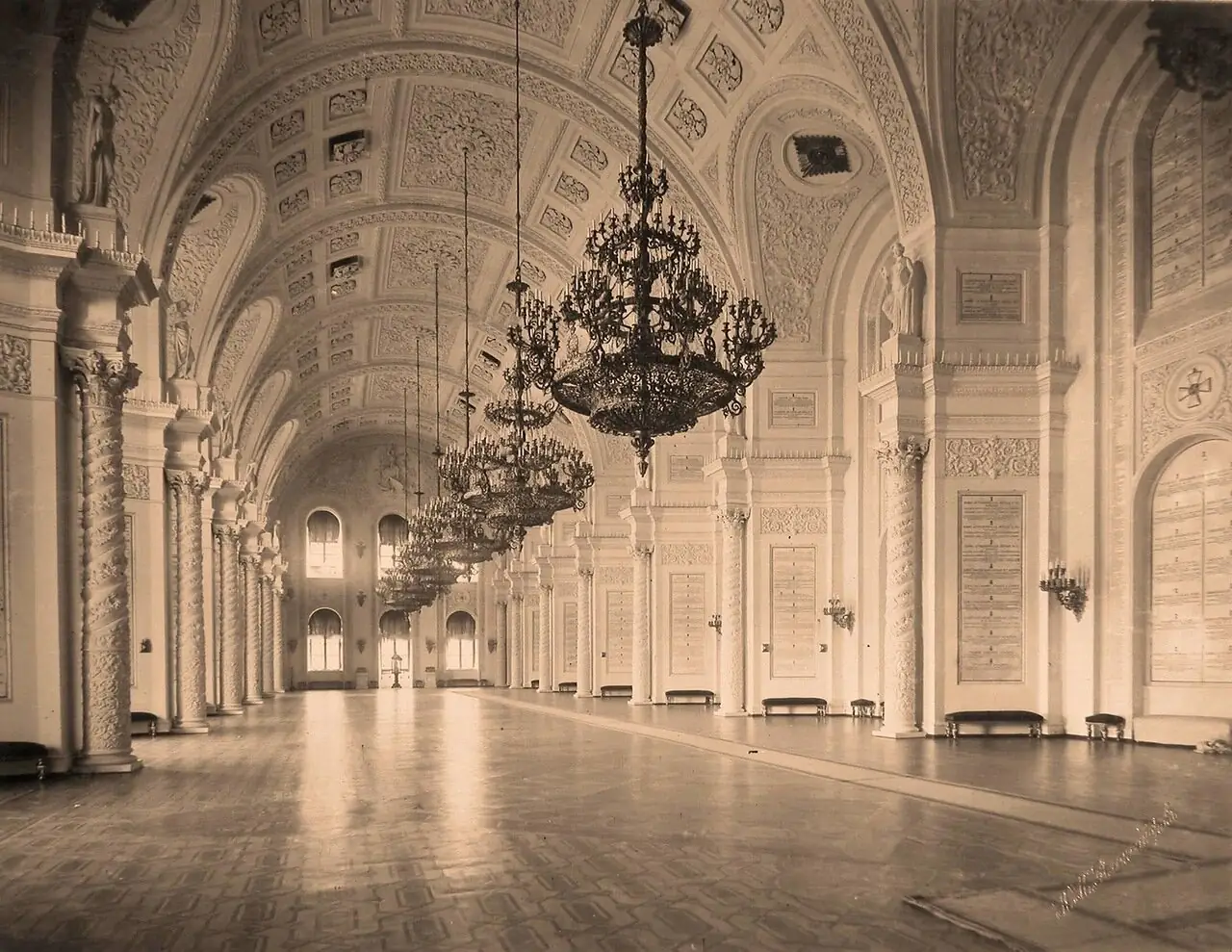
The hall measures 61 by 20.5 meters, according to TASS, and the parquet covers between 1,200 and 1,250 m², depending on the source. The design is by the academician Fyodor Solntsev, who drew parquet sketches for the whole palace. The 1912 guidebook described it as an immense carpet of more than twenty precious woods, each a different color.
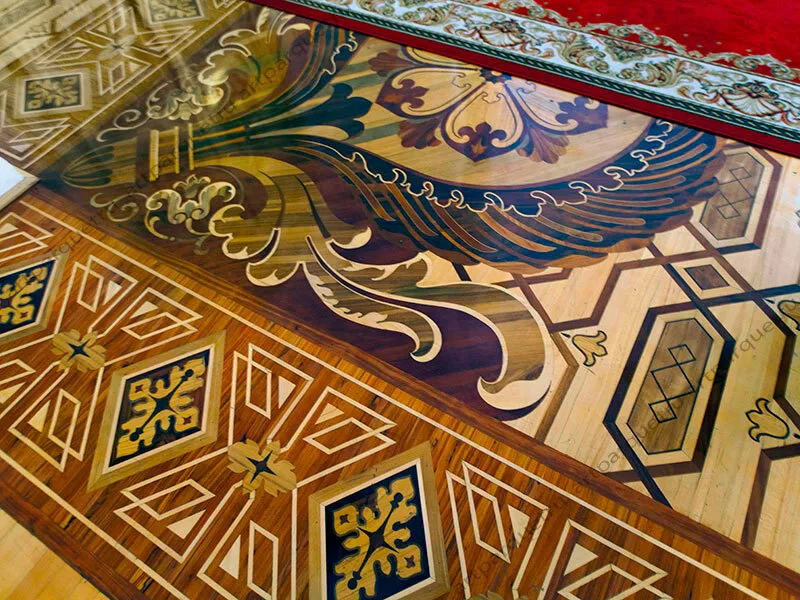
TASS gives the list for the original: oak, beech, ash, walnut, Indian rosewood, African padauk and plane, some natural and others stained. Izvestia describes what can be seen: yellow lilies in lemonwood, a border of red lozenges with ebony and the pink ornament of the plane. The light background is beech.
The pattern is not fully symmetrical. ArtParquet, which made the new floor, explains that the original was assembled by hand and its repeats do not match to the millimeter.
Under the floor, pine beams resting on the vault
TASS described what was under the parquet when it was lifted. Squared beams rested on the crown of the brick vault and were set into recesses in the walls. Other beams ran diagonally in their slots; on top, a base of wood panels and, on that, the parquet.
AiF went down to see it in 2019. The framing was pine from Nicholas I’s construction, more than 180 years old, and some beams had been reused from another building. There were only two spots damaged by moisture. New reinforcing beams were added, but the old structure stayed.
The bomb of July 1941
On the night of July 21 to 22, 1941, a month after the German invasion, a 250 kg bomb fell on the hall. It went through the roof and the vault and did not explode. According to the history of the Kremlin published by its guard service, it broke one square meter of vault and about four of floor.
It fell next to the fourth pillar and wrecked the parquet, the base and the beams in that section. An officer of the Kremlin regiment, A. Esaulov, told Rossiyskaya Gazeta that he saw the bomb caught where the floor beams crossed, between the fourth and fifth chandeliers.
AiF published the report sent to Beria and how it was repaired that same year, with steel sections over the broken bricks. It was the stretch of the original parquet that suffered most.
Receptions, restorations and wear
On that floor, on May 24, 1945, the reception for the commanders of the Red Army was held at which Stalin toasted the Russian people. A month later, on June 24, the day of the Victory Parade, the hall hosted another large reception, according to the Kremlin guard service.
In 1968 the hall closed for almost a year and around 30 % of the floor was replaced, the palace curator Anastasia Pavlova told Izvestia. The mechanical sanders of the time left circles and scratches, and the varnish was not good.
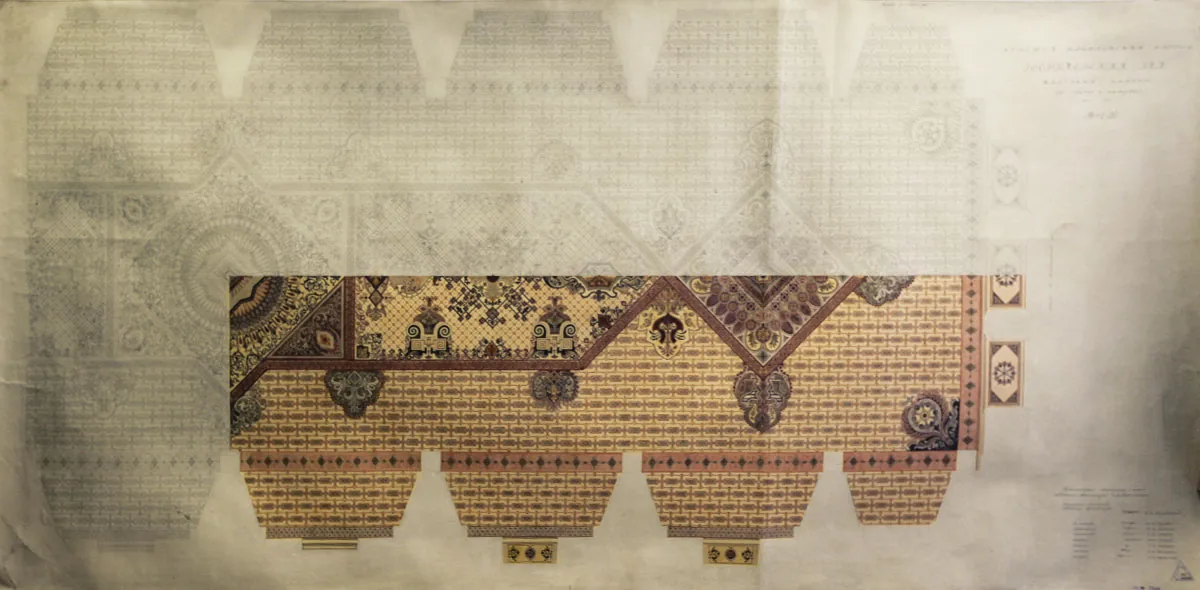
Between 1997 and 1999 a team of Italian restorers replaced the most worn pieces and sanded the whole surface, according to ArtParquet. They made full-size templates of the whole pattern from the tsarist-era drawings, and set the number of woods needed to copy it at 23.
Every sanding took wood with it. By 2018 the usable layer, which had been 2 to 5 mm, was down to 1 or 1.5 mm in some spots. The pieces replaced in earlier work stood out by their color. According to ArtParquet, more than 80 % could no longer be repaired area by area.
When the varnish was removed, it turned out that the background of the parquet was a milky white, Pavlova explained to AiF. The wood had darkened over the years and under the layers of varnish.
A new floor with Solntsev’s design
The hall closed on November 28, 2018. ArtParquet, which carried out the work with the company Yantarnaya Pryad-Parket, of Khimki, drew every section with its dimensions and woods and photographed the whole floor before taking it up.
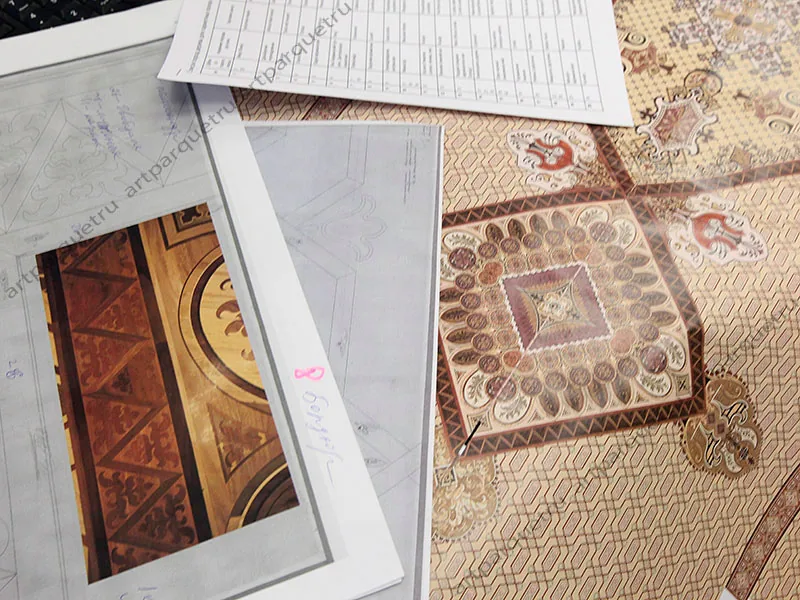
Several of the original woods are protected today and cannot be exported. According to Izvestia, they were replaced with others of similar color and density. The parquet was made in two types of piece. Some were workshop modules with the motif already assembled; others, a mosaic of loose pieces joined with tape, assembled in the hall.
The new base is plywood sheets on planks. Assembly finished on April 23, 2019, and one week was left to plane and varnish, with an Italian varnish of the Chimiver brand. On April 29 Patriarch Kirill consecrated the hall with the new floor.
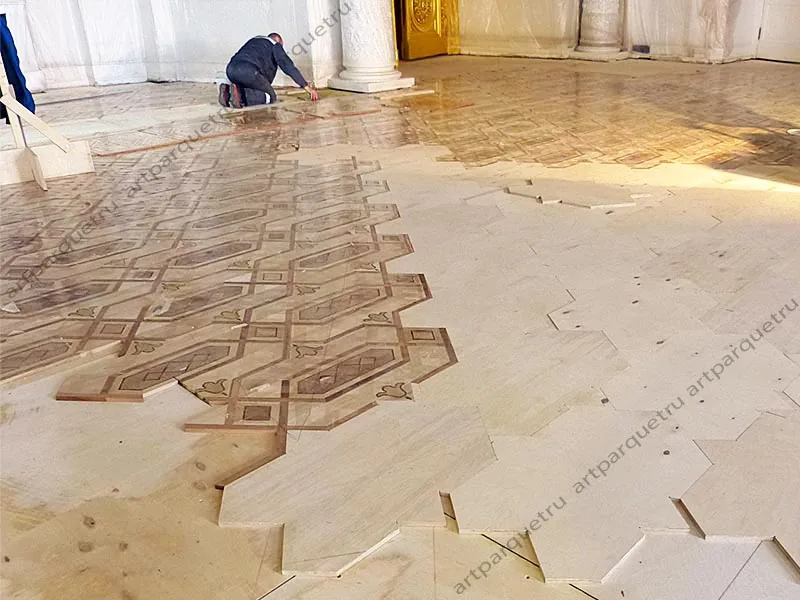
About 10 m² of the 1845 parquet were kept, the best preserved, from the least walked area. ArtParquet restored them in its workshop so that they could be laid again in the hall behind a barrier, according to its project. Next to a fragment with Müller’s seal, the chief architect, Olga Galanicheva, explained the work to the patriarch.
ArtParquet put its own mark next to the old seal. While the work lasted, the only original parquet in view was the one in the anteroom, according to AiF.
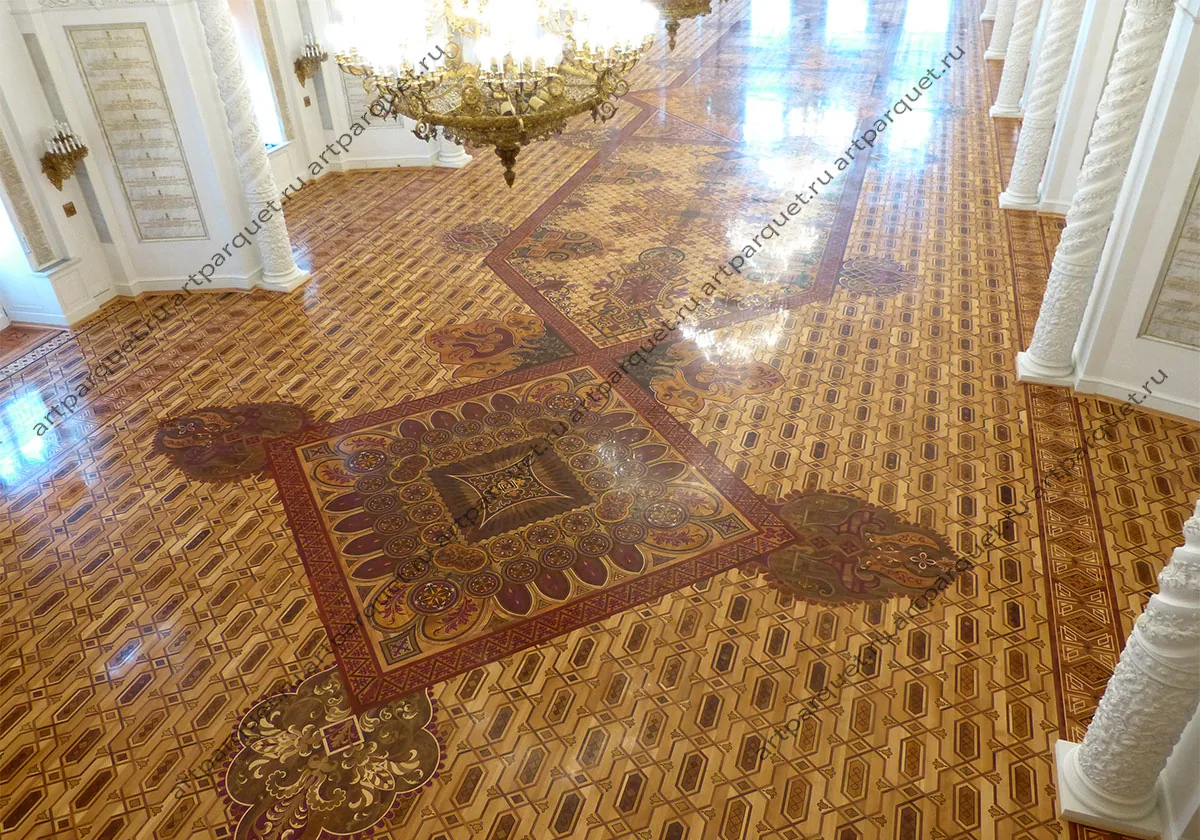
St. Andrew’s Hall, demolished and rebuilt
Next to St. George’s were the halls of St. Andrew (Андреевский зал) and St. Alexander (Александровский зал), also with marquetry parquets. Between 1932 and 1934 both were dismantled. In their place the session hall of the Supreme Soviet was built, for 1,500 people, according to the same history by the guard service.
Izvestia records the slogan that justified it: “Down with the columns!” They blocked the view of the rostrum. The two halls were rebuilt between 1995 and 1999, under a presidential decree of 1994.
The parquet of St. Andrew’s was reproduced in 22 woods from Solntsev’s drawings and archive photos. It was laid by the Italian firm Berti, the same one that made the floors of the Sale Apollinee at La Fenice. In 2020 ArtParquet went over its 991 m², with sanding, replacement of loose pieces and seven coats of varnish.
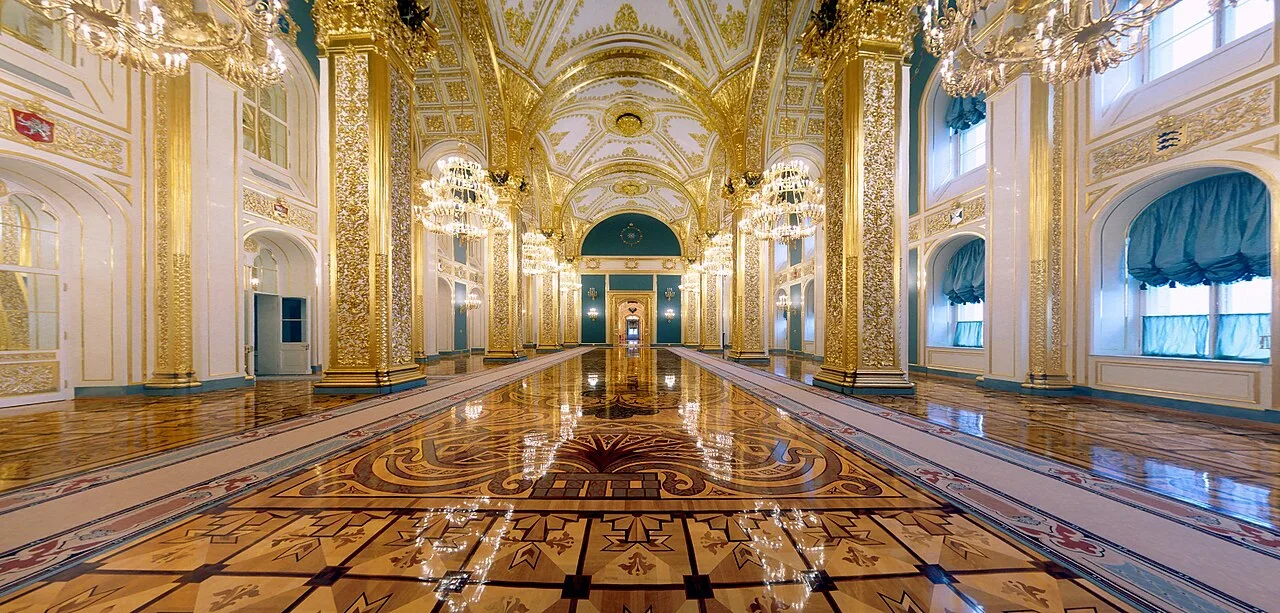
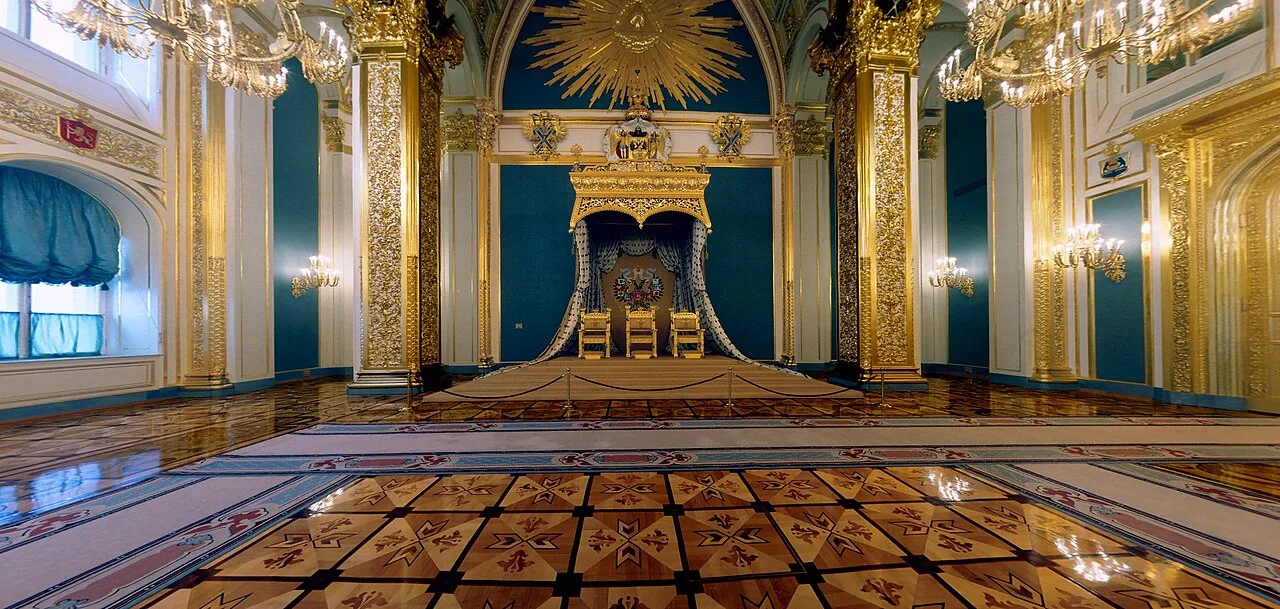
St. Alexander’s Hall
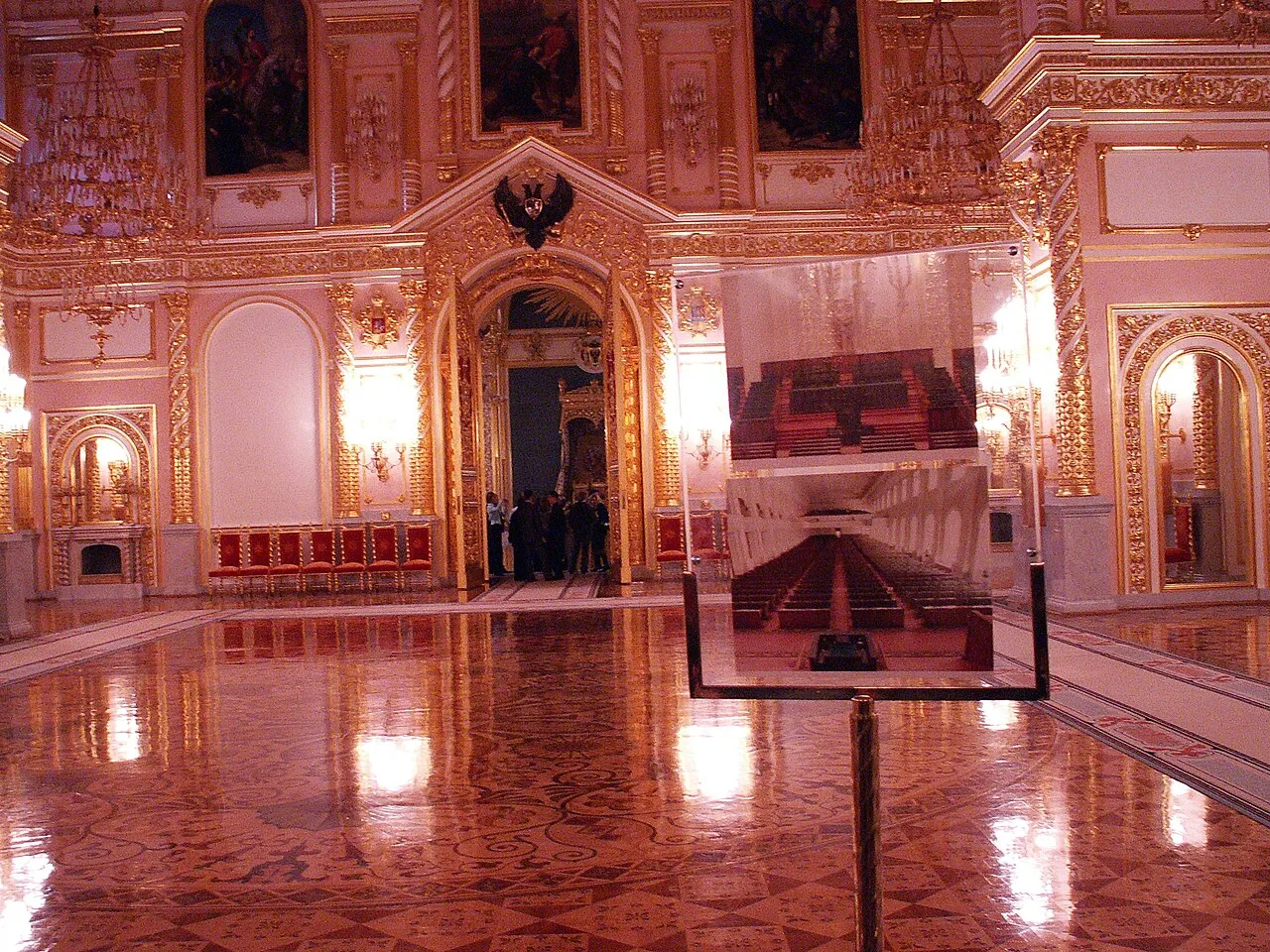
The parquet of St. Alexander’s was, according to ArtParquet, an 1843 design that looked like a carpet with floral ornament; the 1912 guidebook attributed it to the parquet maker Blechschmidt. It was reproduced in the same job as St. Andrew’s.
Its 642 m² were gone over in the same 2020 campaign. A 2009 photo shows, on that floor, a panel with the Supreme Soviet hall that took its place for about sixty years.
When no wood is left, it is copied
St. George’s Hall was restored several times, in 1968 and between 1997 and 1999, while there was wood left to sand. In 2018 there was none left, and it was copied. In St. Andrew’s and St. Alexander’s there was nothing to restore: the demolition of the 1930s forced the floor to be reproduced from the drawings.
Of the 1845 parquet, what remains is Müller’s seal in the anteroom and the 10 m² fragment kept in 2019. The rest of the hall is a 2019 copy with Solntsev’s design.
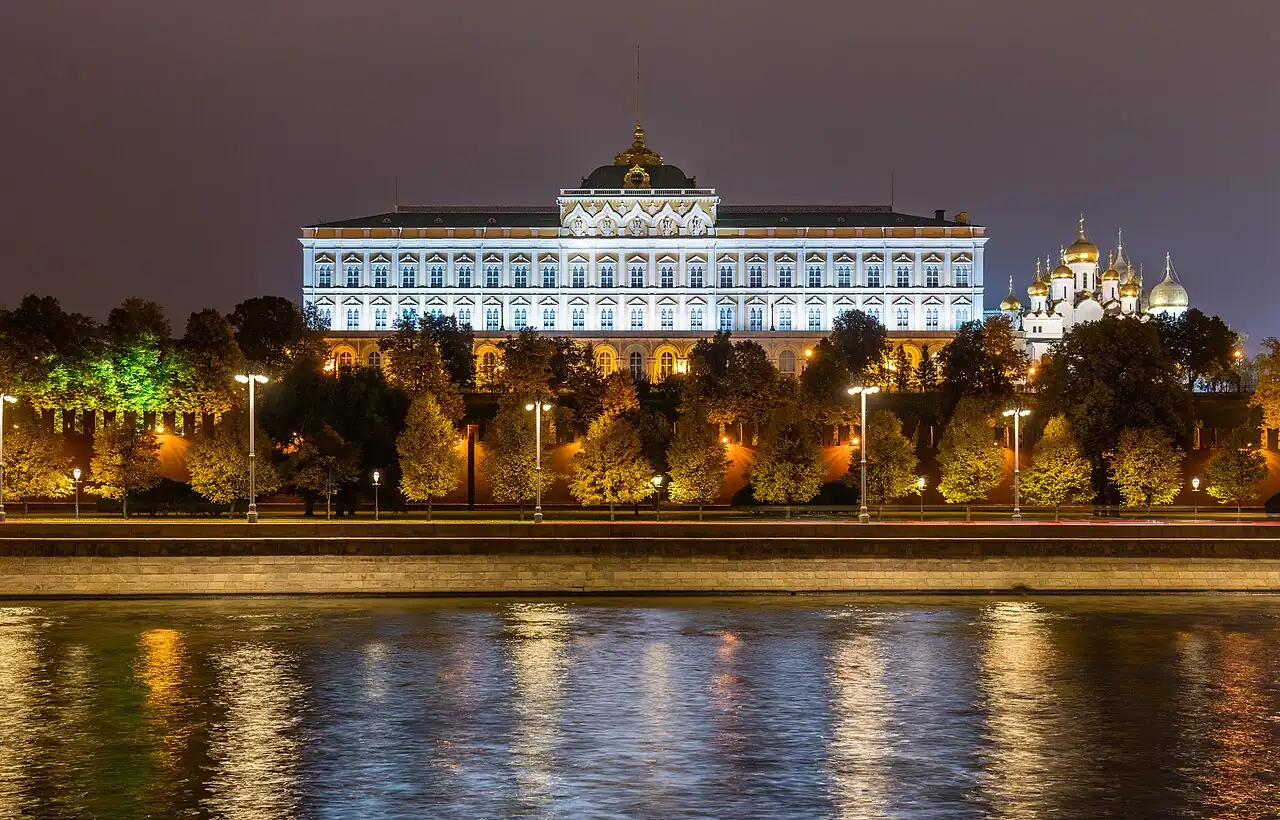
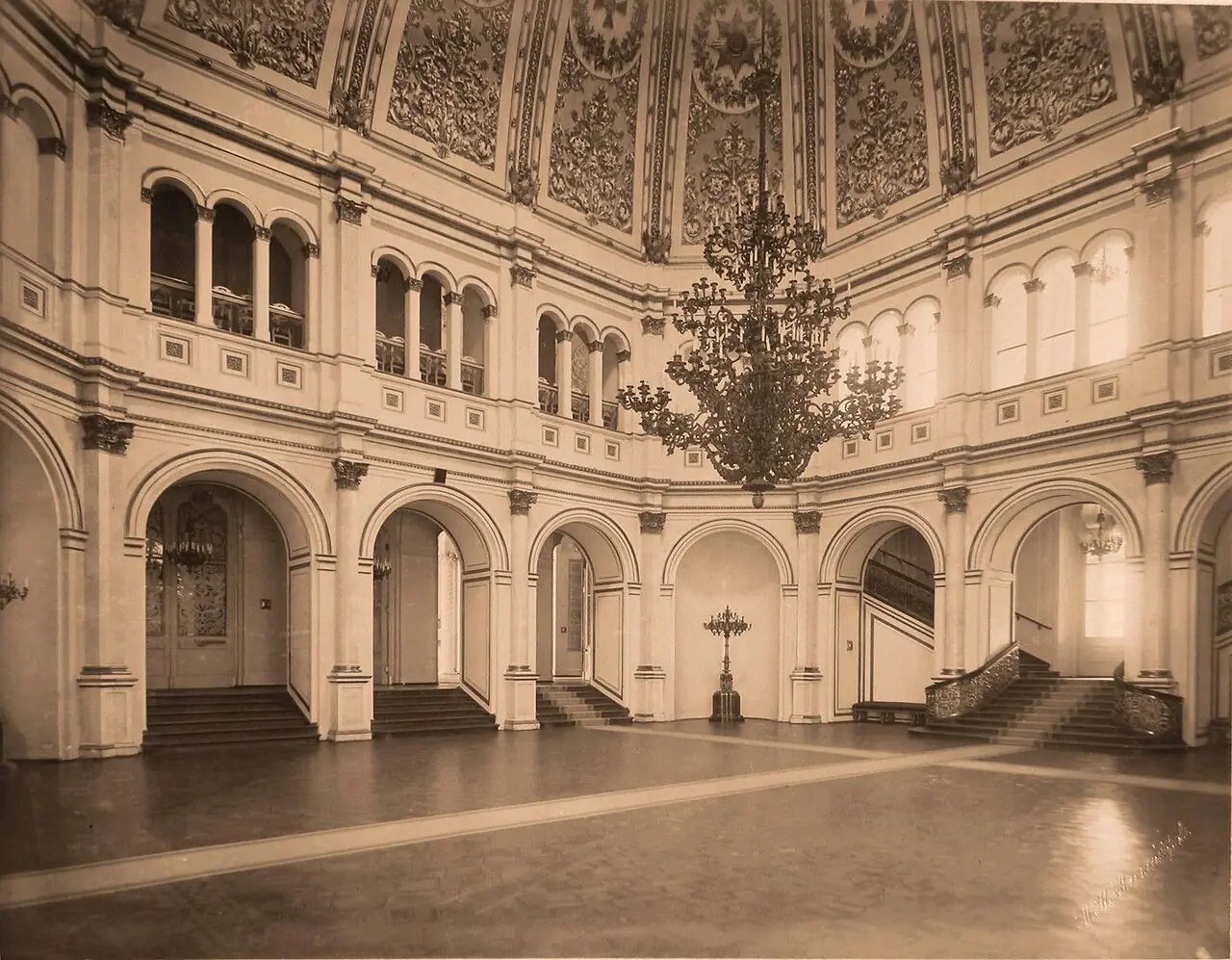
The Grand Kremlin Palace in pictures
Restoration of marquetry parquet
Before deciding whether to restore or reproduce a marquetry parquet, you have to measure how much usable wood it has left. More on floors with history in Historic parquet.
Sources
- ArtParquet, Большой Кремлевский дворец — Георгиевский зал (license not recorded).
- ArtParquet, Большой Кремлевский дворец — Георгиевский зал (license not recorded).
- ArtParquet, Большой Кремлевский дворец — Георгиевский зал (license not recorded).
- ArtParquet, Большой Кремлевский дворец — Георгиевский зал (license not recorded).
- ArtParquet, Большой Кремлевский дворец — Георгиевский зал (license not recorded).
- ArtParquet, Большой Кремлевский дворец — Георгиевский зал (license not recorded).
- kremlin.ru, Wikimedia Commons, CC BY 4.0.
- kremlin.ru, Wikimedia Commons, CC BY 4.0.
- kremlin.ru, Wikimedia Commons, CC BY 4.0.
- Vigoshi, Wikimedia Commons, CC BY-SA 4.0.
- Юрий Д.К., Wikimedia Commons, CC BY 4.0.
- Александров И.Н., Wikimedia Commons, Public domain.
- Diego Delso, Wikimedia Commons, CC BY-SA 4.0.
- Александров И.Н., Wikimedia Commons, Public domain.


