
Technical data sheets for wood flooring species
Technical guide to the properties, hardness, durability and on-site behavior of 16 wood species for parquet and wood flooring.
Alphabetical index of species:
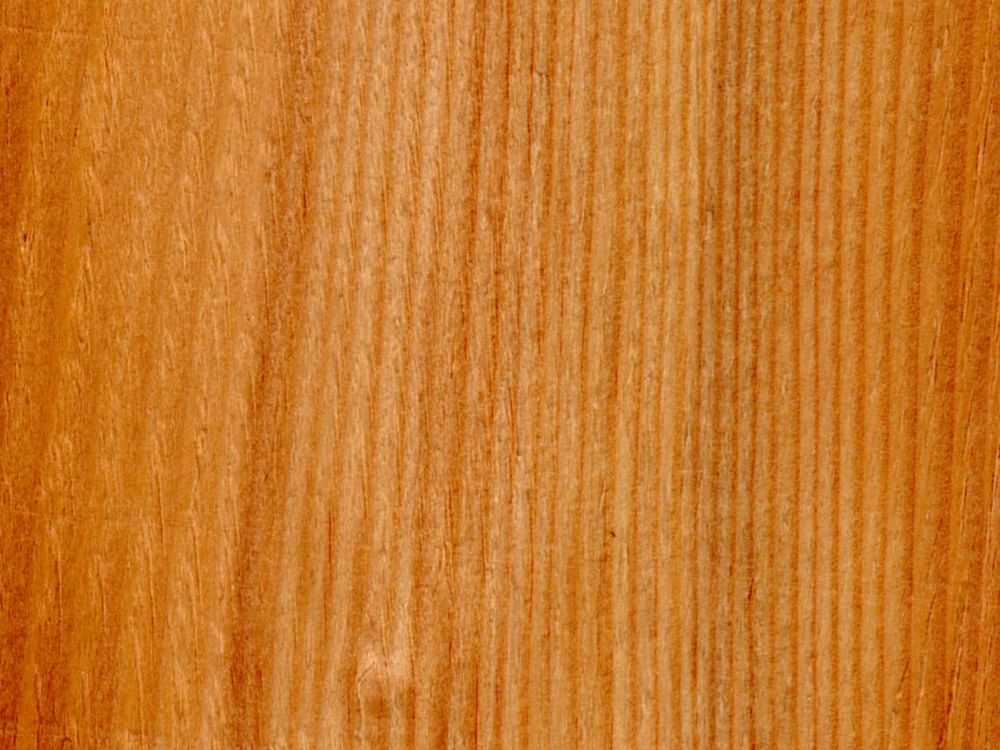
Fir
Abies alba · Central and mountainous Europe
1,420 N
T/R 2.2
Conditional
Class 1
A light, very soft wood. It dents from heels or dropped objects. It works well as a core layer in engineered flooring because it is light. As an exposed solid floor it is only specified for a rustic mountain look.
▸ See the full physical and mechanical test data (13 parameters)
| Standardized density | 415 kg/m³ |
|---|---|
| Chalais-Meudon hardness (Monnin) | 1.3 (Very soft) |
| Compression parallel to the grain | 41.0 MPa |
| Static bending (MOR) | 66.1 MPa |
| Modulus of elasticity (MOE) | 8.28 GPa |
| Radial / tangential shrinkage | Radial: 4.0% / Tangential: 8.7% |
| Total volumetric shrinkage | 12,8 % |
| Anisotropy coefficient (T/R) | 2.2 (Very prone to movement) |
| Natural durability (UNE-EN 350) | Class 4–5 (not durable) (5–10 years untreated (sapwood not durable)) |
| Underfloor heating (heating, UNE-EN 1264) | Conditional (low conductivity; use thickness ≤ 14 mm) |
| Underfloor cooling (summer heat-pump cooling) | Not recommended for summer cooling |
| Specified adhesive (ISO 17178) | Elastic modified silane adhesive (MS/SMP) |
| Chemical surface treatment | Natural oil or open-pore wood stain |
| Slip resistance (CTE DB-SUA) | Class 1 (dry interiors) |
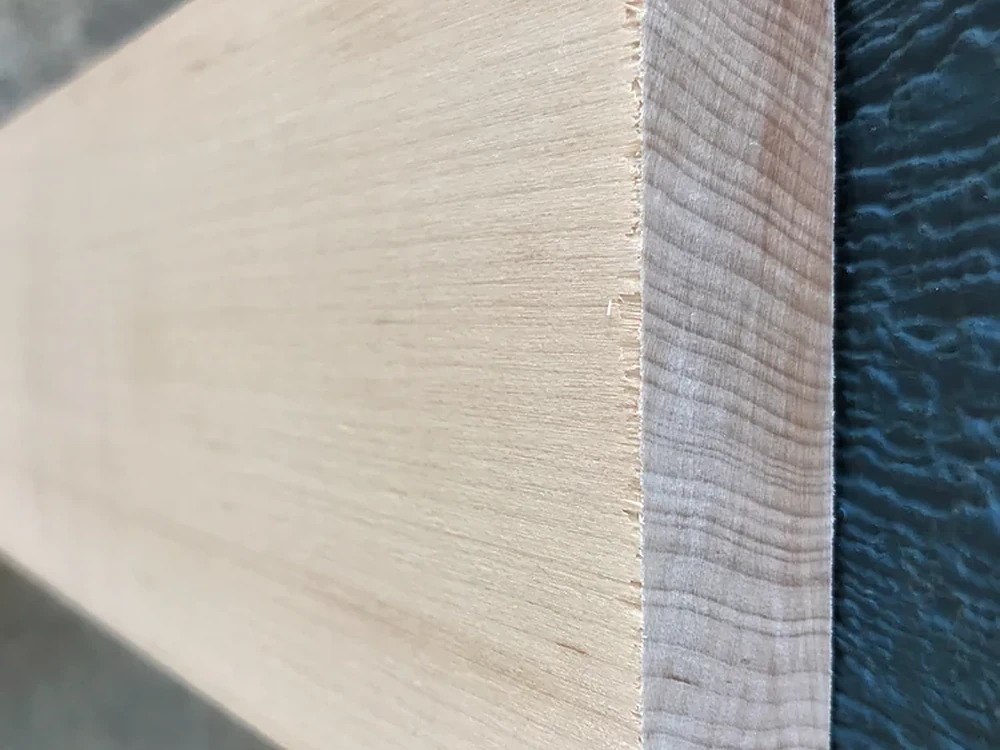
Maple
Acer saccharum · Northeastern North America
6,450 N
T/R 2.1
Not recommended in solid form
Class 1
An elegant ivory tone, but very high hygroscopic reactivity. In Madrid’s dry winter (RH < 30% from heating) it opens seasonal joints unless humidity is kept at 40–60%. It requires a primer beforehand to prevent edge bonding of the joints, and strict perimeter gluing.
▸ See the full physical and mechanical test data (13 parameters)
| Standardized density | 705 kg/m³ |
|---|---|
| Chalais-Meudon hardness (Monnin) | 4.7 (Medium-hard to hard) |
| Compression parallel to the grain | 54.0 MPa |
| Static bending (MOR) | 109.0 MPa |
| Modulus of elasticity (MOE) | 12.62 GPa |
| Radial / tangential shrinkage | Radial: 4.8% / Tangential: 9.9% |
| Total volumetric shrinkage | 14,7 % |
| Anisotropy coefficient (T/R) | 2.1 (Very prone to movement) |
| Natural durability (UNE-EN 350) | Class 5 (not durable outdoors) (< 5 years outdoors; indoor use only) |
| Underfloor heating (heating, UNE-EN 1264) | Not recommended in solid form (allowed in engineered ≤ 14 mm) |
| Underfloor cooling (summer heat-pump cooling) | Not advised (high risk of cupping from condensation) |
| Specified adhesive (ISO 17178) | Rigid-elastic MS polymer (ISO 17178) |
| Chemical surface treatment | Two-component (2K) waterborne polyurethane finish with UV filter |
| Slip resistance (CTE DB-SUA) | Class 1 (dry interiors) |
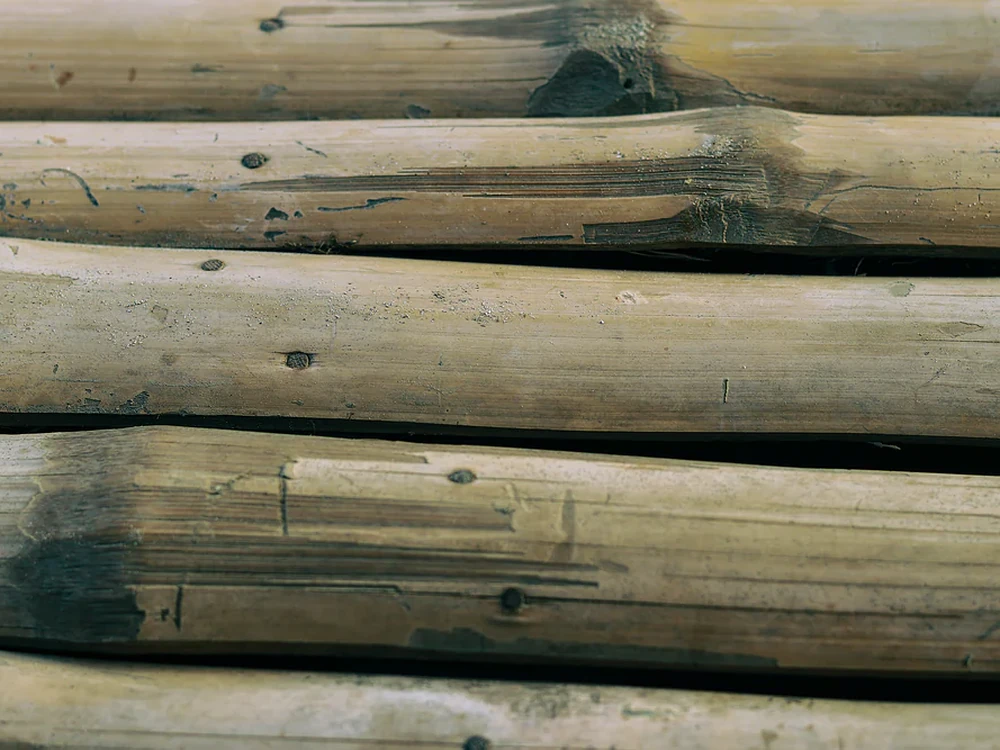
Bamboo
Phyllostachys edulis (Moso) · East Asia (engineered)
6,270 – 7,160 N
T/R 1.7
Suitable in the pressed strand-woven version
Class 1 indoors / Class 3 grooved outdoors
A grass hot-pressed with phenolic resins. Very good stability, and twice the hardness of oak in the strand-woven version. You need to check its formaldehyde emission (class E1 or E0) and use water-free adhesives.
▸ See the full physical and mechanical test data (13 parameters)
| Standardized density | 700–850 kg/m³ (Densified) |
|---|---|
| Chalais-Meudon hardness (Monnin) | 5.2 (Very hard in the pressed version) |
| Compression parallel to the grain | 68.0 MPa |
| Static bending (MOR) | 115.0 MPa |
| Modulus of elasticity (MOE) | 14.00 GPa |
| Radial / tangential shrinkage | Radial: 2.2% / Tangential: 3.8% |
| Total volumetric shrinkage | 6,5 % |
| Anisotropy coefficient (T/R) | 1.7 (Stable) |
| Natural durability (UNE-EN 350) | Class 1–2 (depending on resins and heat treatment) (15–25 years indoors / treated outdoors) |
| Underfloor heating (heating, UNE-EN 1264) | Suitable in the pressed strand-woven version |
| Underfloor cooling (summer heat-pump cooling) | Suitable with dew-point control (flow temperature ≥ 18 °C) |
| Specified adhesive (ISO 17178) | Elastic modified silane adhesive |
| Chemical surface treatment | Matte waterborne finish or water-repellent penetrating oil |
| Slip resistance (CTE DB-SUA) | Class 1 indoors / Class 3 grooved outdoors |
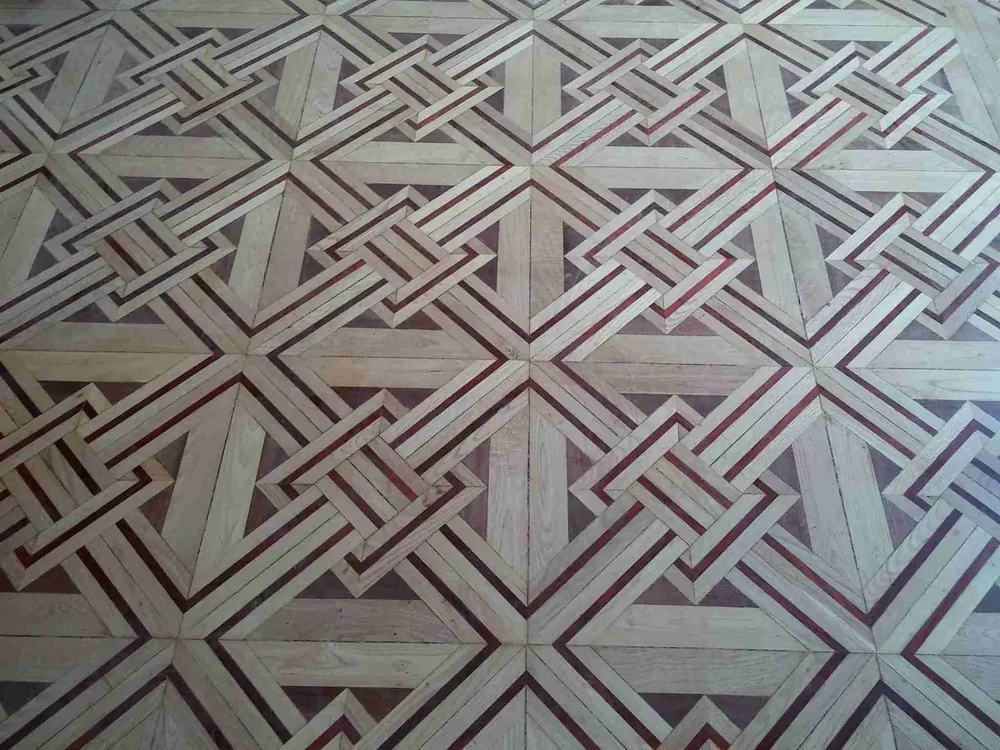
Chestnut
Castanea sativa · Iberian Peninsula and southern Europe
3,020 N
T/R 1.6
Suitable
Class 1
A native hardwood with a very warm look. Its low density combined with exceptional stability (T/R 1.6) makes it very good for underfloor heating. The tannins must be sealed to avoid black stains if it comes into contact with ferrous metals or water.
▸ See the full physical and mechanical test data (13 parameters)
| Standardized density | 590 kg/m³ |
|---|---|
| Chalais-Meudon hardness (Monnin) | 2.1 (Soft to medium-hard) |
| Compression parallel to the grain | 43.8 MPa |
| Static bending (MOR) | 71.4 MPa |
| Modulus of elasticity (MOE) | 8.61 GPa |
| Radial / tangential shrinkage | Radial: 4.2% / Tangential: 6.9% |
| Total volumetric shrinkage | 12,6 % |
| Anisotropy coefficient (T/R) | 1.6 (Very stable) |
| Natural durability (UNE-EN 350) | Class 2 (durable thanks to its high tannin content) (15–25 years outdoors / indefinite indoors) |
| Underfloor heating (heating, UNE-EN 1264) | Suitable (very good dimensional stability and conductivity) |
| Underfloor cooling (summer heat-pump cooling) | Suitable with dew-point control |
| Specified adhesive (ISO 17178) | One-component elastic silane (ISO 17178) |
| Chemical surface treatment | Tannin-blocking sealer + two-component (2K) waterborne finish |
| Slip resistance (CTE DB-SUA) | Class 1 (dry interiors) |
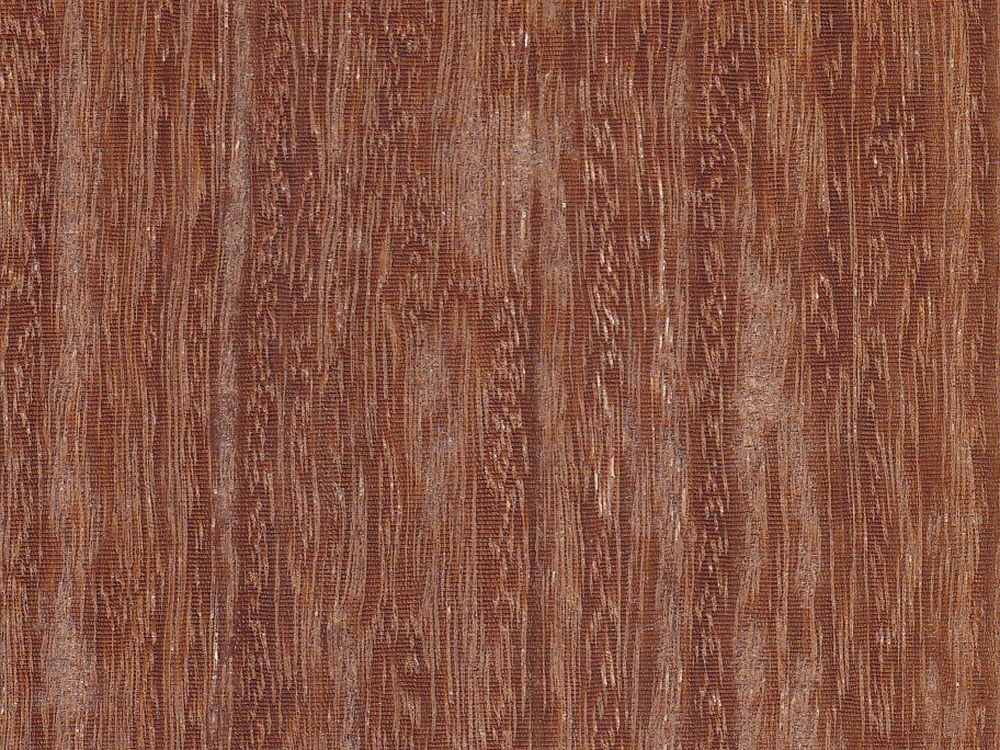
Cumaru
Dipteryx odorata · South America (Amazon basin)
14,800 N
T/R 1.5
Not advised
Class 3
A lower-cost alternative to ipe, and very hard. It has interlocked grain, so every stainless steel screw needs a pilot hole. It needs a finish of non-film-forming oils so the pores can breathe.
▸ See the full physical and mechanical test data (13 parameters)
| Standardized density | 1,070 kg/m³ |
|---|---|
| Chalais-Meudon hardness (Monnin) | 10.5 (Very high hardness) |
| Compression parallel to the grain | 84.0 MPa |
| Static bending (MOR) | 178.0 MPa |
| Modulus of elasticity (MOE) | 22.10 GPa |
| Radial / tangential shrinkage | Radial: 5.3% / Tangential: 7.7% |
| Total volumetric shrinkage | 13,4 % |
| Anisotropy coefficient (T/R) | 1.5 (Stable) |
| Natural durability (UNE-EN 350) | Class 1 (very durable against fungi and insects) (> 25–35 years in harsh outdoor exposure) |
| Underfloor heating (heating, UNE-EN 1264) | Not advised (density too high, R > 0.15 m²K/W) |
| Underfloor cooling (summer heat-pump cooling) | Not suitable |
| Specified adhesive (ISO 17178) | Two-component (2K) polyurethane or high-cohesion elastic silane |
| Chemical surface treatment | Teak oils or plant-based penetrating oils |
| Slip resistance (CTE DB-SUA) | Class 3 (outdoors / anti-slip grooved, UNE 41901) |
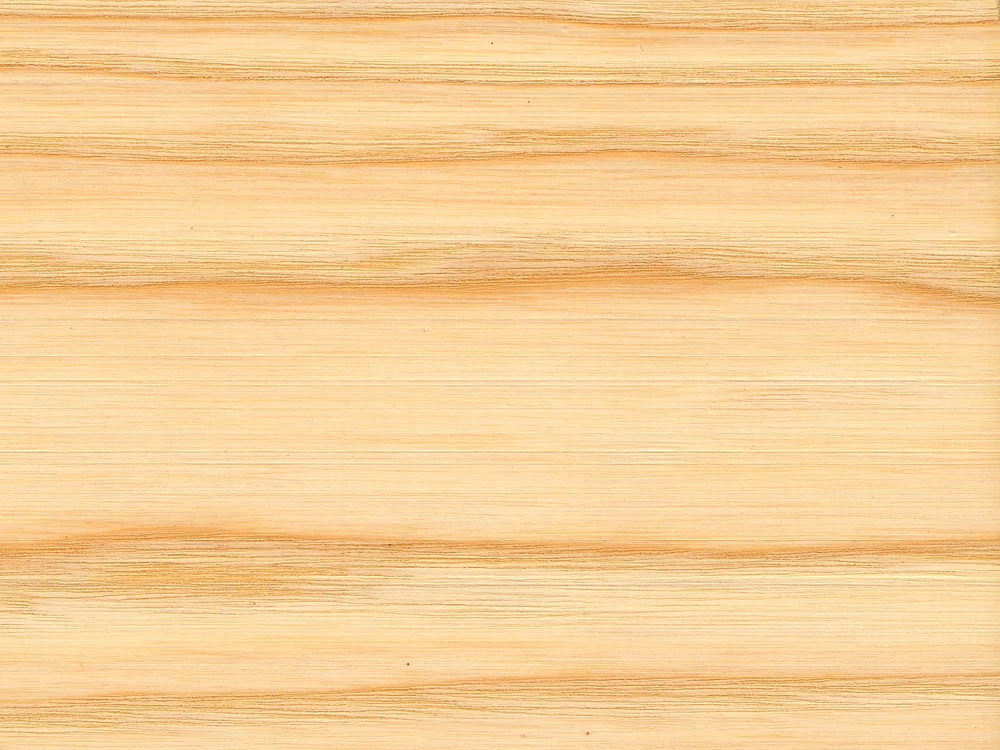
Ash
Fraxinus excelsior · Central and eastern Europe
5,870 N
T/R 1.8
Conditional
Class 1
A wood with very marked ring grain and high impact toughness (used on basketball courts). As solid flooring over underfloor heating it is unstable. As engineered flooring with a birch base it behaves reliably.
▸ See the full physical and mechanical test data (13 parameters)
| Standardized density | 680 kg/m³ |
|---|---|
| Chalais-Meudon hardness (Monnin) | 4.1 (Medium-hard) |
| Compression parallel to the grain | 51.0 MPa |
| Static bending (MOR) | 113.0 MPa |
| Modulus of elasticity (MOE) | 12.90 GPa |
| Radial / tangential shrinkage | Radial: 4.6% / Tangential: 8.2% |
| Total volumetric shrinkage | 13,6 % |
| Anisotropy coefficient (T/R) | 1.8 (Moderately prone to movement in solid form) |
| Natural durability (UNE-EN 350) | Class 5 (not durable outdoors) (< 5 years outdoors; indoor use only) |
| Underfloor heating (heating, UNE-EN 1264) | Conditional (engineered format only; not in solid form) |
| Underfloor cooling (summer heat-pump cooling) | Not advised |
| Specified adhesive (ISO 17178) | Rigid-elastic MS polymer |
| Chemical surface treatment | Waterborne finish with anti-yellowing blocker |
| Slip resistance (CTE DB-SUA) | Class 1 (dry interiors) |
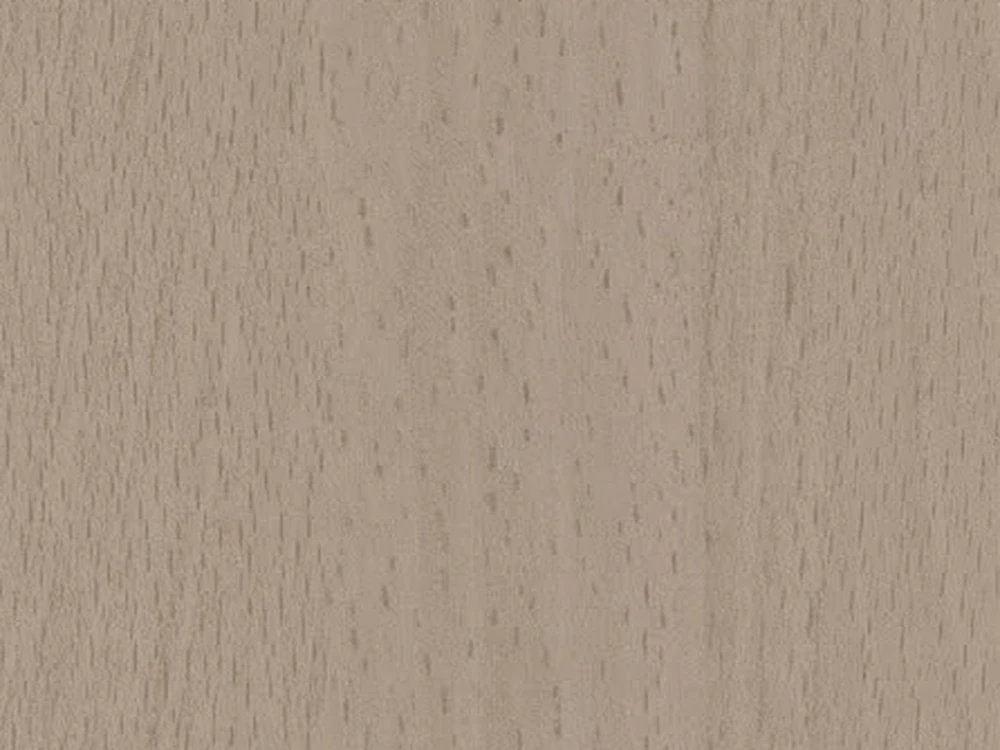
Beech
Fagus sylvatica · Central and northern Europe
5,780 N
T/R 2.0
Strongly advised against
Class 1
The textbook example of a wood unsuited to underfloor heating or to Madrid’s dry winter without humidification. Its tangential shrinkage coefficient of 11.8% causes severe shrinkage gaps with the heating on. It should only be installed as stabilized engineered flooring, with the indoor climate kept at RH 45–60%.
▸ See the full physical and mechanical test data (13 parameters)
| Standardized density | 710 kg/m³ |
|---|---|
| Chalais-Meudon hardness (Monnin) | 3.4 (Medium-hard) |
| Compression parallel to the grain | 58.0 MPa |
| Static bending (MOR) | 110.0 MPa |
| Modulus of elasticity (MOE) | 14.31 GPa |
| Radial / tangential shrinkage | Radial: 5.8% / Tangential: 11.8% |
| Total volumetric shrinkage | 17,9 % |
| Anisotropy coefficient (T/R) | 2.0 (Very prone to movement) |
| Natural durability (UNE-EN 350) | Class 5 (not durable against wood-boring insects and moisture) (< 5 years without fungicide treatment) |
| Underfloor heating (heating, UNE-EN 1264) | Strongly advised against (UNE 56810 / UNE-EN 1264) |
| Underfloor cooling (summer heat-pump cooling) | Not allowed (high risk of cell collapse) |
| Specified adhesive (ISO 17178) | Elastic silane; water-based adhesive not allowed |
| Chemical surface treatment | Waterborne polyurethane finish with UV protection |
| Slip resistance (CTE DB-SUA) | Class 1 (dry interiors) |
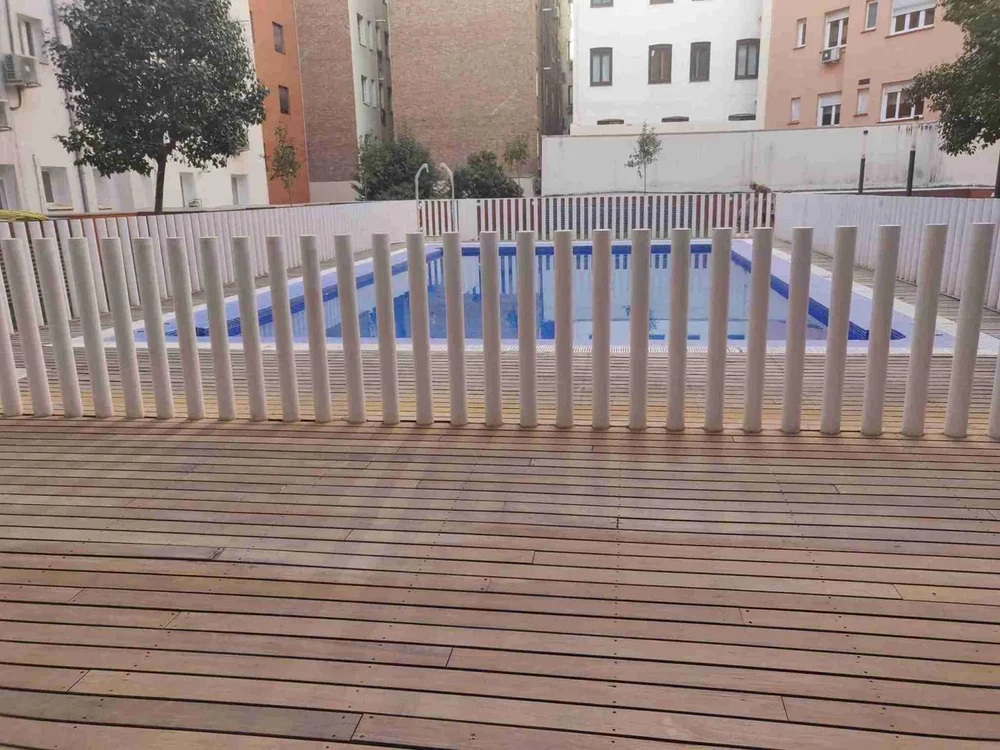
Ipe / Lapacho
Handroanthus serratifolius · Central and South America
16,370 N
T/R 1.5
Not advised in solid form
Class 3
The undisputed first choice for outdoor decking. Natural fire resistance class Bfl-s1. Its very high density is hard on cutting tools (it dulls carbide tips). It requires A4 stainless steel screws and one coat of oil a year under the Madrid sun.
▸ See the full physical and mechanical test data (13 parameters)
| Standardized density | 1,050 kg/m³ |
|---|---|
| Chalais-Meudon hardness (Monnin) | 12.0 (Very high hardness) |
| Compression parallel to the grain | 96.0 MPa |
| Static bending (MOR) | 175.0 MPa |
| Modulus of elasticity (MOE) | 22.00 GPa |
| Radial / tangential shrinkage | Radial: 5.1% / Tangential: 7.4% |
| Total volumetric shrinkage | 12,7 % |
| Anisotropy coefficient (T/R) | 1.5 (Stable) |
| Natural durability (UNE-EN 350) | Class 1 (immune to termites and rot) (> 40 years in harsh outdoor exposure) |
| Underfloor heating (heating, UNE-EN 1264) | Not advised in solid form (allowed in thin engineered flooring) |
| Underfloor cooling (summer heat-pump cooling) | Not suitable in solid form |
| Specified adhesive (ISO 17178) | Two-component (2K) polyurethane or hard-elastic MS silane |
| Chemical surface treatment | Open-pore penetrating oil (non-film-forming) |
| Slip resistance (CTE DB-SUA) | Class 3 (outdoors / pools, UNE 41901) |
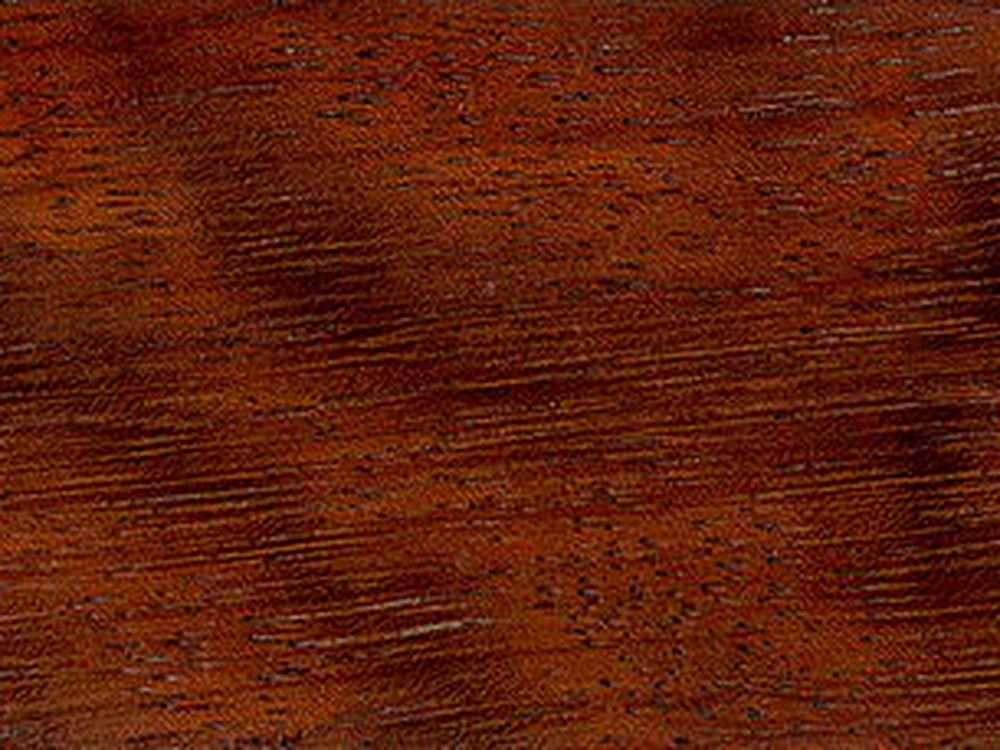
Iroko
Milicia excelsa · Tropical Africa (Ivory Coast, Cameroon)
5,600 N
T/R 1.5
Suitable
Class 1 indoors / Class 3 grooved outdoors
Known as ‘African teak’. Its very low volumetric shrinkage (9.4%) makes it one of the best options for underfloor heating and wet areas. Watch out for its natural chlorophorin: it can slow the drying of oil-modified finishes; it needs alcohol-based blocking sealers.
▸ See the full physical and mechanical test data (13 parameters)
| Standardized density | 650 kg/m³ |
|---|---|
| Chalais-Meudon hardness (Monnin) | 3.9 (Medium-hard) |
| Compression parallel to the grain | 54.0 MPa |
| Static bending (MOR) | 92.0 MPa |
| Modulus of elasticity (MOE) | 10.50 GPa |
| Radial / tangential shrinkage | Radial: 3.7% / Tangential: 5.6% |
| Total volumetric shrinkage | 9,4 % |
| Anisotropy coefficient (T/R) | 1.5 (Very stable) |
| Natural durability (UNE-EN 350) | Class 1–2 (very durable against fungi and insects) (25–35 years outdoors) |
| Underfloor heating (heating, UNE-EN 1264) | Suitable (very good dimensional stability, T/R 1.5) |
| Underfloor cooling (summer heat-pump cooling) | Suitable with dew-point control |
| Specified adhesive (ISO 17178) | One-component elastic silane (ISO 17178) |
| Chemical surface treatment | Degreasing sealer + polyurethane finish or oil |
| Slip resistance (CTE DB-SUA) | Class 1 indoors / Class 3 grooved outdoors |
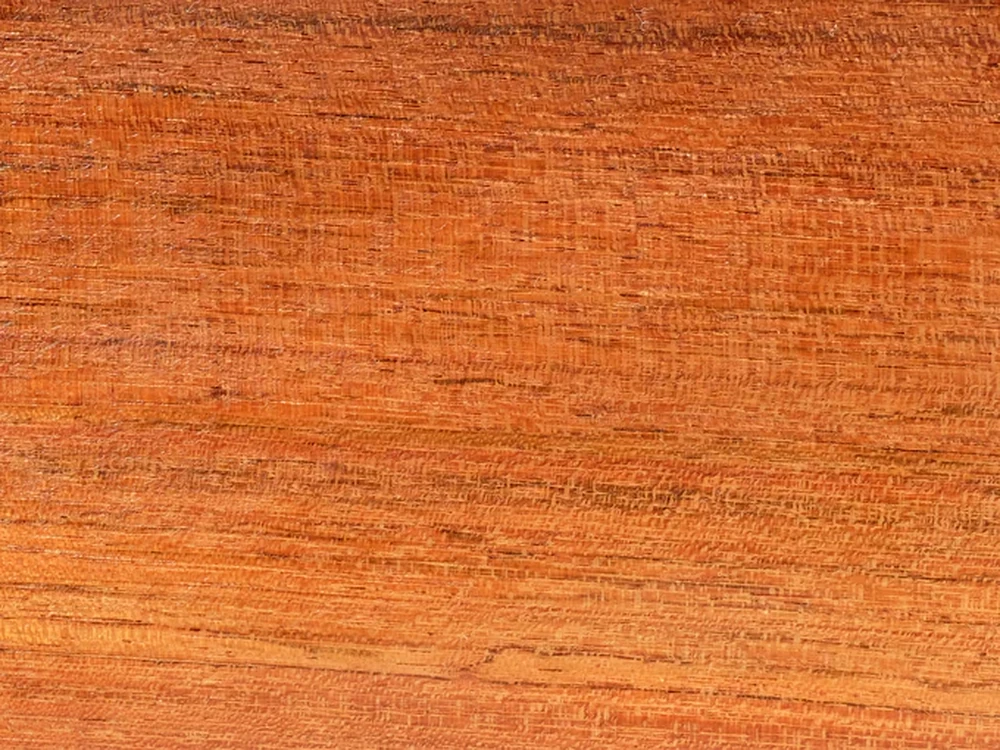
Jatoba
Hymenaea courbaril · Central and South America (Amazon)
11,960 N
T/R 1.9
Conditional
Class 1 indoors / Class 2 wet areas
A wood with a strong dark cherry tone that darkens in sunlight. It is twice as hard as oak, which makes it practically immune to heel marks. On underfloor heating its thermal resistance is high; it is specified as engineered flooring to offset its tendency to move.
▸ See the full physical and mechanical test data (13 parameters)
| Standardized density | 910 kg/m³ |
|---|---|
| Chalais-Meudon hardness (Monnin) | 8.5 (Very hard) |
| Compression parallel to the grain | 77.0 MPa |
| Static bending (MOR) | 154.0 MPa |
| Modulus of elasticity (MOE) | 17.10 GPa |
| Radial / tangential shrinkage | Radial: 4.5% / Tangential: 8.5% |
| Total volumetric shrinkage | 13,2 % |
| Anisotropy coefficient (T/R) | 1.9 (Moderately prone to movement) |
| Natural durability (UNE-EN 350) | Class 1–2 (very resistant to rot) (20–30 years in outdoor contact) |
| Underfloor heating (heating, UNE-EN 1264) | Conditional (thin engineered format only, ≤ 12 mm) |
| Underfloor cooling (summer heat-pump cooling) | Not recommended |
| Specified adhesive (ISO 17178) | Two-component (2K) polyurethane or hard-elastic silane |
| Chemical surface treatment | Heavy-traffic two-component (2K) waterborne polyurethane finish |
| Slip resistance (CTE DB-SUA) | Class 1 indoors / Class 2 wet areas |
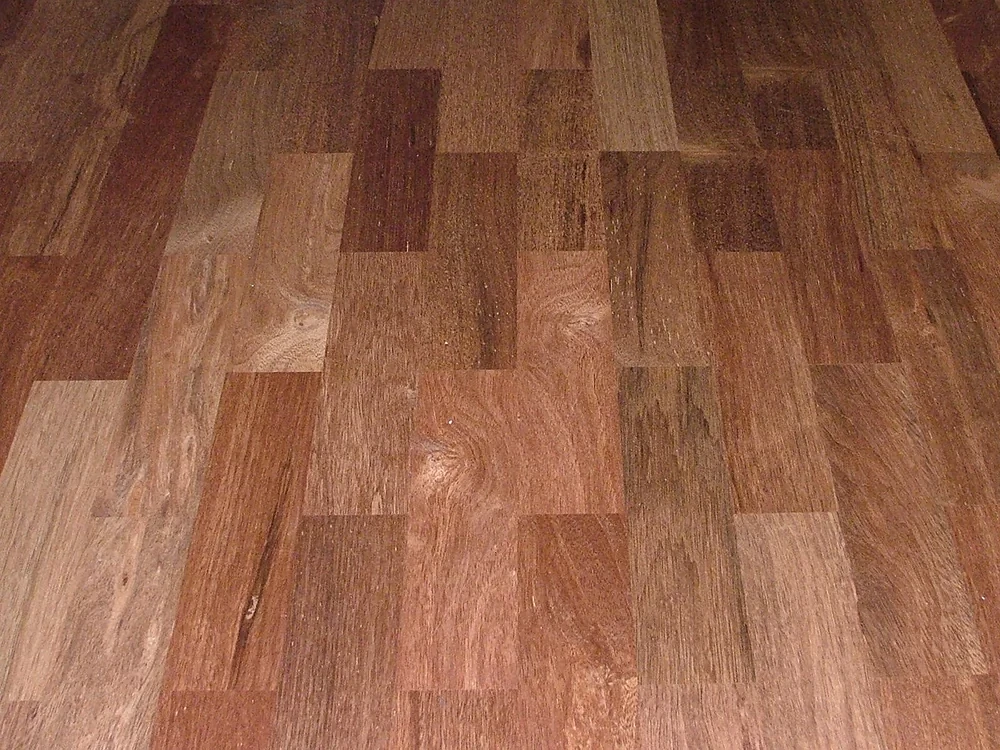
Merbau
Intsia bijuga · Southeast Asia and Oceania
7,600 N
T/R 1.7
Suitable
Class 1 indoors / Class 2 entrance areas
A golden-brown wood with unmistakable yellow flecks of ‘matezitol’. Its volumetric shrinkage is very low (7.8%) for its high density. That makes it reliable over underfloor heating.
▸ See the full physical and mechanical test data (13 parameters)
| Standardized density | 830 kg/m³ |
|---|---|
| Chalais-Meudon hardness (Monnin) | 6.3 (Hard) |
| Compression parallel to the grain | 73.0 MPa |
| Static bending (MOR) | 145.0 MPa |
| Modulus of elasticity (MOE) | 15.90 GPa |
| Radial / tangential shrinkage | Radial: 2.7% / Tangential: 4.6% |
| Total volumetric shrinkage | 7,8 % |
| Anisotropy coefficient (T/R) | 1.7 (Very stable) |
| Natural durability (UNE-EN 350) | Class 1–2 (very high biological resistance) (> 25 years outdoors) |
| Underfloor heating (heating, UNE-EN 1264) | Suitable (very stable dimensional behavior) |
| Underfloor cooling (summer heat-pump cooling) | Suitable with dew-point control |
| Specified adhesive (ISO 17178) | Elastic modified silane |
| Chemical surface treatment | Two-component (2K) waterborne finish or technical oil |
| Slip resistance (CTE DB-SUA) | Class 1 indoors / Class 2 entrance areas |
American Walnut
Juglans nigra · Eastern and central North America
4,490 N
T/R 1.4
Suitable
Class 1
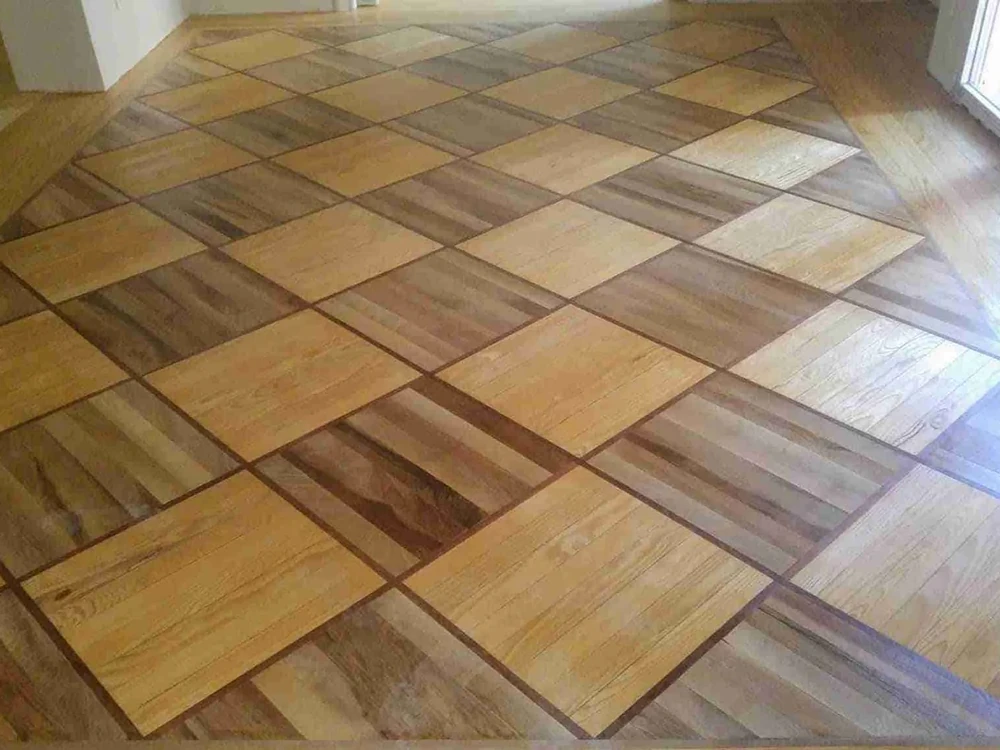
Valued for its coffee tones and soft, wavy grain. Its T/R ratio of 1.4 is among the best of any wood, which minimizes warping. Because it is softer than oak, it needs pads on furniture legs and shoes free of grit.
▸ See the full physical and mechanical test data (13 parameters)
| Standardized density | 610 kg/m³ |
|---|---|
| Chalais-Meudon hardness (Monnin) | 3.2 (Medium-hard) |
| Compression parallel to the grain | 52.0 MPa |
| Static bending (MOR) | 101.0 MPa |
| Modulus of elasticity (MOE) | 11.58 GPa |
| Radial / tangential shrinkage | Radial: 5.5% / Tangential: 7.8% |
| Total volumetric shrinkage | 12,8 % |
| Anisotropy coefficient (T/R) | 1.4 (Exceptionally stable) |
| Natural durability (UNE-EN 350) | Class 3 (moderately durable indoors) (indefinite in dry interiors; not suitable outdoors) |
| Underfloor heating (heating, UNE-EN 1264) | Suitable (very good thermal and dimensional balance) |
| Underfloor cooling (summer heat-pump cooling) | Suitable with strict humidity control |
| Specified adhesive (ISO 17178) | One-component elastic silane |
| Chemical surface treatment | Ultra-matte waterborne finish or natural hardwax oil |
| Slip resistance (CTE DB-SUA) | Class 1 (dry interiors) |
Olive
Olea europaea · Mediterranean basin
12,050 N
T/R 1.6
Conditional
Class 1
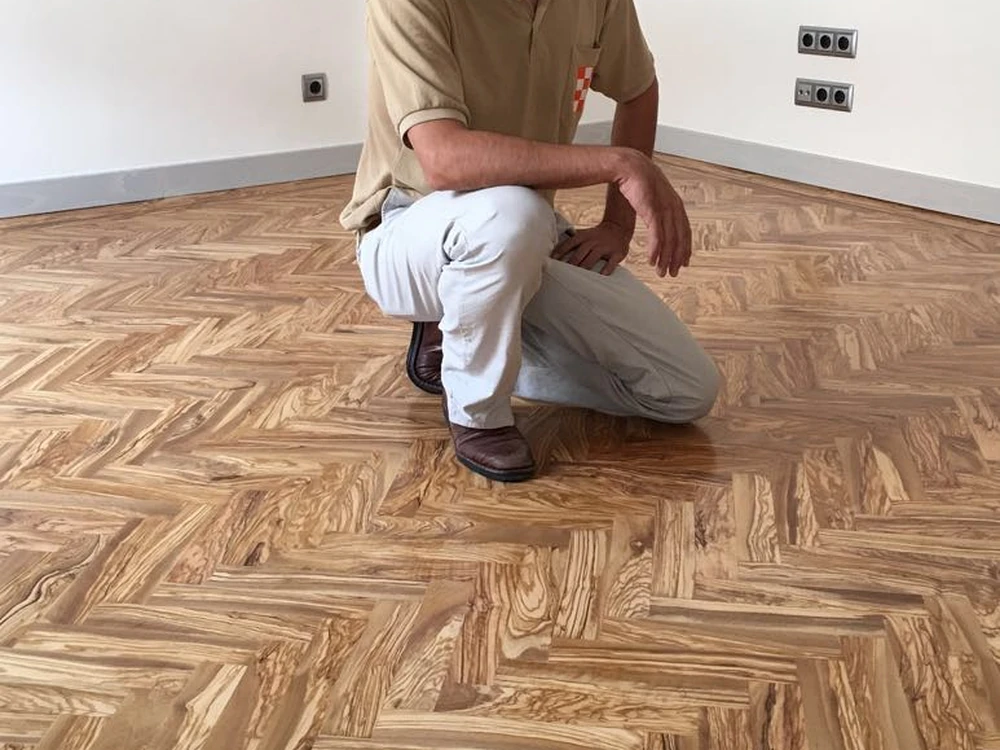
Swirling grain and characteristic contrasts between golden and dark brown tones. A dense, slow-growing wood. Its internal stresses mean it has to be machined into small formats (strip parquet (lamparquet) or marquetry). That avoids warping in long boards.
▸ See the full physical and mechanical test data (13 parameters)
| Standardized density | 900 kg/m³ |
|---|---|
| Chalais-Meudon hardness (Monnin) | 8.2 (Very hard) |
| Compression parallel to the grain | 62.0 MPa |
| Static bending (MOR) | 135.0 MPa |
| Modulus of elasticity (MOE) | 12.50 GPa |
| Radial / tangential shrinkage | Radial: 5.4% / Tangential: 8.8% |
| Total volumetric shrinkage | 14,4 % |
| Anisotropy coefficient (T/R) | 1.6 (Stable) |
| Natural durability (UNE-EN 350) | Class 1–2 (very durable against fungi) (> 20 years in solid indoor pieces) |
| Underfloor heating (heating, UNE-EN 1264) | Conditional (only as end-grain blocks or small format ≤ 10 mm) |
| Underfloor cooling (summer heat-pump cooling) | Not advised |
| Specified adhesive (ISO 17178) | Two-component (2K) polyurethane or high-bond elastic silane |
| Chemical surface treatment | Penetrating plant oil or deep-penetrating finish |
| Slip resistance (CTE DB-SUA) | Class 1 (dry interiors) |
Old Pitch Pine
Pinus palustris · Old-growth forests, resin-rich wood
3,900 N
T/R 1.5
Suitable with strict acclimation
Class 1
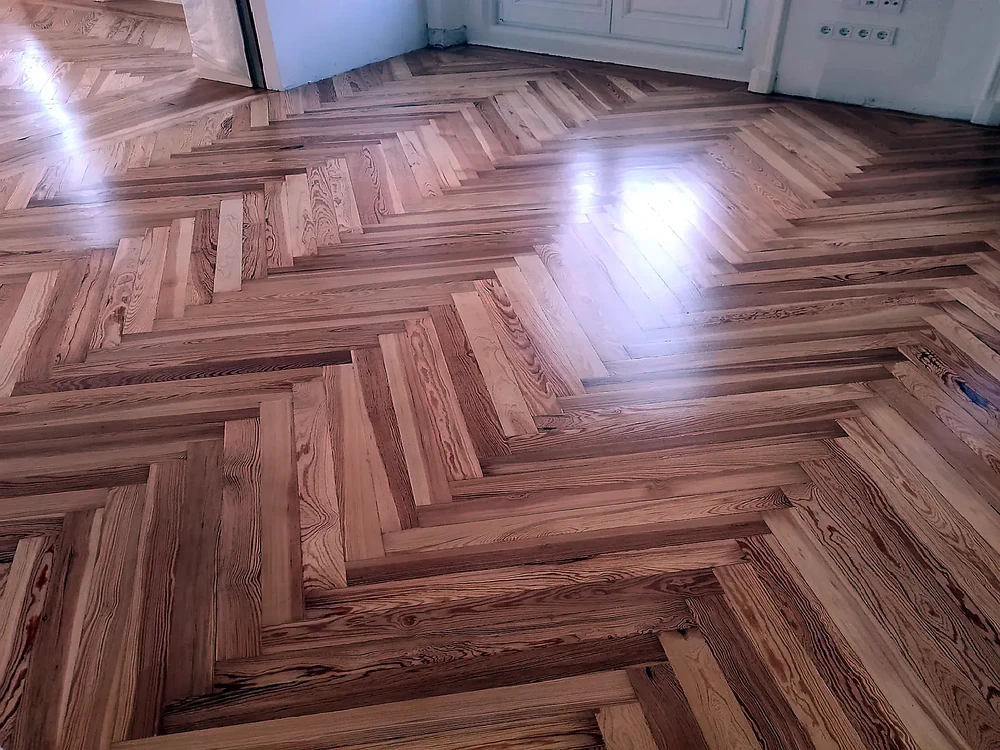
The historic floor of Madrid’s grand old apartments (Chamberí, Salamanca, Centro). Not to be confused with Galician pine or plantation Scots pine. Its reddish heartwood, saturated with turpentine, is very stable after a century of natural drying.
▸ See the full physical and mechanical test data (13 parameters)
| Standardized density | 650–750 kg/m³ (Heavy heartwood) |
|---|---|
| Chalais-Meudon hardness (Monnin) | 2.8 (Medium-hard from resin saturation) |
| Compression parallel to the grain | 48.0 MPa |
| Static bending (MOR) | 88.0 MPa |
| Modulus of elasticity (MOE) | 11.20 GPa |
| Radial / tangential shrinkage | Radial: 4.8% / Tangential: 7.2% |
| Total volumetric shrinkage | 12,2 % |
| Anisotropy coefficient (T/R) | 1.5 (Very stable) |
| Natural durability (UNE-EN 350) | Class 2 (very durable thanks to its resin content) (> 100 years documented in historic buildings) |
| Underfloor heating (heating, UNE-EN 1264) | Suitable with strict acclimation (thickness ≤ 15 mm) |
| Underfloor cooling (summer heat-pump cooling) | Suitable with condensation control |
| Specified adhesive (ISO 17178) | Elastic modified silane (ISO 17178) |
| Chemical surface treatment | Resin-blocking sealer + two-component (2K) waterborne finish |
| Slip resistance (CTE DB-SUA) | Class 1 (dry interiors) |
European Oak
Quercus robur / Quercus petraea · Europe (continental basins of Ukraine, Poland, France and Germany)
4,980 – 6,000 N
T/R 1.8
Suitable
Class 1
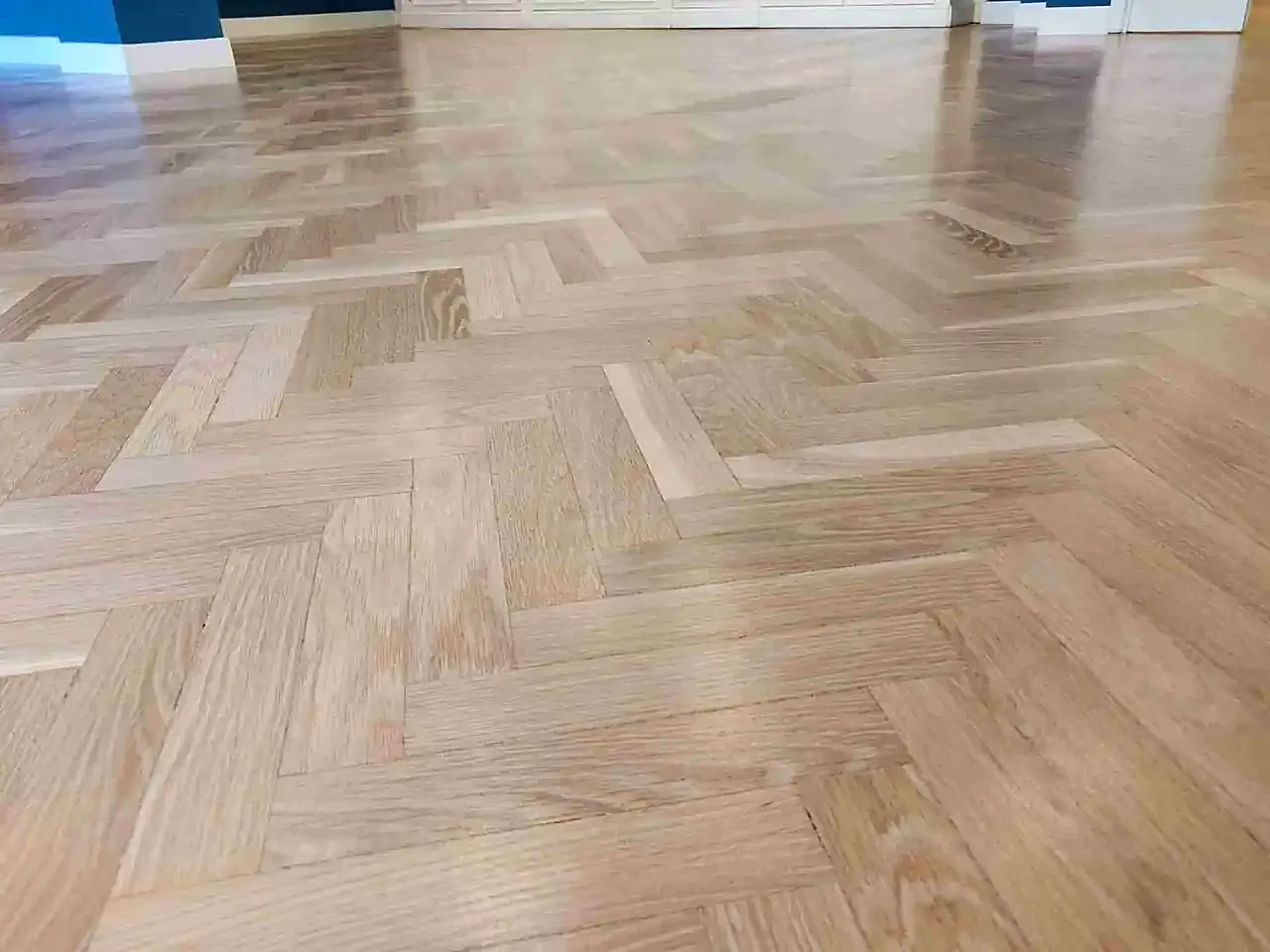
The reference wood in European architecture. It takes every finish (stained, whitewashed, fumed and brushed). In wide large-format boards, the most stable grades come from the continental basins of Ukraine and Eastern Europe. Long cold periods narrow the annual rings and reduce shrinkage from humidity changes. Its medullary rays, or ‘ray flecks’, in quarter-sawn boards are its botanical mark of authenticity. See our study on the quality and sourcing of continental Ukrainian oak.
▸ See the full physical and mechanical test data (13 parameters)
| Standardized density | 690 kg/m³ |
|---|---|
| Chalais-Meudon hardness (Monnin) | 3.7 (Medium-hard) |
| Compression parallel to the grain | 52.0 MPa |
| Static bending (MOR) | 107.0 MPa |
| Modulus of elasticity (MOE) | 12.30 GPa |
| Radial / tangential shrinkage | Radial: 4.3% / Tangential: 7.9% |
| Total volumetric shrinkage | 12,6 % |
| Anisotropy coefficient (T/R) | 1.8 (Stable) |
| Natural durability (UNE-EN 350) | Class 2–3 (heartwood durable, sapwood not durable) (20–30 years for heartwood / centuries indoors) |
| Underfloor heating (heating, UNE-EN 1264) | Suitable (the official test reference under UNE-EN 1264) |
| Underfloor cooling (summer heat-pump cooling) | Suitable (flow temperature ≥ 18 °C with dew-point sensor) |
| Specified adhesive (ISO 17178) | Elastic silane / MS polymer |
| Chemical surface treatment | Two-component (2K) waterborne polyurethane finish or natural hardwax oil |
| Slip resistance (CTE DB-SUA) | Class 1 (dry interiors) |
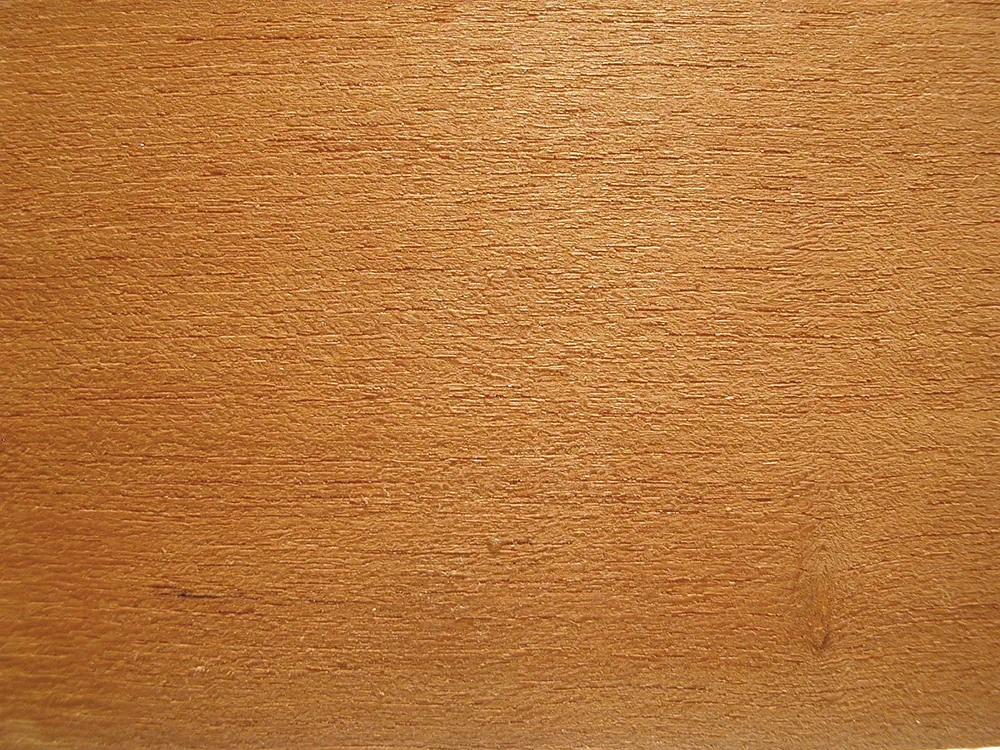
Teak
Tectona grandis · Southeast Asia (Burma, Thailand)
4,760 N
T/R 1.9
Suitable
Class 1 indoors / Class 3 grooved outdoors
The wood with the best reputation in the world for standing up to water. Its natural resins and oils protect it from rot and summer humidity. On underfloor heating and cooling it behaves without problems, as long as the surface tectoquinone is cleaned off before gluing.
▸ See the full physical and mechanical test data (13 parameters)
| Standardized density | 660 kg/m³ |
|---|---|
| Chalais-Meudon hardness (Monnin) | 3.5 (Medium-hard) |
| Compression parallel to the grain | 56.0 MPa |
| Static bending (MOR) | 97.0 MPa |
| Modulus of elasticity (MOE) | 11.10 GPa |
| Radial / tangential shrinkage | Radial: 2.5% / Tangential: 4.7% |
| Total volumetric shrinkage | 7,3 % |
| Anisotropy coefficient (T/R) | 1.9 (Exceptionally stable owing to low volumetric shrinkage) |
| Natural durability (UNE-EN 350) | Class 1 (immune to rot, termites and fungi) (> 40 years in extreme outdoor conditions) |
| Underfloor heating (heating, UNE-EN 1264) | Suitable (very good dimensional stability and conductivity) |
| Underfloor cooling (summer heat-pump cooling) | Suitable with condensation control |
| Specified adhesive (ISO 17178) | One-component elastic silane or two-component (2K) polyurethane |
| Chemical surface treatment | Natural teak oil or flexible marine varnish |
| Slip resistance (CTE DB-SUA) | Class 1 indoors / Class 3 grooved outdoors (UNE 41901) |
Comparison table of technical properties and physical suitability
The shrinkage, hardness and density values in this table sum up the reference tests for floors (UNE 56810) and species durability (UNE-EN 350). In Madrid’s climate, these figures decide three key trade questions: the exact perimeter expansion gap along walls to avoid buckling, whether the board will work over underfloor heating without winter shrinkage gaps, and how it stands up to daily traffic.
| Species | Density | Janka hardness | Stability (T/R) | Durability (EN 350) | Underfloor heating | Cooling mode | Best format / use |
|---|---|---|---|---|---|---|---|
| Fir Abies alba | 415 kg/m³ | 1.420 N | T/R 2.2 Cv: 12.8% | Class 4–5 | Conditional | Not recommended for summer cooling | Low-traffic rustic floors and engineered core layers |
| Maple Acer saccharum | 705 kg/m³ | 6.450 N | T/R 2.1 Cv: 14.7% | Class 5 | Not recommended in solid form | Not advised | Light contemporary interiors and high traffic |
| Bamboo Phyllostachys edulis (Moso) | 700–850 kg/m³ (Densified) | 6,270 – 7,160 N (densified strand-woven) | T/R 1.7 Cv: 6.5% | Class 1–2 | Suitable in the pressed strand-woven version | Suitable with dew-point control | Sustainable, very hard floors with an avant-garde design |
| Chestnut Castanea sativa | 590 kg/m³ | 3.020 N | T/R 1.6 Cv: 12.6% | Class 2 | Suitable | Suitable with dew-point control | Heritage restoration, mansions and warm homes |
| Cumaru Dipteryx odorata | 1,070 kg/m³ | 14.800 N | T/R 1.5 Cv: 13.4% | Class 1 | Not advised | Not suitable | High-impact terraces, pools and public areas |
| Ash Fraxinus excelsior | 680 kg/m³ | 5.870 N | T/R 1.8 Cv: 13.6% | Class 5 | Conditional | Not advised | Contemporary floors, sports floors and Nordic design |
| Beech Fagus sylvatica | 710 kg/m³ | 5.780 N | T/R 2.0 Cv: 17.9% | Class 5 | Strongly advised against | Not allowed | Scandinavian-design interiors and continuous floors |
| Ipe / Lapacho Handroanthus serratifolius | 1,050 kg/m³ | 16.370 N | T/R 1.5 Cv: 12.7% | Class 1 | Not advised in solid form | Not suitable in solid form | Demanding outdoor terraces, penthouses, pool edges and bathrooms |
| Iroko Milicia excelsa | 650 kg/m³ | 5.600 N | T/R 1.5 Cv: 9.4% | Class 1–2 | Suitable | Suitable with dew-point control | Underfloor heating, bathrooms, kitchens, terraces and boat joinery |
| Jatoba Hymenaea courbaril | 910 kg/m³ | 11.960 N | T/R 1.9 Cv: 13.2% | Class 1–2 | Conditional | Not recommended | Commercial areas, offices and formal reception rooms |
| Merbau Intsia bijuga | 830 kg/m³ | 7.600 N | T/R 1.7 Cv: 7.8% | Class 1–2 | Suitable | Suitable with dew-point control | Underfloor heating, commercial spaces and hotels |
| American Walnut Juglans nigra | 610 kg/m³ | 4.490 N | T/R 1.4 Cv: 12.8% | Class 3 | Suitable | Suitable with strict humidity control | High-end homes, large-format floating floors |
| Olive Olea europaea | 900 kg/m³ | 12.050 N | T/R 1.6 Cv: 14.4% | Class 1–2 | Conditional | Not advised | Mosaics, custom checkerboards and one-off floors |
| Old Pitch Pine Pinus palustris | 650–750 kg/m³ (Heavy heartwood) | 3,900 N (mature pitch pine) | T/R 1.5 Cv: 12.2% | Class 2 | Suitable with strict acclimation | Suitable with condensation control | Heritage restoration, Madrid mansions (PGOUM-97) |
| European Oak Quercus robur / Quercus petraea | 690 kg/m³ | 4.980 – 6.000 N | T/R 1.8 Cv: 12.6% | Class 2–3 | Suitable | Suitable | The worldwide reference standard for solid and engineered wood flooring |
| Teak Tectona grandis | 660 kg/m³ | 4.760 N | T/R 1.9 Cv: 7.3% | Class 1 | Suitable | Suitable with condensation control | Underfloor heating, bathrooms, spas, yacht decks and terraces |