
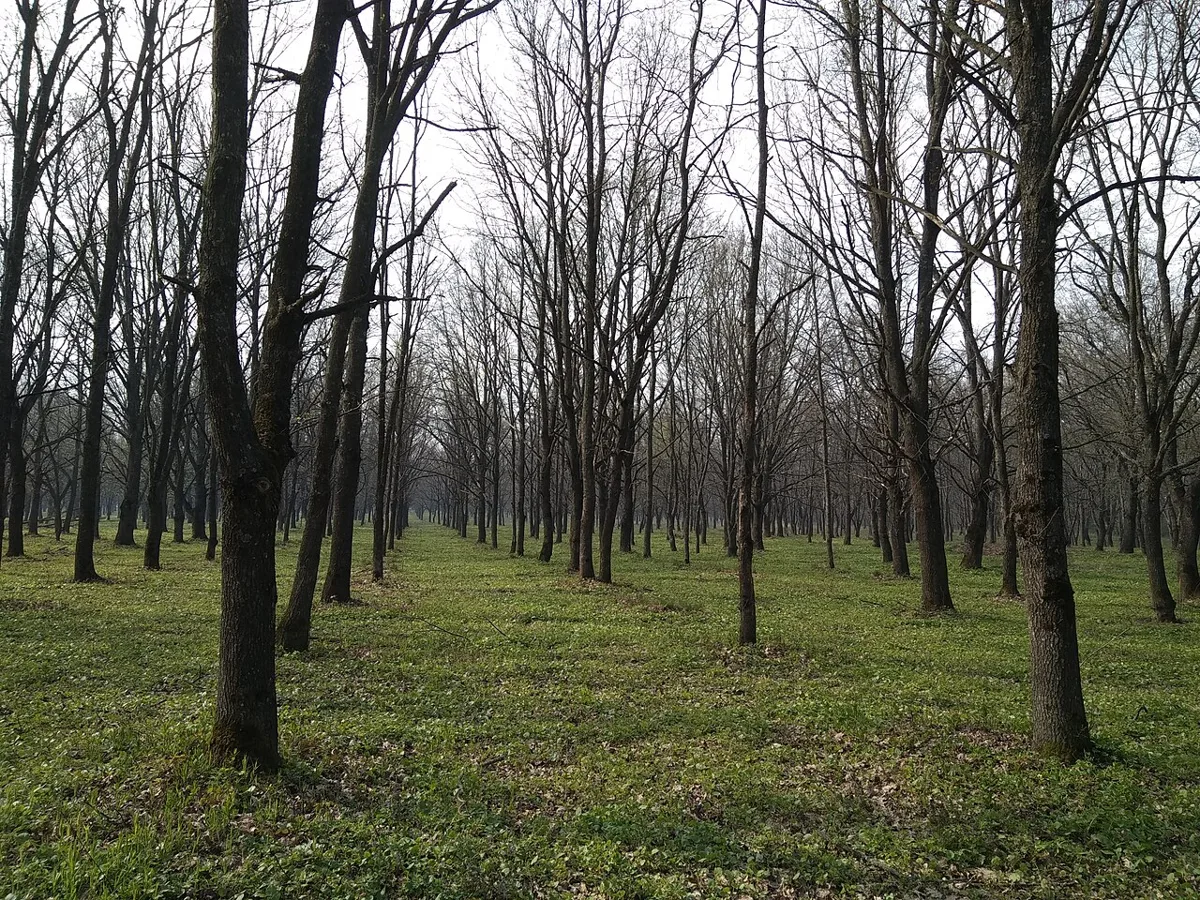
European oak (Quercus robur and Quercus petraea) is the most widely installed wood in hardwood floors in Madrid. In solid wood flooring and wide boards, how the wood behaves depends on the climate where the tree grew.
Much of the close-grained oak that reaches European sawmills comes from continental basins in Ukraine: Volyn, Polesia and the Carpathians. Long, cold winters slow the tree’s growth and produce very narrow annual rings. That pattern reduces shrinkage gaps when Madrid’s heating dries the indoor air to 20-30% relative humidity.
The Russian invasion of 2022 disrupted the felling, sawing and transport of these lots to European processing centers.
1. Wood structure and response to Madrid’s climate
The forest climate shapes the anatomy of the trunk and how it behaves on site.
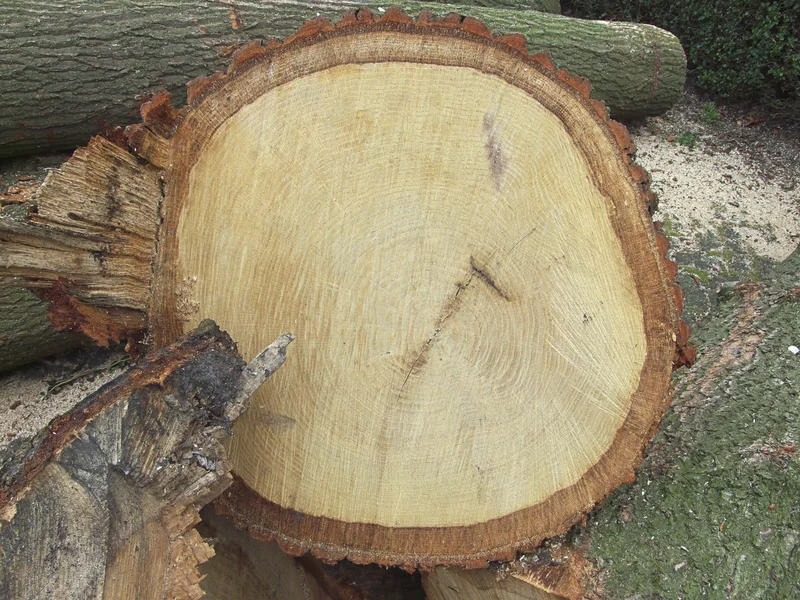
Growth rings and tight grain
In Volyn and Polesia, winter temperatures often drop from -15 °C to -25 °C. The growing season is cut down to a few months of spring and summer.
This slow pace produces narrow growth rings, usually between 8 and 12 rings per linear centimeter. Unlike fast-grown Atlantic oaks, the share of porous springwood is small. The density is even across the whole board.
Density and hardness (UNE-EN 1534)
At the reference moisture content of 12%, the density of continental oak ranges from 710 to 750 kg/m³. It is a medium-heavy, hard wood.
In Brinell hardness tests under UNE-EN 1534, it gives values between 3.7 and 3.9 HB (37 N/mm²). This density resists the static point load of furniture legs and the impact of heels in homes and commercial premises.
Hygroscopic shrinkage and acclimatization in Madrid (UNE 56810)
In Madrid, radiators and central heating lower indoor relative humidity to 20–30% in winter. The equilibrium moisture content (EMC) of the wood drops to 5–6%.
Exported oak arrives kiln-dried at 8 ± 2% moisture content. To absorb this moisture gradient without checks or open joints, the UNE 56810 standard requires acclimatizing the material on site before it is fixed down for good.
Continental oak has a low tangential coefficient (ct = 0.28%) and an anisotropy ratio of 1.7 (tangential / radial). Once stabilized in the room, its shrinkage is far lower than that of unstable species or fast-grown valley oaks.
Tannins and surface finish
The heartwood of continental oak builds up a high concentration of natural tannic acid. It gives Class 2 durability (under UNE-EN 350) against wood-boring insects and sets its golden tone.
In the workshop, tannic acid calls for chemical control: being water-soluble, it reacts with the water in waterborne dispersions, causing tannin bleed and dark stains. Applying a finish therefore requires a tannin-blocking primer coat before the 2K waterborne polyurethane, or the use of open-pore oils.
2. Legal traceability and European regulations
In Madrid, we select the wood through wholesale importers with their own warehouse and approved European sawmills.
Regulatory transition: from the EUTR to the EUDR Regulation
Every commercial lot of oak complies with European Union regulations:
- EUDR Regulation (EU Regulation 2023/1115): It will replace the EUTR (EU Regulation 995/2010) from 30 December 2026 for large companies (June 2027 for small ones). It adds the obligation to geolocate the felling plots by coordinates to certify deforestation-free timber.
- Chain of custody: FSC or PEFC certification from the forest to unloading at the workshop.
Ukraine’s state forestry company, «Ліси України», sells timber from its forests at auction and publishes its sales contracts, oak included, on its website.
European Union sanctions and the ban on Russian timber
The European Union bans imports of timber from Russia (EU Regulation 2022/576) and from Belarus (EU Regulation 2022/355). Documentary traceability rules out triangulation through third countries or conflict timber.
The authorized lots come from forests managed by Ukraine’s State Forest Resources Agency in the central and western provinces (Lviv, Rivne, Volyn, Zhytomyr, Zakarpattia). The European Union supports this legal trade to keep civilian jobs and the country’s economy going.
3. Extraction and sawing conditions in wartime
The war imposes technical and operational difficulties on Ukraine’s civilian forestry industry.
Safe plots and metal checks
Commercial felling takes place in the west and center of the country, far from the front. In northern areas that saw fighting in 2022, plots suspected of containing mines or munitions have been closed off by civil protection.
At the sawmill, logs go through metal detectors before they are cut up. This preventive check protects the band saws from shrapnel and ensures that the exported board is clean, sound timber.
Kilns running on diesel generators
Attacks on the civilian power grid cut supply to the sawmills. Drying kilns need continuous heat and ventilation for weeks to bring the moisture down without splitting the board.
The sawmills run on high-output diesel generators and biomass boilers. This fuel spending raises the cost of drying at source, but keeps the moisture content at the 8±2% required for export.
Labor and continuity
Some of the forestry workers have been mobilized. Felling, sawing and grading are taken on by veteran workers, civilian mechanics and women on the cutting lines.
Sawmill activity supports jobs in dozens of rural towns and secures legitimate income for families.
Overland transport to the European border
With the Black Sea ports closed to timber, all freight to the European Union leaves by road and cross-border rail.
Trucks cross at the border points with Poland (Dorohusk, Korczowa), Slovakia and Hungary. Customs backups mean waits of days for the haulers, so orders in Madrid have to be placed earlier.
4. Technical criteria and installation in Madrid
At ParkSinta we check the traceability and moisture content of every lot of oak before it goes to the site. Tight-grained continental timber needs its acclimatization time in the Madrid home to be respected.
The work on site is carried out with workshop technique: clean layouts, cutting without waste and sealer coats that keep the floor durable for decades.

Photo sources
- Oak stand in a Ukrainian state forest (Sunkivske, Cherkasy): Maxim Gavrilyuk, Wikimedia Commons, CC BY-SA 4.0.
- Cross-section of an oak trunk showing growth rings: Rasbak, Wikimedia Commons, CC BY-SA 3.0.
- 22 mm solid Ukrainian oak flooring glued with silane at the Palacio de Buenavista (Madrid): ParkSinta technical archive.
Hardwood Oak Flooring and Designer Parquet in Madrid
At ParkSinta we select tight-grained continental oak for solid wood flooring and wide-board installations in Madrid, with technical preparation of the screed and workshop moisture control.