

Sanding a parquet floor for a waterborne finish is similar to the work for a solvent-based finish, but finer: it takes more passes of sandpaper. We explain it with a specific job, an office finished with Bona Mega, and with the full process, from rough sanding to drying.
What we are asked most is how much dust is raised and how long you have to wait before walking on the floor again. With the room empty and vacuuming between passes, no cloud of sawdust forms, and the last coat of finish can be walked on after 12–24 hours.
The job: an office finished with Bona Mega
In an office where five people worked, we sanded the parquet and finished it with Bona Mega, a one-component waterborne finish. The client hesitated between that and Bona Traffic, which is harder, but with so few people we did not see the need for that extra hardness.
The right finish is not always the hardest one, but the one the real use of the space calls for: for an office with moderate use, Bona Mega was enough. We work with two-component (2K) waterborne finish, with one-component (1K) finish and with oils, and how they compare in hardness is in the most durable finish for parquet and wood flooring.
On that job we also used the Bona buffer. It is a machine that allows finer work on cross-grain floors, such as mosaic parquet, herringbone or boards laid in hallways.
Why waterborne finish calls for finer sanding
Waterborne finish shows the preparation underneath more clearly. If the sanding is poorly done, marks, changes in tone, halos or differences in sheen appear.
That is why it takes more passes of sandpaper than the work for a solvent-based finish. The edges are finished off, the hard-to-reach areas are evened out and the wood is ready before finishing. The work is a little slower, but the result is cleaner and more stable.
Where this care shows most:
- Mosaic parquet.
- Herringbone parquet.
- Boards laid in hallways.
- Floors where the grain changes direction.
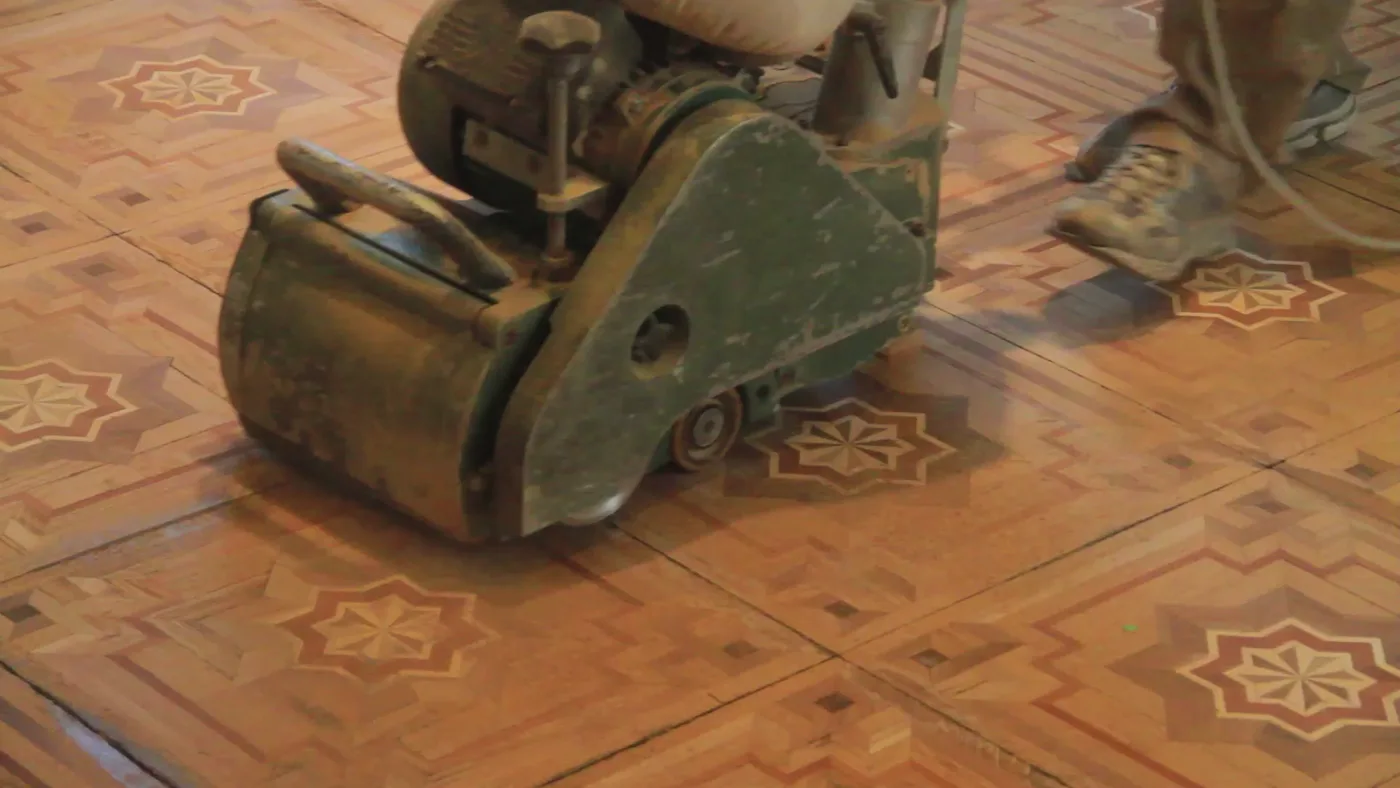
The photo shows a checkerboard strip parquet floor just after sanding, a cross-grain floor. Each group of strips has its grain running in a different direction from the one next to it. It is the kind of floor where sanding for a waterborne finish calls for the most care.

Preparation and initial rough sanding: leveling and removing the old finish
The first stage consists of checking the floor to set any protruding nails and remove leftover adhesive or stuck-on dirt. Then the main sander goes in with coarse grit, chosen according to the thickness of the old finish. The passes run diagonally to the grain to correct the height differences between boards without opening deep scratches.
The room being sanded is emptied completely: we do not sand with the furniture inside. The sanders have built-in dust extraction, and a cyclonic vacuum is run between one pass and the next. That way no cloud of sawdust forms, although some fine dust settles on shelves and frames; we explain it in dustless parquet sanding.
Intermediate sanding, perimeter edging and joint filling
Once the surface is level, we switch to finer grits to refine the surface and remove the marks of the rough sanding. Along the perimeter and in the corners we work with the edger and the steel scraper, until the edge is as flat as the center. It is handwork: you have to reach the baseboard without knocking it or leaving marks in the wood.
Next the joints are filled with resins made for parquet, from Bona or Deva. The filler is spread with a spatula to close the fine joints and shrinkage gaps in the boards before the fine sanding.
Buffing with a single-disc machine and coats of finish
Before finishing, the single-disc machine is run with a screen to leave the wood smooth to the touch, and the whole room is cleaned thoroughly. If the system calls for it, the first coat is a waterborne primer, which evens out the absorption of the wood and takes about 2 hours to dry.
The finish is three coats or more, applied with a roller. Between one intermediate coat and the next at least 4 to 5 hours go by, more if it needs buffing again. The 2K waterborne finishes we apply carry the EMICODE EC1 Plus label and have little odor.
The stages of sanding, one by one
Each stage prepares the next: skipping an intermediate grit or forcing the machine shows later in the finish. The table gives each stage with its machine and what it is for.
| Stage | Machine or tool | What for |
|---|---|---|
| Rough sanding | Main sander with built-in dust extraction and coarse grit | Remove the old finish and the lips between boards |
| Edging | Edger and steel scraper | Even out corners and edges along the baseboards |
| Filling | Spatula and resin made for parquet (Bona or Deva) | Close fine joints and shrinkage gaps |
| Fine sanding | Sander with finer grits and a cyclonic vacuum between passes | Remove the marks of the rough sanding |
| Refining | Single-disc machine with screen; on cross-grain floors, buffer | Leave the wood smooth and ready for the finish |
| Finishing | Roller | Primer if the system calls for it and a finish of 3 coats or more |
Drying and getting back to using the home
Waterborne finish is dry to the touch in a few hours, but takes days to harden fully. The Aquadeva Transit Plus data sheet gives 8 to 10 days for maximum hardness. After the last coat you have to wait 12 to 24 hours to walk on it.
Ventilate, but without strong drafts that bring street dust onto the fresh finish. For the rest, the Bona and Deva data sheets give these times:
- Walking in socks: once the last coat can be walked on, 12 to 24 hours later, and not in street shoes.
- Heavy furniture, after 3 days: the Bona data sheet asks for that period without heavy objects; after that they go back in with felt pads on the legs.
- Rugs, later: at least 3 days according to Bona and a week according to Deva.
- No wet mopping: two weeks according to the Deva data sheet; in the meantime, a dry microfiber mop.
Frequently asked questions
How long does it take to sand and finish an apartment in Madrid?
From 2 to 5 days for 40–90 m², depending on the level of restoration and the condition of the floor. That time includes the rough sanding, the edging, the joint filling and the coats of finish, which are three or more.
How long does it take to dry between coats and after the last coat?
It depends on the coat: the primer, about 2 hours; between finish coats, at least 4 or 5 hours; the last one, 12 to 24 hours until it can be walked on. The finish is 3 coats or more, and more time is left between an intermediate coat and the next if it needs buffing again. Full curing depends on the product, the weather and its technical data sheet.
Is it safe to stay in the house while the waterborne finish is applied?
Yes. Waterborne finish has little odor, and the 2K finishes we apply carry the EMICODE EC1 Plus label, which requires solvent-free, very low-emission products. The room being finished is empty and is not walked on until the last coat dries, 12 to 24 hours; while it is applied, ventilate.
What is the difference between a one-component and a two-component finish?
Two-component (2K) finish is mixed with a hardener just before applying and stands up better to abrasion and chemicals; one-component (1K) comes ready to use. We work with both and with oils, depending on the use: for the office in this article, Bona Mega, a one-component finish, was enough.
Does waterborne finish change the color of the wood or yellow it over time?
It does not yellow: Deva lists its Aquadeva Transit Plus as a non-yellowing product, and Bona says its finishes do not change color with light. What does change is the tone when it is applied: waterborne finish usually makes the floor lighter than the old finishes did. And the wood, under any finish, keeps changing color with light.
Technical restoration and dustless sanding in Madrid
Before giving a quote we look at the floor and the use it will have, and with that we choose the sanding and the finish. We have been applying waterborne finishes since 1999, with Bona.