
The Palacio de Zurbano (Zurbano Palace), also known as the town house of the Count of Muguiro and the palace of the Marquis of Casa Riera, stands at Calle de Zurbano 7, in Madrid’s Chamberí district. According to the book and the 2018 leaflet, it belongs to the Ministerio de Fomento (Spanish Ministry of Public Works). The Comunidad de Madrid book “Palacios de Madrid” covers it on pp. 334-337.
The photos on this page are ParkSinta’s; we have worked on the marquetry floor of the ballroom. The official sources consulted tell the history of the building and do not describe its floors. This page is part of our guide to parquet in the palaces of Madrid.

The marquetry floor of the ballroom
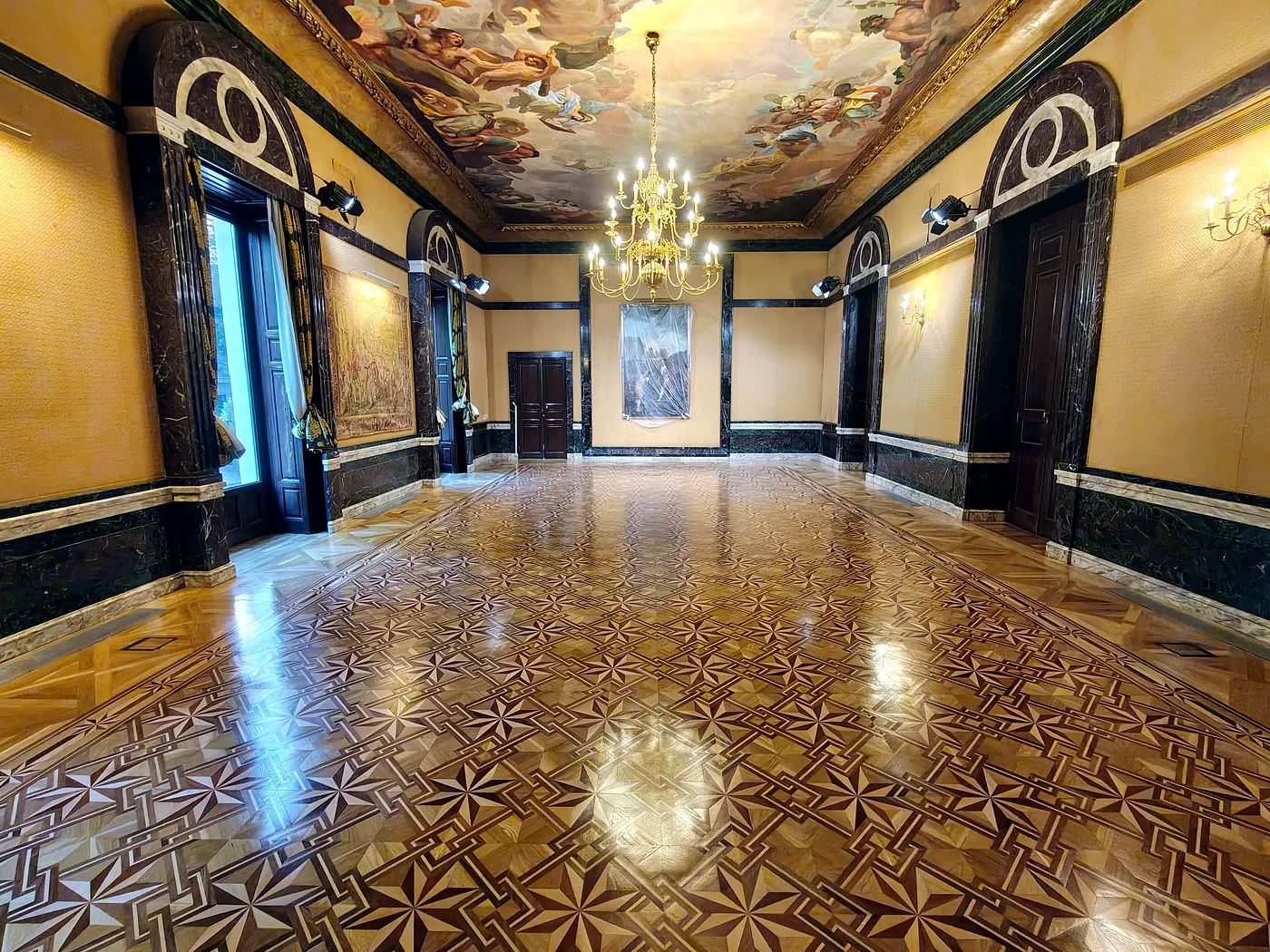
The header photo shows the ballroom, with a painted ceiling, dark marble wainscots and a marquetry floor that fills the center of the room, framed by a border of plain parquet. The pattern repeats eight-pointed stars on a grid of interlaced bands, with a border running around the edge.
The ballroom belongs to Eladio Laredo’s enlargement for the Marquis of Casa Riera, not to the 1878–1881 building. The book dates it to 1920 and the Comunidad de Madrid leaflet to the second decade of the 20th century, and neither describes the ballroom floor.
The pattern of stars and bands, up close
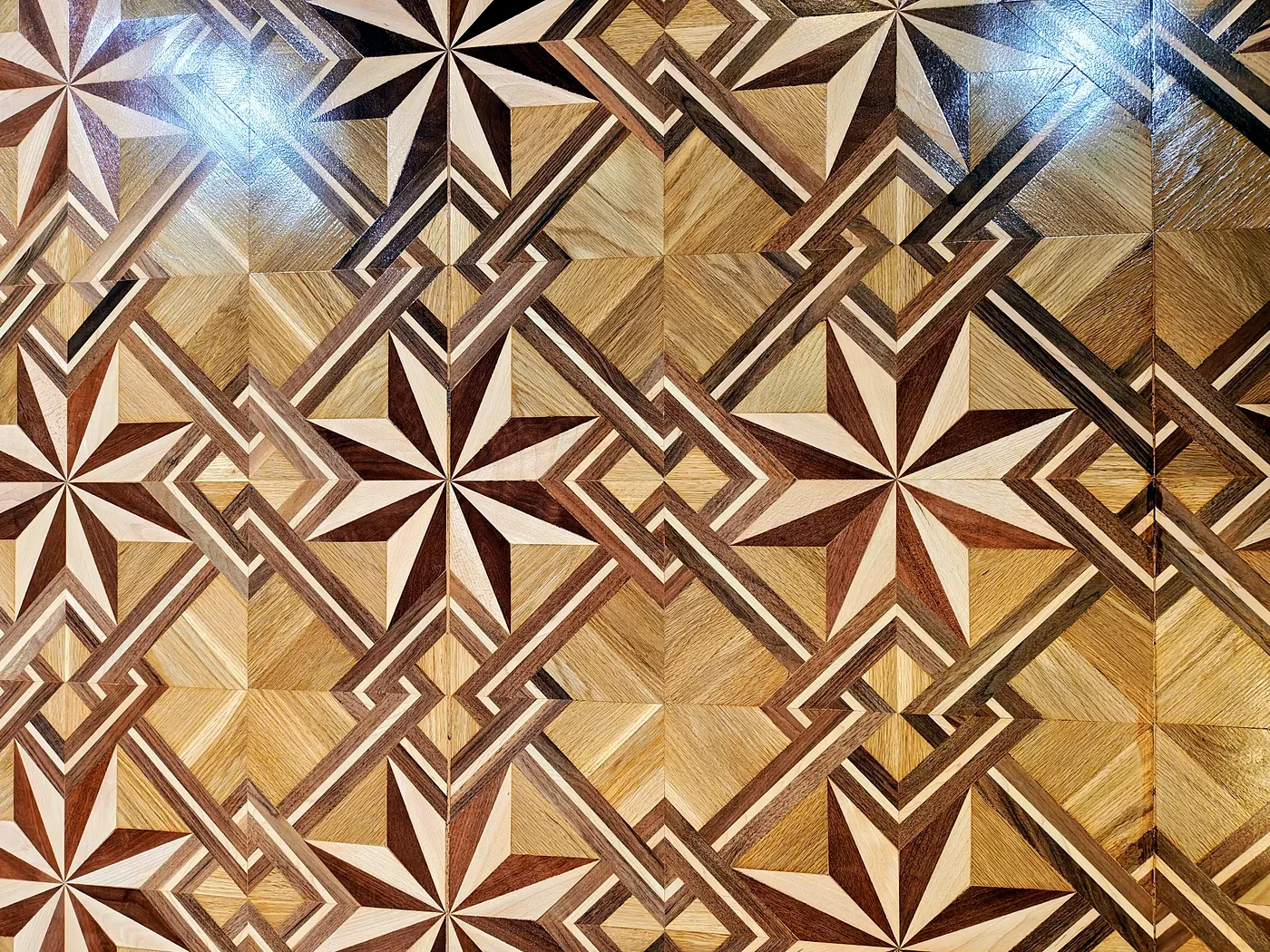
In the detail you can make out the eight-pointed stars, made of pieces in several wood tones, and the interlaced bands around them, edged with light fillets. Between stars and bands, the background fields are squares set on the diagonal and split into four triangles. None of the official sources consulted says which woods these are or when the floor was laid.
From the Count of Muguiro’s town house to the Casa Riera palace
Fermín de Muguiro, Count of Muguiro, commissioned the building from Severiano Sainz de la Lastra, and it was built between 1878 and 1881. Arturo Mélida did the interior decoration and the garden (book, pp. 334-335; 2018 leaflet “¡Bienvenidos a palacio!”).
In 1920 the count’s descendants sold the house to Gonzalo de Mora, Marquis of Casa Riera, who asked Eladio Laredo to enlarge it. The work doubled the floor area, removed the carriage houses and part of the garden, and added new rooms: the ballroom, the library and the state dining room. Mélida’s wall decoration in the original rooms was covered over (pp. 334-335).
From the sale to the Ministry to the 1995–1996 restoration
In 1986 the Mora family sold the building to the Ministerio de Obras Públicas y Urbanismo (Ministry of Public Works and Urban Planning). Between 1995 and 1996 a thorough rehabilitation and restoration installed the Centro de Estudios Históricos de Obras Públicas y Urbanismo (Center for Historical Studies of Public Works and Urban Planning) in part of the palace. The rest was used by the Ministerio de Fomento for official functions, according to the book (pp. 336-337).
The restoration recovered Mélida’s covered paintings, among them those in the Salón de los Continentes, the Salón de las Abejas and the Salón de la Rotonda (pp. 336-337). The book does not say what was done with the floors.
Facts about the building and its floor
- Building: Palacio de Zurbano, formerly the town house of the Count of Muguiro and palace of the Marquis of Casa Riera (owned by the Ministerio de Fomento, according to the book and the 2018 leaflet).
- Location: Calle de Zurbano 7 according to the 2018 leaflet (the book gives 5 and 7, with a side on Calle Fernando el Santo 6), Chamberí district (Madrid).
- First phase: 1878–1881: Severiano Sainz de la Lastra for the Count of Muguiro; interior decoration and garden by Arturo Mélida.
- Second phase: Second decade of the 20th century (the book says 1920): enlargement by Eladio Laredo for the Marquis of Casa Riera, with new rooms, among them the ballroom.
- Current use: According to the book and the 2018 leaflet, home of the Centro de Estudios Históricos de Obras Públicas y Urbanismo and a venue for official functions of the Ministerio de Fomento; restored in 1995–1996.
- Floor in the photos: Marquetry of eight-pointed stars on a grid of interlaced bands, in the ballroom, in several wood tones; the official sources do not describe it.
- Photo credits: ParkSinta archive.
This monograph is part of our technical guide to historic floors in the palaces of Madrid.