
The Palacio de Santoña, also called the palace of the Marquis of Ugena or of the Marquis of Manzanedo, stands at Calle de las Huertas 13, on the corner of Calle del Príncipe, in Madrid, according to the Comunidad de Madrid fact sheet. The Comunidad de Madrid book “Palacios de Madrid” gives the address as Príncipe 28, on the corner of Huertas 3, and says it has belonged to the Cámara de Comercio e Industria de Madrid (Madrid Chamber of Commerce and Industry) since 1933 (p. 168).
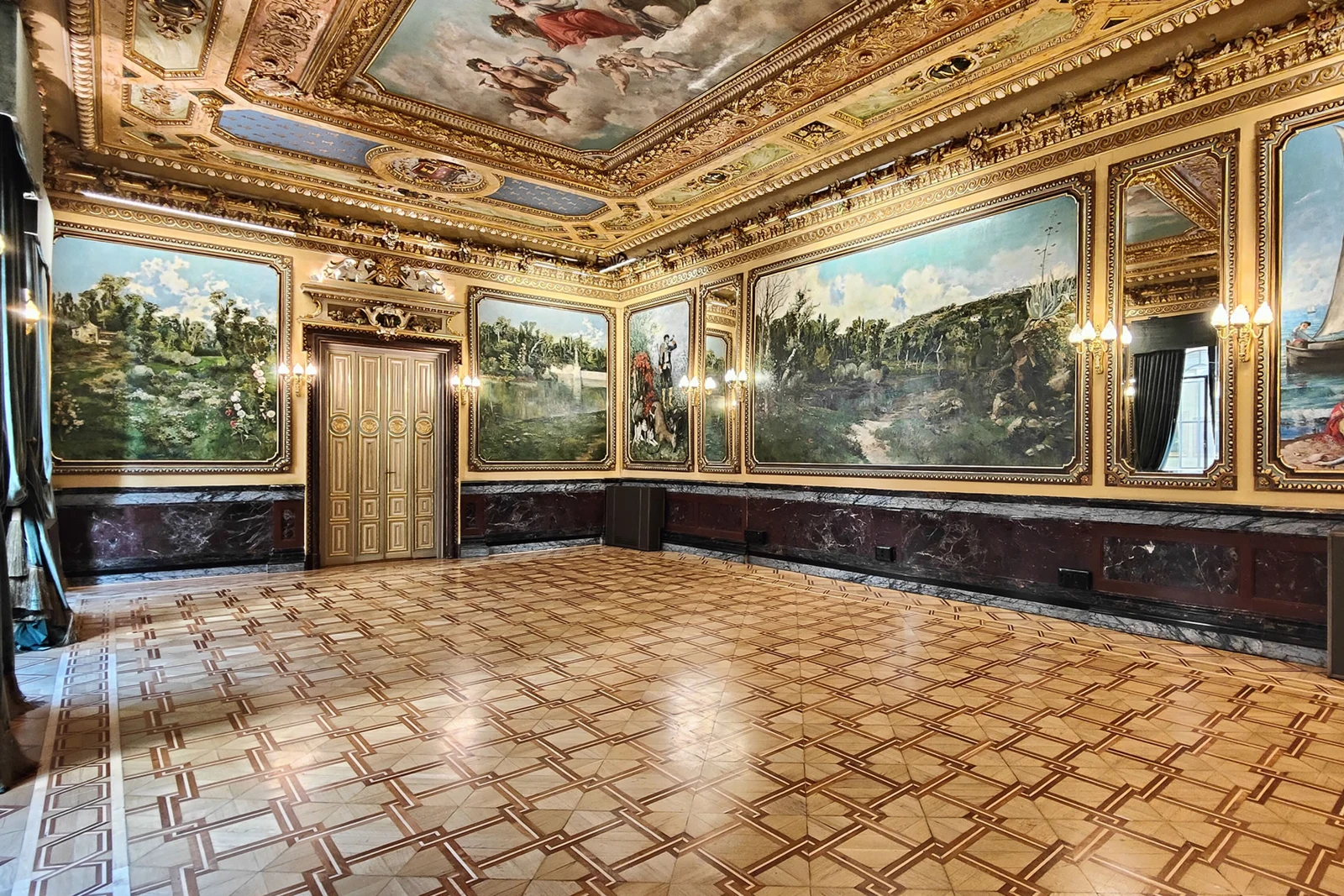
The State Dining Room has a paneled wood floor with fillets and a border, which can be seen almost whole in the first photo. The sources consulted describe the room by its paintings and say nothing about its floor. This page gathers what they say about the building and what can be seen, and is part of our guide to parquet in the palaces of Madrid.

The floor of the State Dining Room
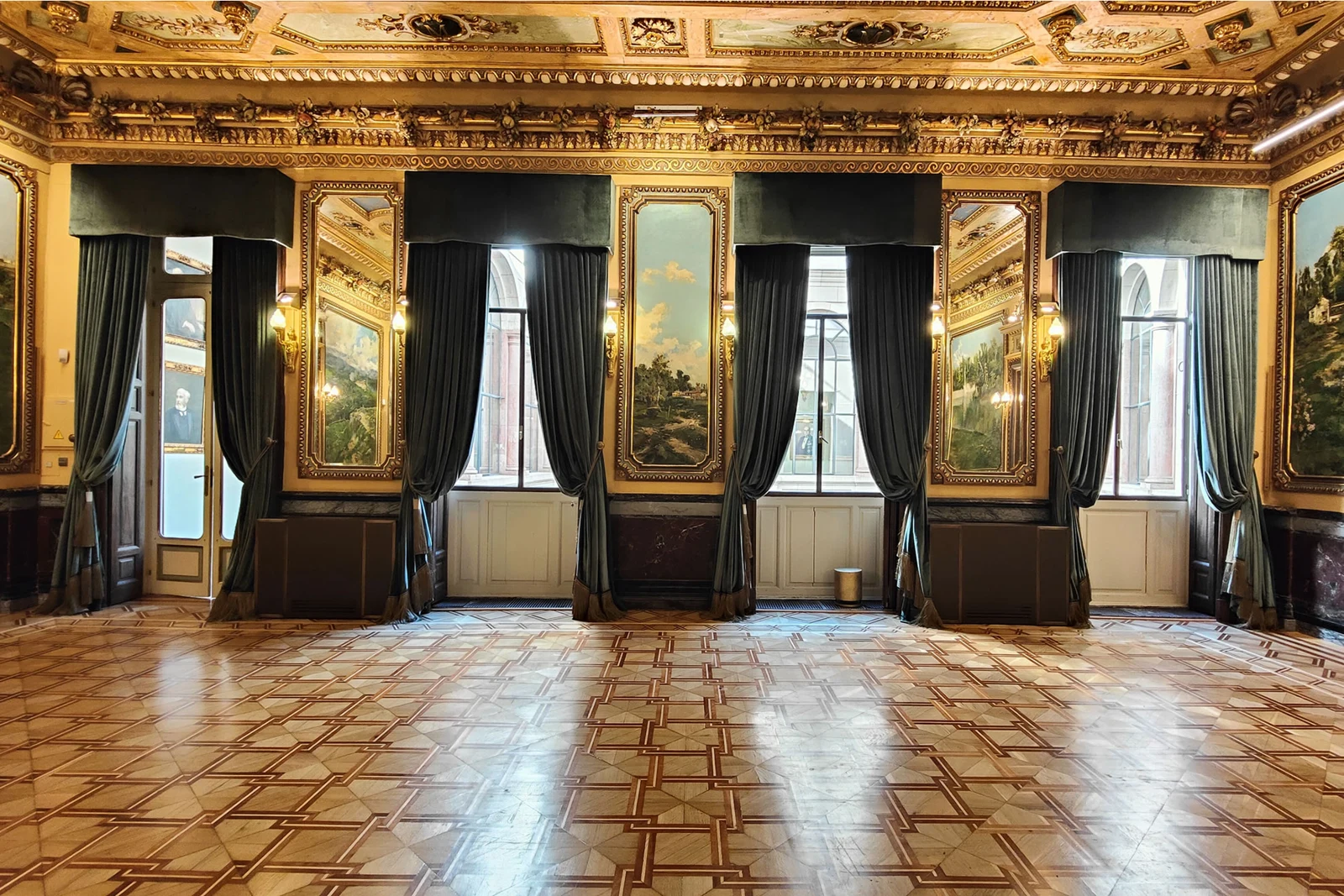
The photos of the State Dining Room show a wood floor of square panels in light woods, separated by dark fillets and surrounded by a perimeter border. The room is empty and the first photo shows almost all of the floor.
The Palacio de Santoña website describes the dining room by its paintings. It lists six canvases of Mediterranean landscapes painted by Antonio Gomar in 1874 for that room. It also lists a ceiling with an allegory of abundance, painted by Alejo de Vera in 1886, and two canvases by Ramón Olavide from 1876, with allegories of hunting and fishing. It measures 85 m² and is 3.5 m high.
The book lists the materials of the Duke of Santoña’s interiors: “marbles, frescoes, gilding, rich fabrics, furniture of great quality” (p. 168). Neither the book nor the website mentions the floor, so we cannot say what woods it is made of or when it dates from.
From Baroque palace to the palace of the Duke of Santoña
The book records the attribution of Diego Roys Bernaldo’s original house to Juan Gómez de Mora, dating it from 1618 onward, and says the name of its designer has not been established. The renovation of 1731 to 1735 is attributed to Pedro de Ribera and was commissioned by Juan Francisco de Goyeneche, Marquis of Ugena. Between 1782 and 1784 Ignacio Thomas made a new layout and a new staircase and demolished the tower (pp. 164 and 166).
In 1874 the palace passed to Juan Manuel de Manzanedo, who received the title of Duke of Santoña in 1875. Domingo de Inza, whom some texts replace with Antonio Ruiz de Salces, carried out a full renovation. He redecorated the whole interior and built the main staircase, an imperial marble staircase, with a vault painted by Francisco Sans (pp. 166 and 168).
The Chamber of Commerce since 1933
The Cámara de Comercio e Industria de Madrid bought the building in 1933. It entrusted its conservation to Fernando Chueca Goitia, who restored several parts from 1955 and in 1958 remodeled the courtyard and built a new attic story. It was declared a Bien de Interés Cultural (listed heritage site), in the Monument category, in 1995 (p. 168).
The book adds that, when it was written, the palace was undergoing a full rehabilitation. That text does not say what was done with the floors.
Facts on the building and its floor
- Property: Palacio de Santoña, also the palace of the Marquis of Ugena or of Manzanedo (Fundación de la Cámara de Comercio e Industria de Madrid).
- Location: Calle de las Huertas 13, on the corner of Calle del Príncipe (Madrid).
- Timeline: House of Diego Roys, attributed to Gómez de Mora, from 1618 onward; renovation by Pedro de Ribera in 1731–1735; works by Ignacio Thomas in 1782–1784; renovation by Domingo de Inza from 1874.
- Current owner: Cámara de Comercio e Industria de Madrid, since 1933; Bien de Interés Cultural since 1995.
- State Dining Room: 85 m² and 3.5 m high; six canvases by Antonio Gomar (1874), ceiling by Alejo de Vera (1886) and two canvases by Ramón Olavide (1876).
- State Dining Room floor: Wood in panels with a border of fillets, according to the photos; the sources consulted do not describe it.
- Wood species: The sources consulted do not name them.
This case study is part of our technical guide to historic floors in the palaces of Madrid.