
In the Catherine Palace, in Tsarskoye Selo, one parquet came back from Berlin, several survived the war and others were remade. It is one of the 16 cases among the best parquets in the world.
Lyon Hall: the parquet that came back from Berlin
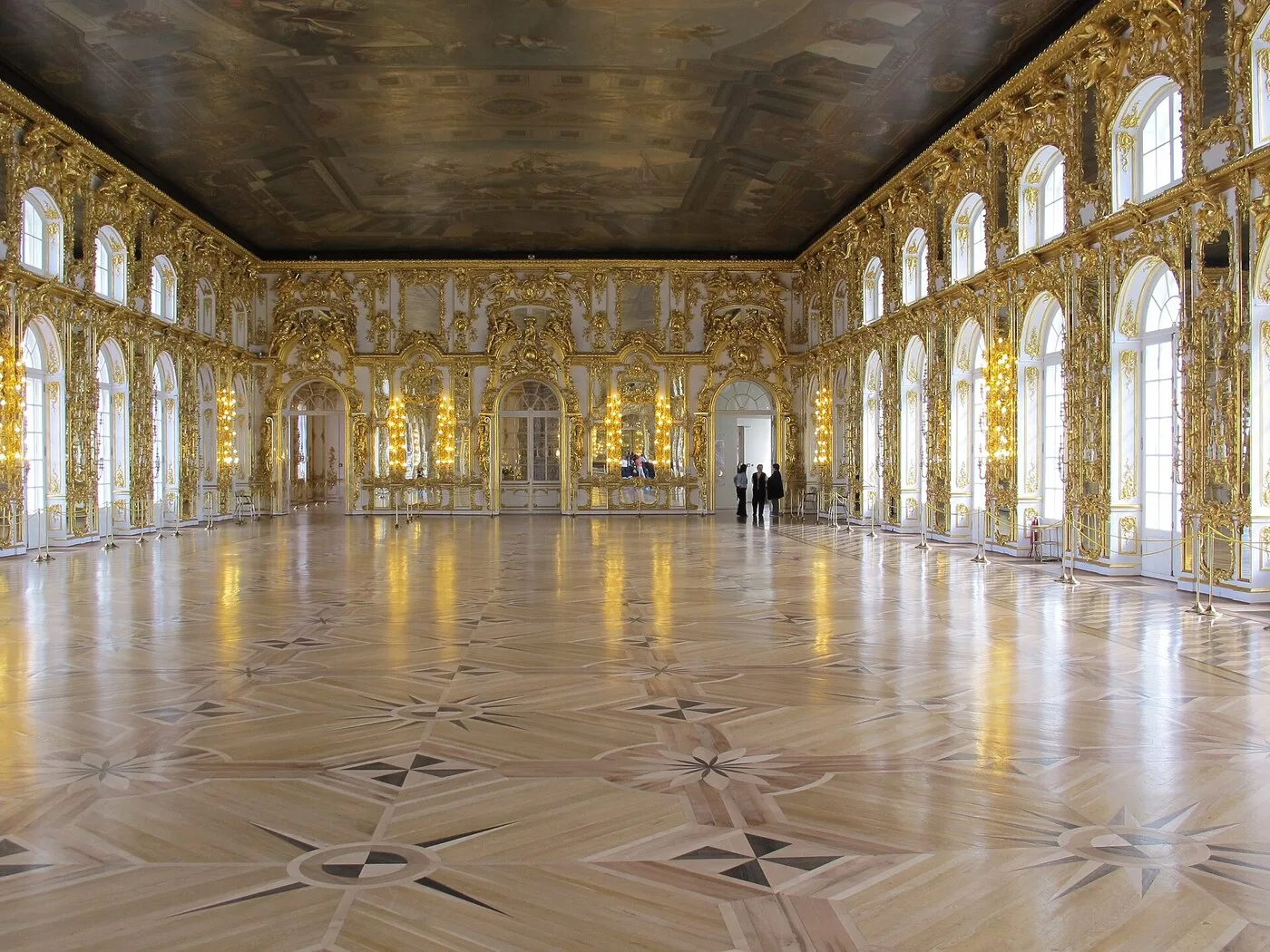
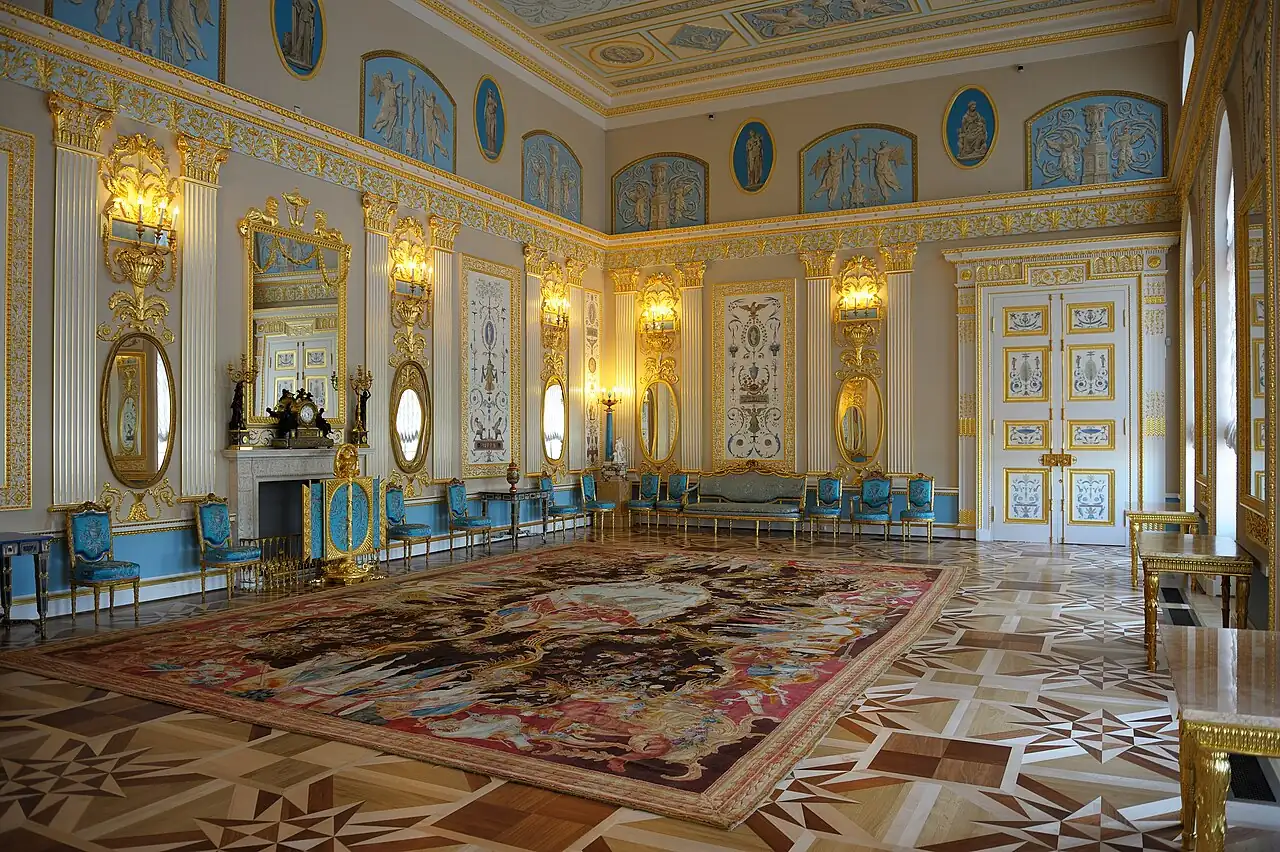
The parquet of the Lyon Hall was designed by Charles Cameron and made in the workshop of Johann Kimmel, in Saint Petersburg, between 1782 and 1784. It was the only element of the room that later alterations did not change. It is a geometric parquet in eight woods: mahogany, tulipwood, amaranth, rosewood, palm, walnut, maple and birch. Light rectangles and diamonds, with rosettes, ribbons and garlands, contrast with dark, solid hexagons. Cameron received five hundred Australian mother-of-pearl shells to inlay only the light panels, but Catherine wanted them in the dark ones too.
In the 18th century four thick cloth covers protected the inlaid wood from the sun when the court was away from Tsarskoye Selo. In the early 1860s a carpet the size of the room was laid.
In 1917 the parquet needed restoration, and in 1918 it was carried out by specialists from the Leroy & Arendt factory. The Nazis took it away during the war; it turned up in Berlin in 1947 and returned to Tsarskoye Selo. Several panels were restored in the early 1970s and were on display until 2018, when the reconstruction of the room began. The restoration of the original parquet was completed in 2021.
The photo of the room is from February 2020, with the work under way. It cannot be said to show Cameron’s parquet.
Antechambers of the Golden Enfilade: a geometric parquet by Rastrelli
The Antechambers opened onto the main staircase and served as waiting rooms before audiences with Empress Elizabeth. There were five, and Catherine II’s alterations turned two of them into the Arabesque Room and the Lyon Hall. Three remain. Rastrelli finished them with gilded carving and a geometric parquet of precious woods.
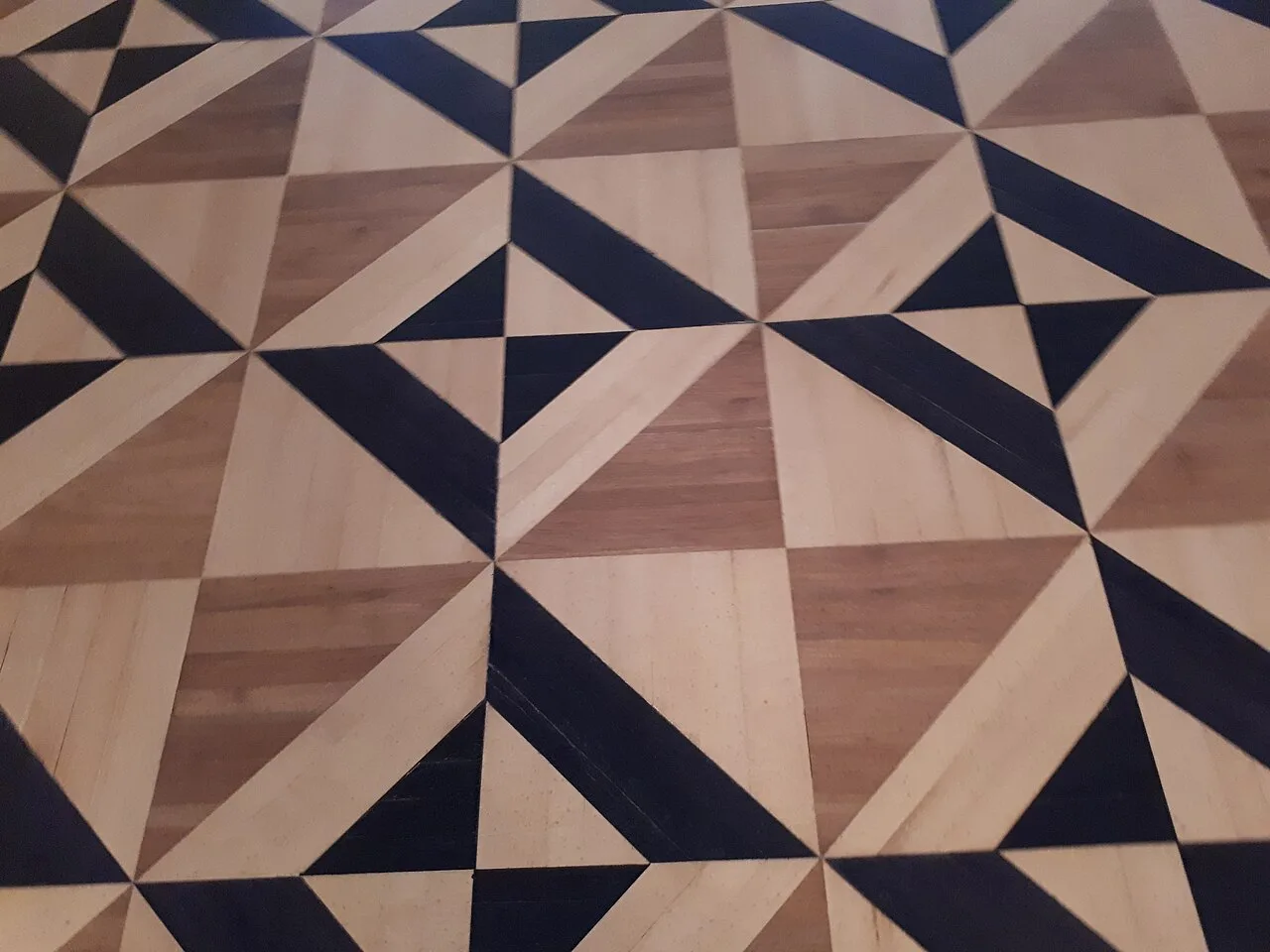
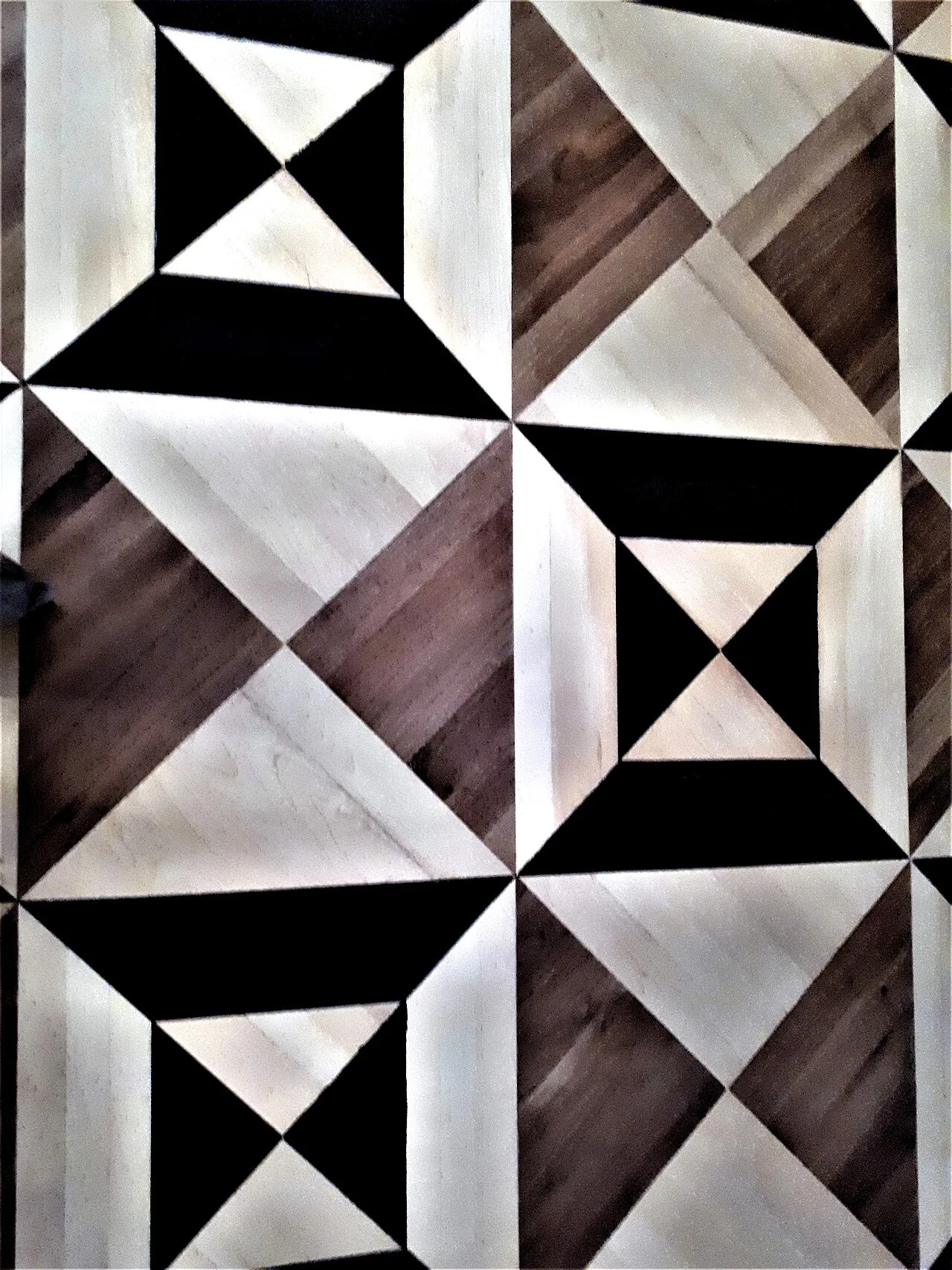
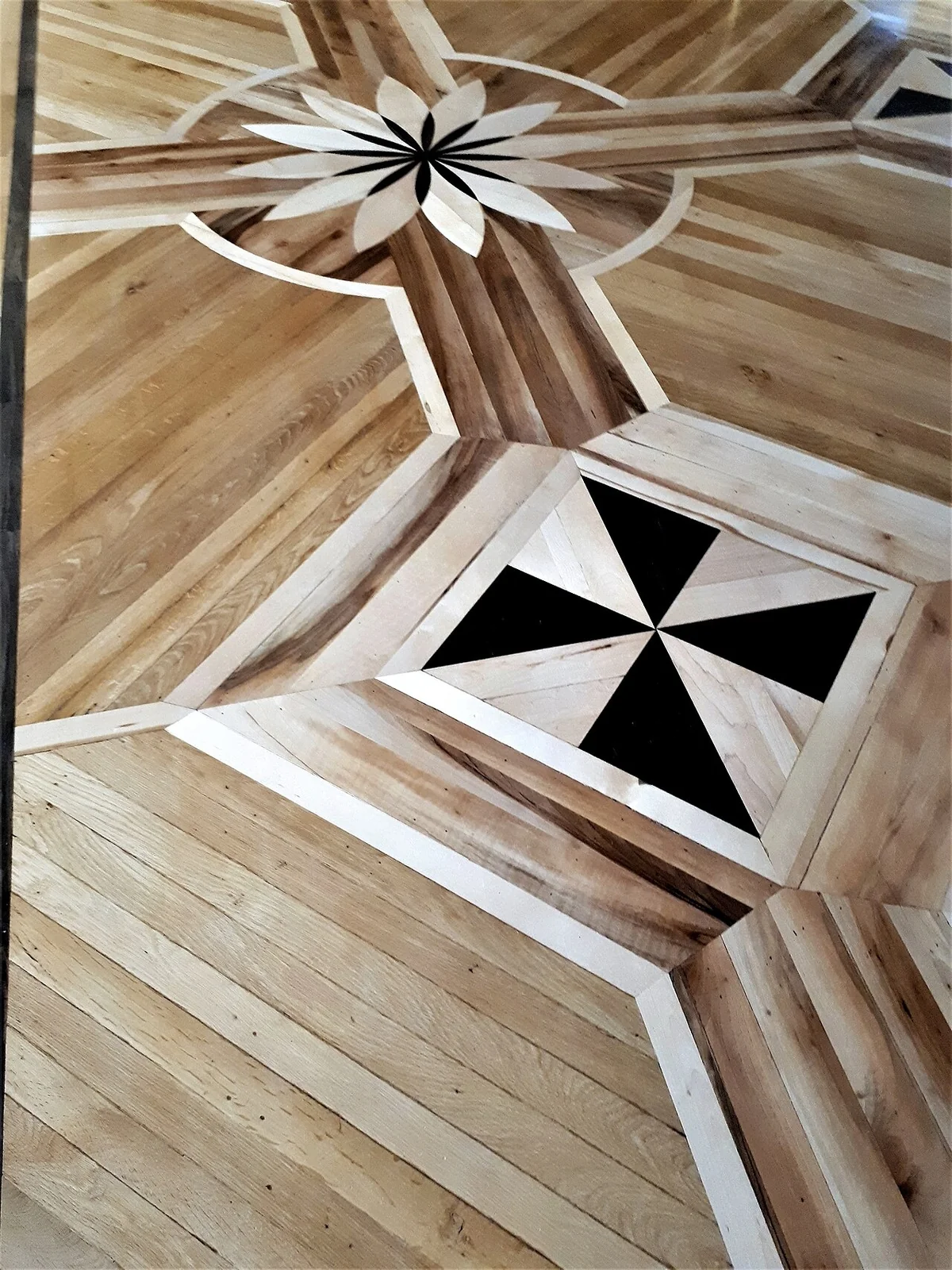
The southern part of the palace suffered especially in the war, and of the decoration only blackened fragments of carving were left among the ashes. The restoration began in the late 1990s, and the paintings and the parquet were recreated. Today’s design, in the photo, is of white, black and brown triangles that form squares and pinwheels.
Great Hall: light oak and bog oak
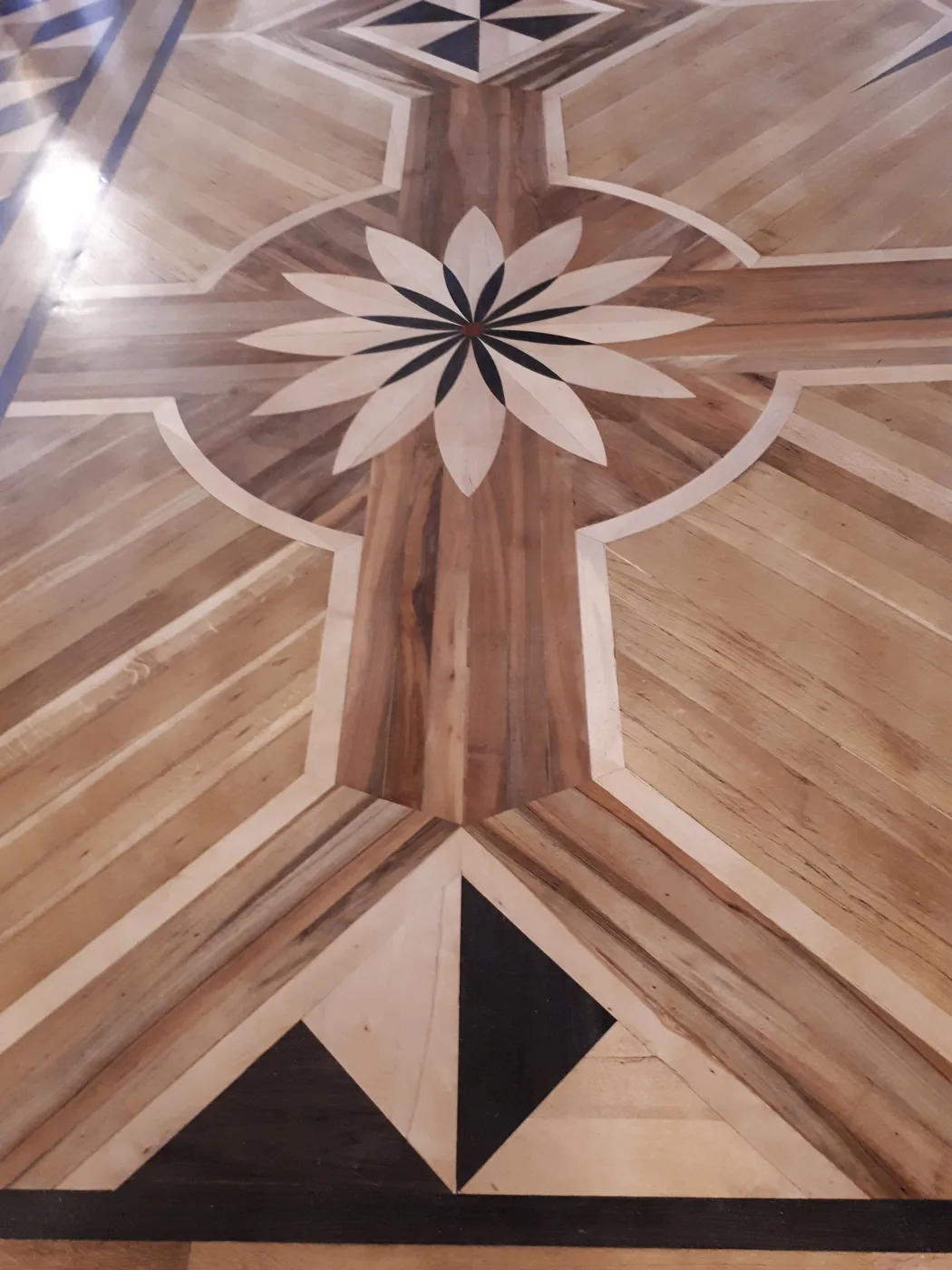
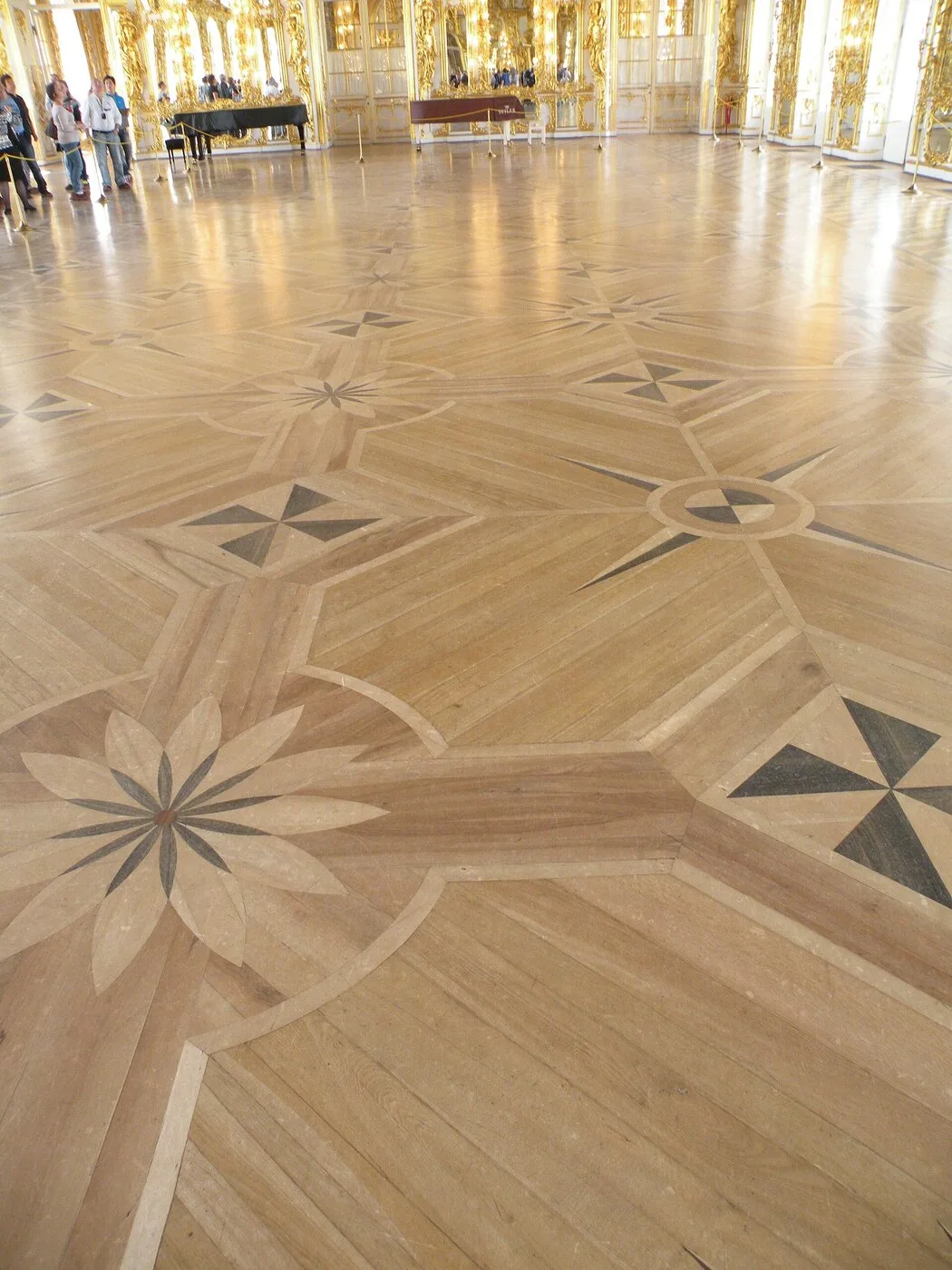
The hall was created between 1752 and 1756 to Rastrelli’s design. Its floor of light oak and bog oak burned during the war. The restoration of the hall began in 1960 and lasted twenty years. Evgeny Kudryashov’s team remade the parquet from Rastrelli’s drawings and from a surviving fragment of oak. The hall opened on July 10, 1980. The floor shows a rosette of light-wood petals and black fillets, at the center of a brown-wood cross surrounded by light strips.
Amber Room: from the fifteen-wood parquet to today’s
The Amber Room, whose basic design was finished in 1756, had a parquet of fifteen kinds of wood, each of a different tone, in circular motifs. The Germans took the amber panels in 1941 and they have never been recovered.
In 1979 it was decided to recreate the room, and work began in 1983. A year later it already had a patterned parquet, which according to the GIA was restored as close as possible to the original designs. The room opened to visitors in 2003, for the 300th anniversary of Saint Petersburg.
State Blue Drawing Room: the parquet that was almost not lost
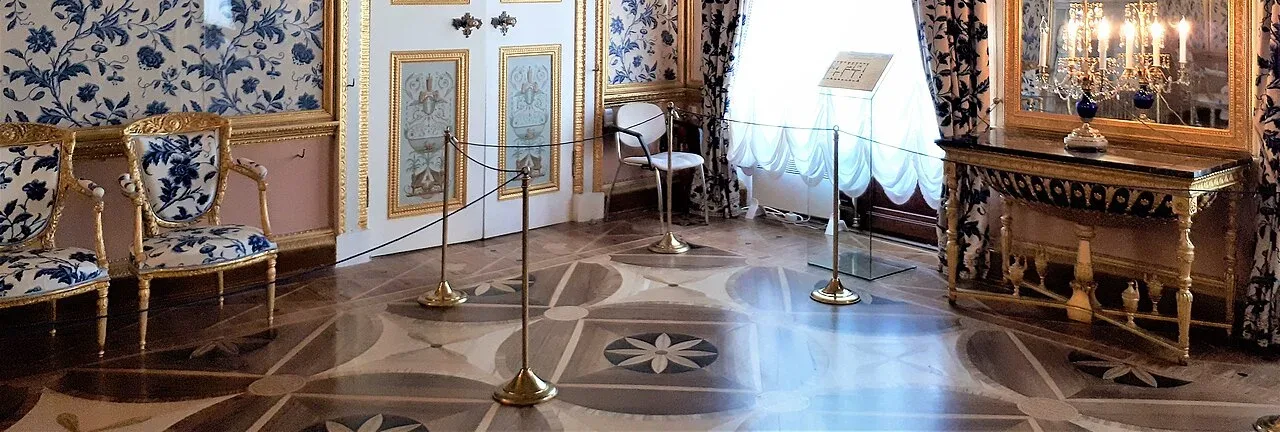
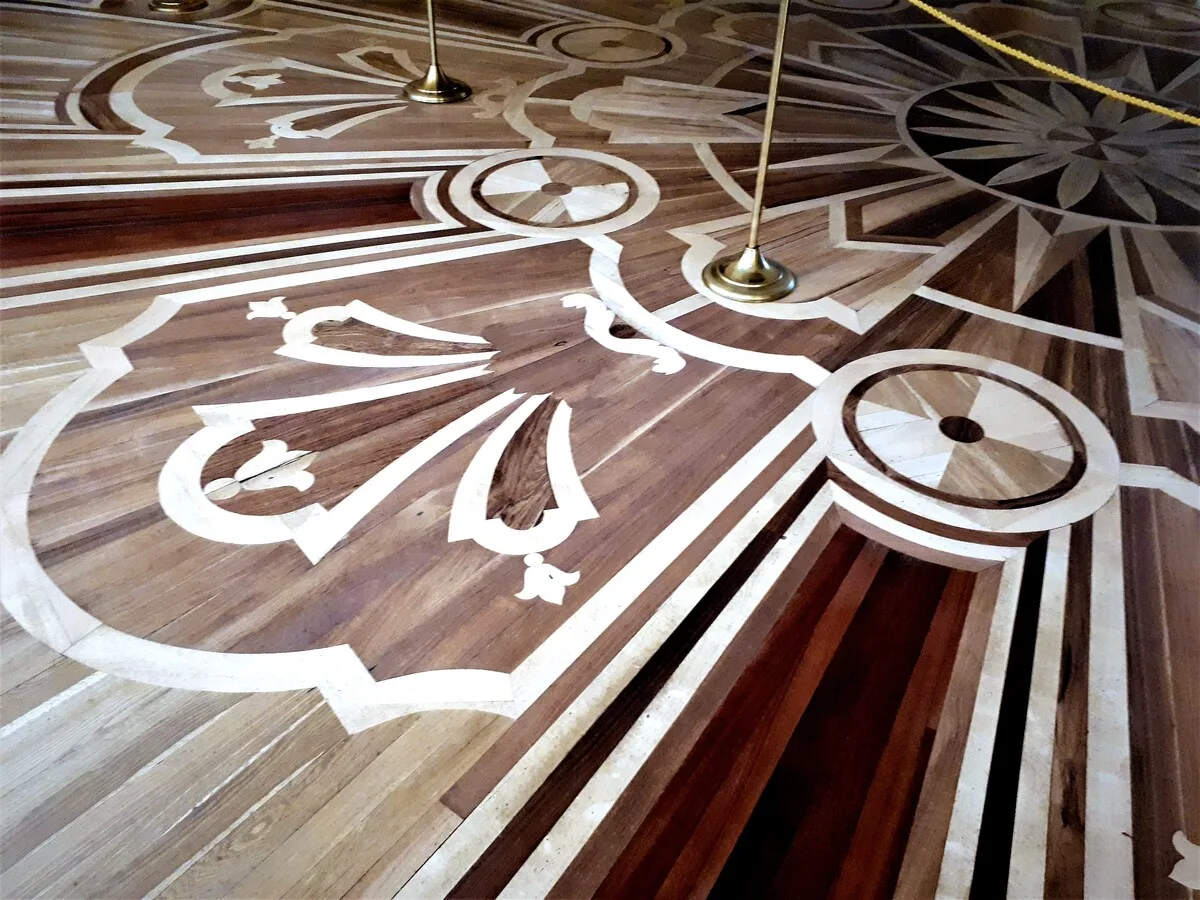
Cameron created this room between 1779 and 1783 for Grand Duke Paul. The patterned parquet was made in Stallmeyer’s workshop, mostly in tulipwood and rosewood. In the photo, circles and ellipses of brown and light woods cross with small petal rosettes.
In the war the silk and the painted ceiling were destroyed or taken away, but the old parquet was saved almost whole and restored. The armchairs, from 1783, had similar luck: one was saved in the evacuation and the rest came back from Königsberg in 1947.
Chinese Blue Drawing Room: a Chinese parasol in the parquet
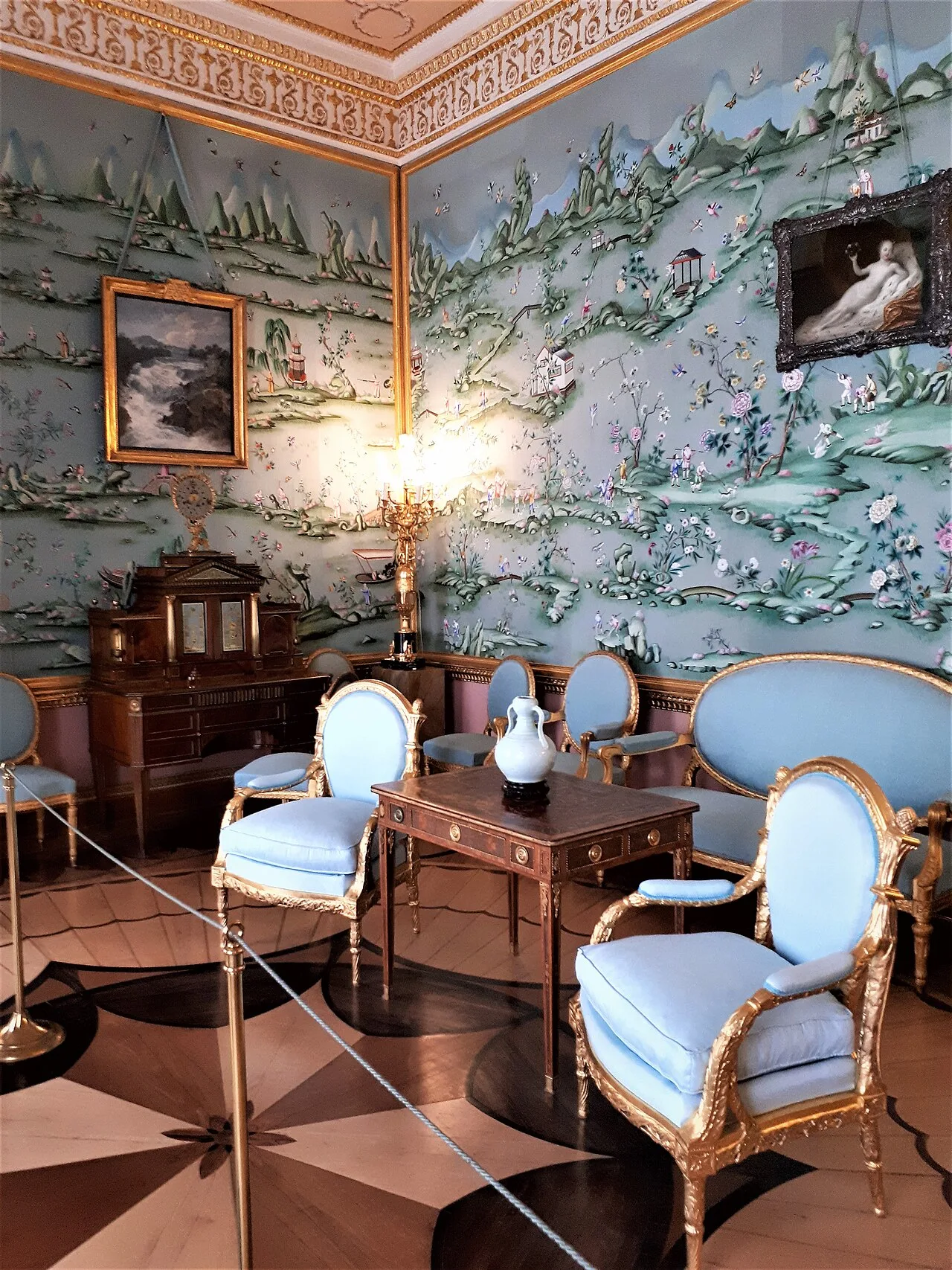
This room, from 1783, is also by Cameron and carries Chinese motifs: a Chinese parasol drawn in the parquet and a blue silk painted with landscapes. In the photo, the floor has a radial design alternating light and dark wood.
In the war the silk was looted and the mirror, the fireplace and the painted ceiling were lost. The room opened to visitors in 1959, with the new silk painted from a fragment found behind the mirror frame.
Portrait Hall: a room recreated from photographs
The Portrait Hall kept the decoration Rastrelli planned for two centuries. In the war it was completely destroyed, and it was recreated from photographs and fragments of the decoration. In the photo, light scrolls and a compass rose are drawn on brown wood.
The museum says nothing about the parquet in this room. The photo, from February 2020, is the only thing that shows what its floor looks like today.
State Study of Alexander I: a parquet lost in the war
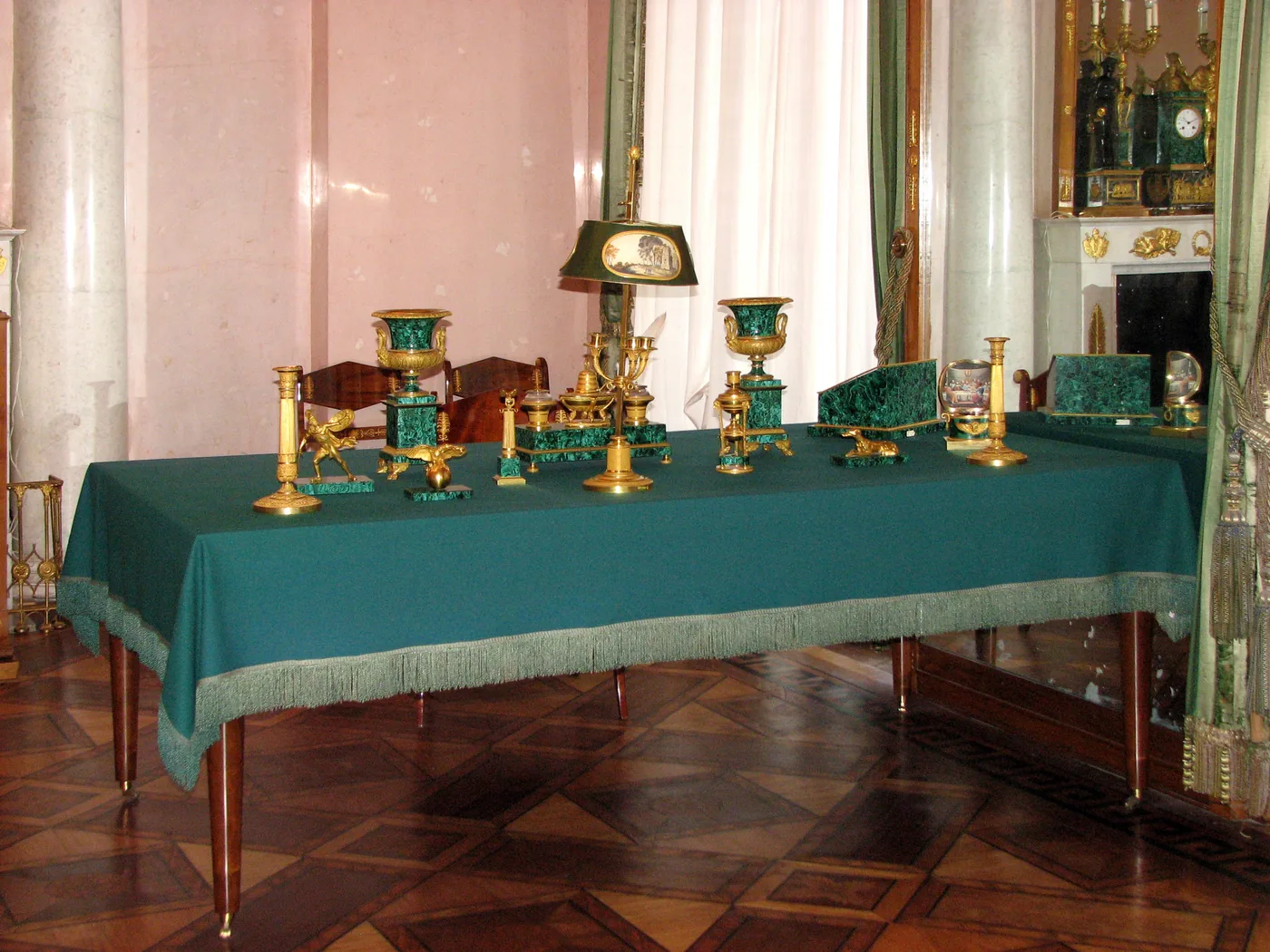
The study was created in 1817 to Stasov’s design, and Tarasov made the parquet and the mahogany doors. After a fire it was restored in 1821 and 1822. In the war the parquet and almost all the furniture were lost, and in 1974 the study reopened to visitors. The photo shows today’s floor: a dark geometric parquet.
Waiters’ Room: the floor laid after the fire
In the 1840s, by order of Nicholas I, Stasov joined two antechambers into a single room. He gave it a geometric parquet of rosewood, amaranth, mahogany, ebony, oak and maple. That floor was lost in a fire in 1863.
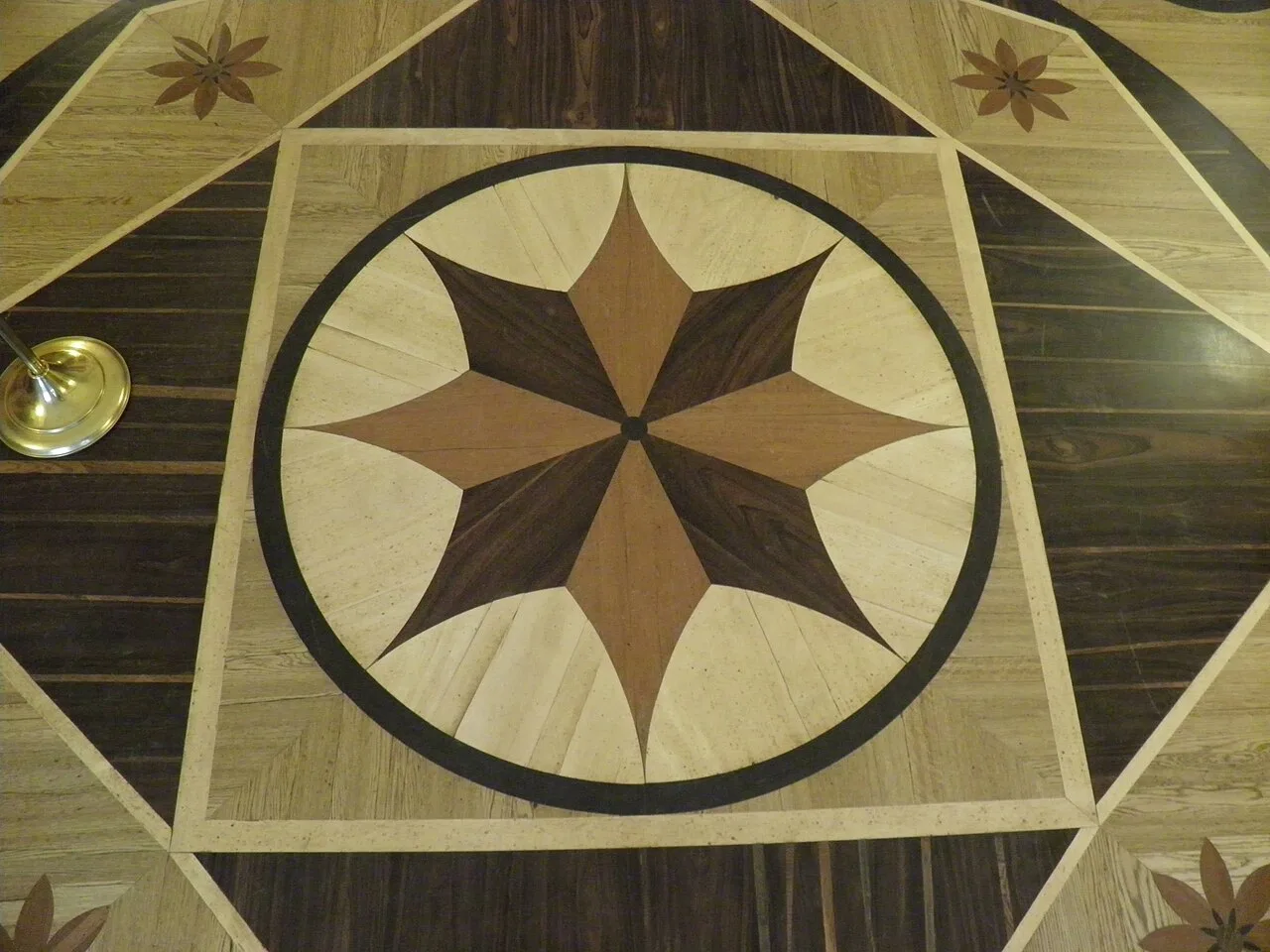
The present one, in the photo, is from the mid-1860s. It has a medallion with an eight-pointed star inside a circle and a square. It survived the war, was restored afterward, and the room opened in 1959.
Zubov Wing: Catherine II’s rooms, rebuilt
Catherine II’s private rooms, in the Zubov Wing, were completely destroyed between 1941 and 1945. They were rebuilt from archives and fragments, and opened to the public on December 25, 2024, for the first time in eighty years.
For Catherine’s bedroom there was a project from the 1980s, with full-size drawings of the parquets and their woods. The museum says those drawings help in the current reconstruction. The team made 474 m² of parquet by hand, plus more than 1,000 m² of glass and other work. The museum says the work covered eight private rooms of Catherine II, took five years and employed more than 200 conservators.
The Catherine Palace in pictures
Historic parquet
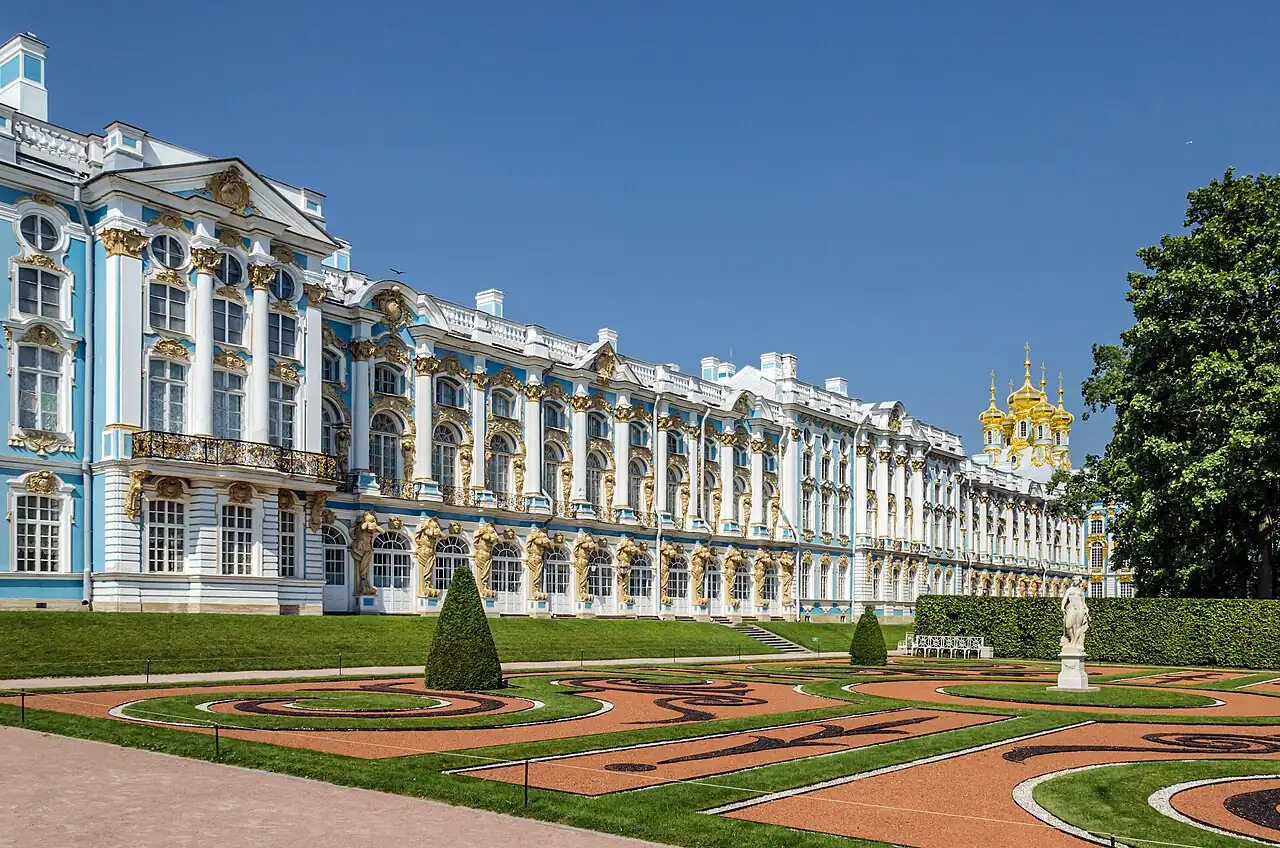
Three of the rooms keep their prewar parquet, with restorations. They are the Lyon Hall, from 1782-84, the State Blue Drawing Room and the Waiters’ Room, from the 1860s. The Antechambers, the Great Hall and Catherine II’s rooms remade theirs, and the State Study lost its own. For the Amber Room, a patterned parquet is on record in 1984. Of the Chinese Blue Drawing Room and the Portrait Hall, all that is known is what the floor design shows. More on historic floors in Historic parquet.
Sources
- GAlexandrova, Wikimedia Commons, CC BY-SA 4.0.
- GAlexandrova, Wikimedia Commons, CC BY-SA 4.0.
- GAlexandrova, Wikimedia Commons, CC BY-SA 4.0.
- Sailko, Wikimedia Commons, CC BY-SA 3.0.
- Chatsam, Wikimedia Commons, CC BY-SA 3.0.
- GAlexandrova, Wikimedia Commons, CC BY-SA 4.0.
- GAlexandrova, Wikimedia Commons, CC BY-SA 4.0.
- GAlexandrova, Wikimedia Commons, CC BY-SA 4.0.
- GAlexandrova, Wikimedia Commons, CC BY-SA 4.0.
- Andrey Korzun, Wikimedia Commons, CC BY-SA 4.0.
- Gzen92, Wikimedia Commons, CC BY-SA 4.0.
- Florstein, Wikimedia Commons, CC BY-SA 4.0.
- Aleks G, Wikimedia Commons, CC BY-SA 3.0.
- GAlexandrova, Wikimedia Commons, CC BY-SA 4.0.
- Wolfgang Moroder, Wikimedia Commons, CC BY-SA 3.0.


