
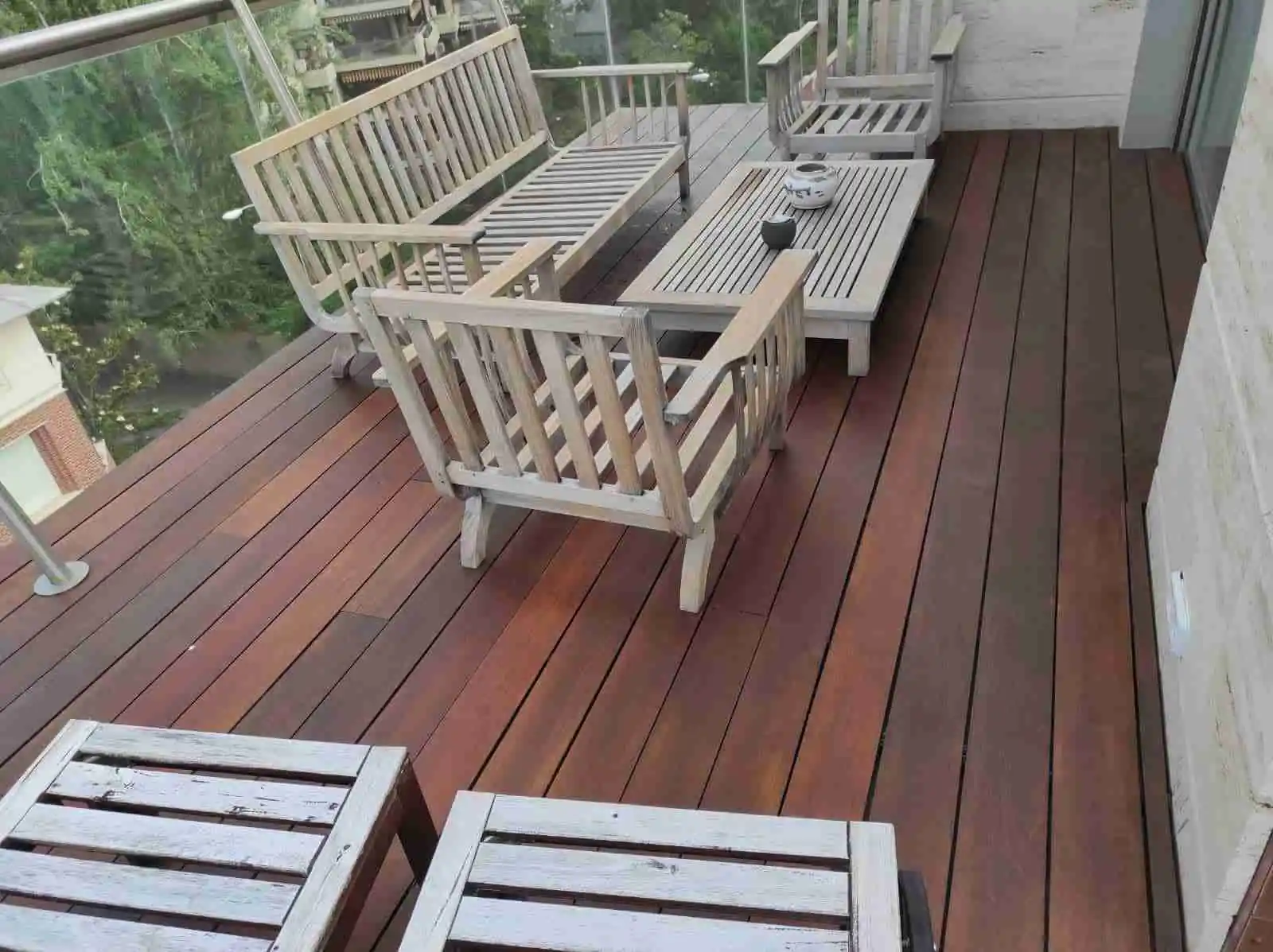
In 2021 we restored the outdoor decking of a penthouse very close to the Santiago Bernabéu stadium in Madrid. It had a large terrace, a small raised pool, a long balcony and an outdoor staircase, and all the wood had gone gray.
First the boards that moved and the ones that had sunk were fixed. Then the decking was sanded and given two coats of Bona Deck Oil, the oil we recommend for outdoor use.
The job, before and after
The terrace is the first photo, finished and with the furniture back in place. Below it is the terrace as we found it: the wood gray from end to end and stained.

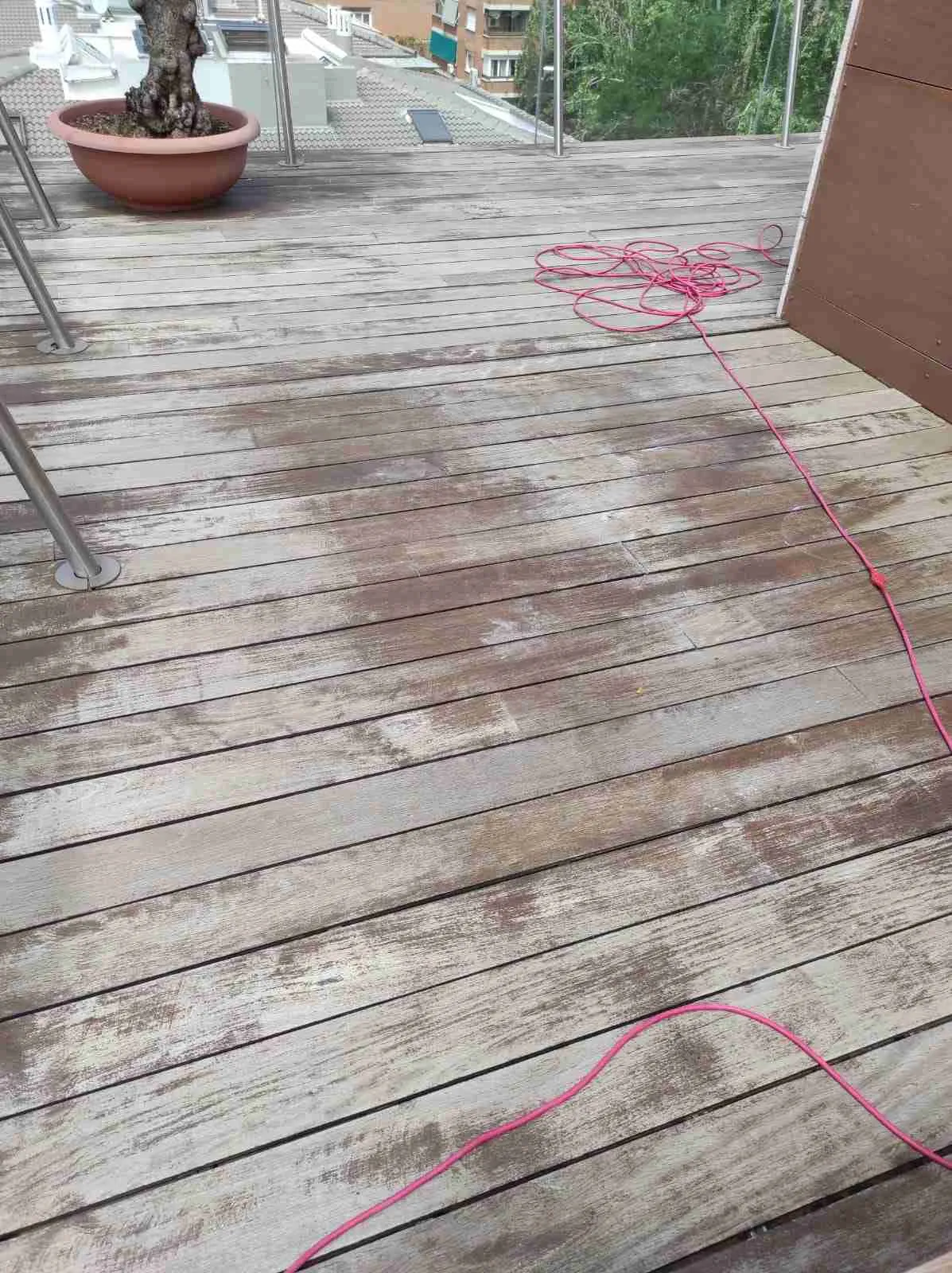
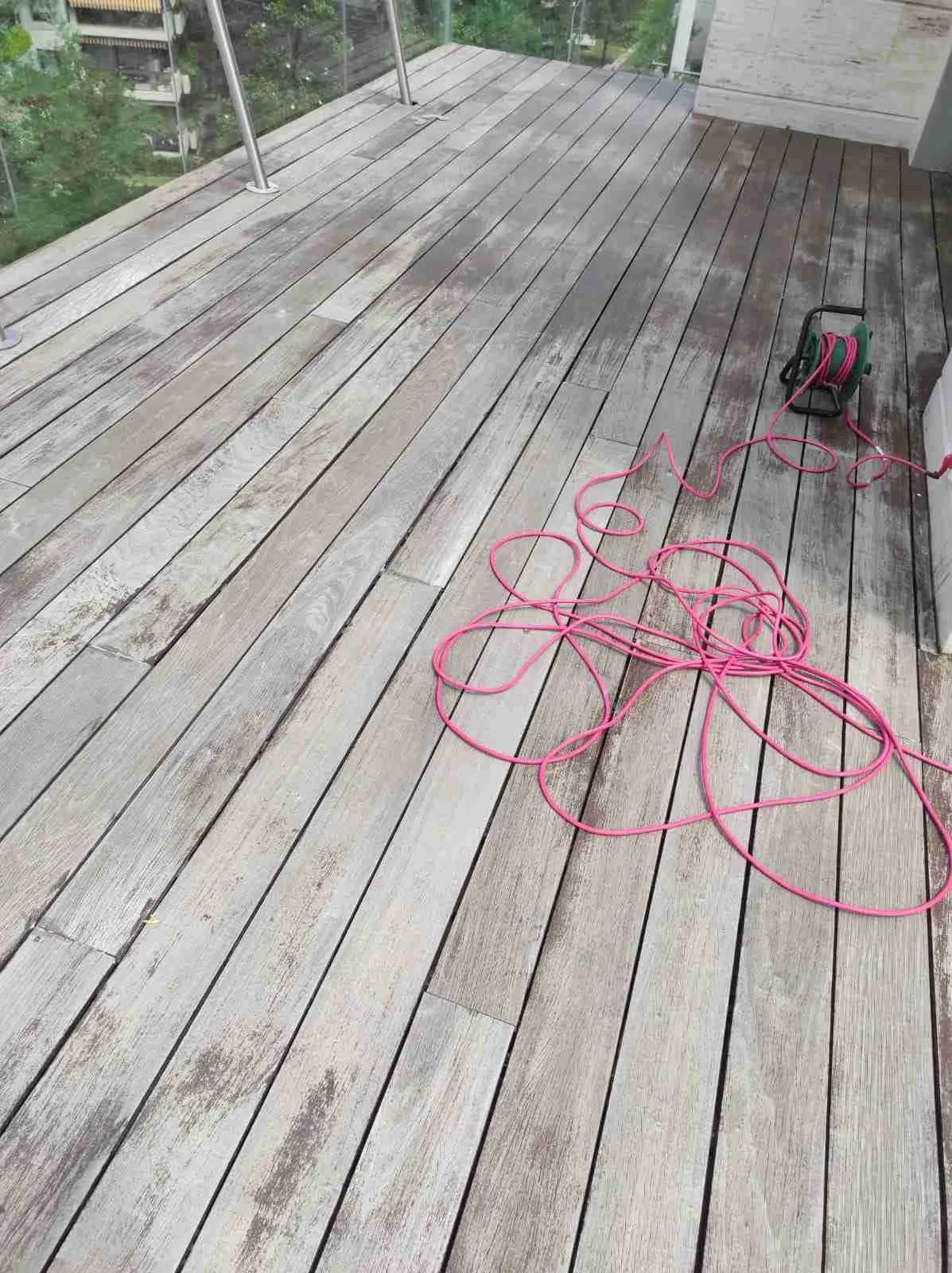
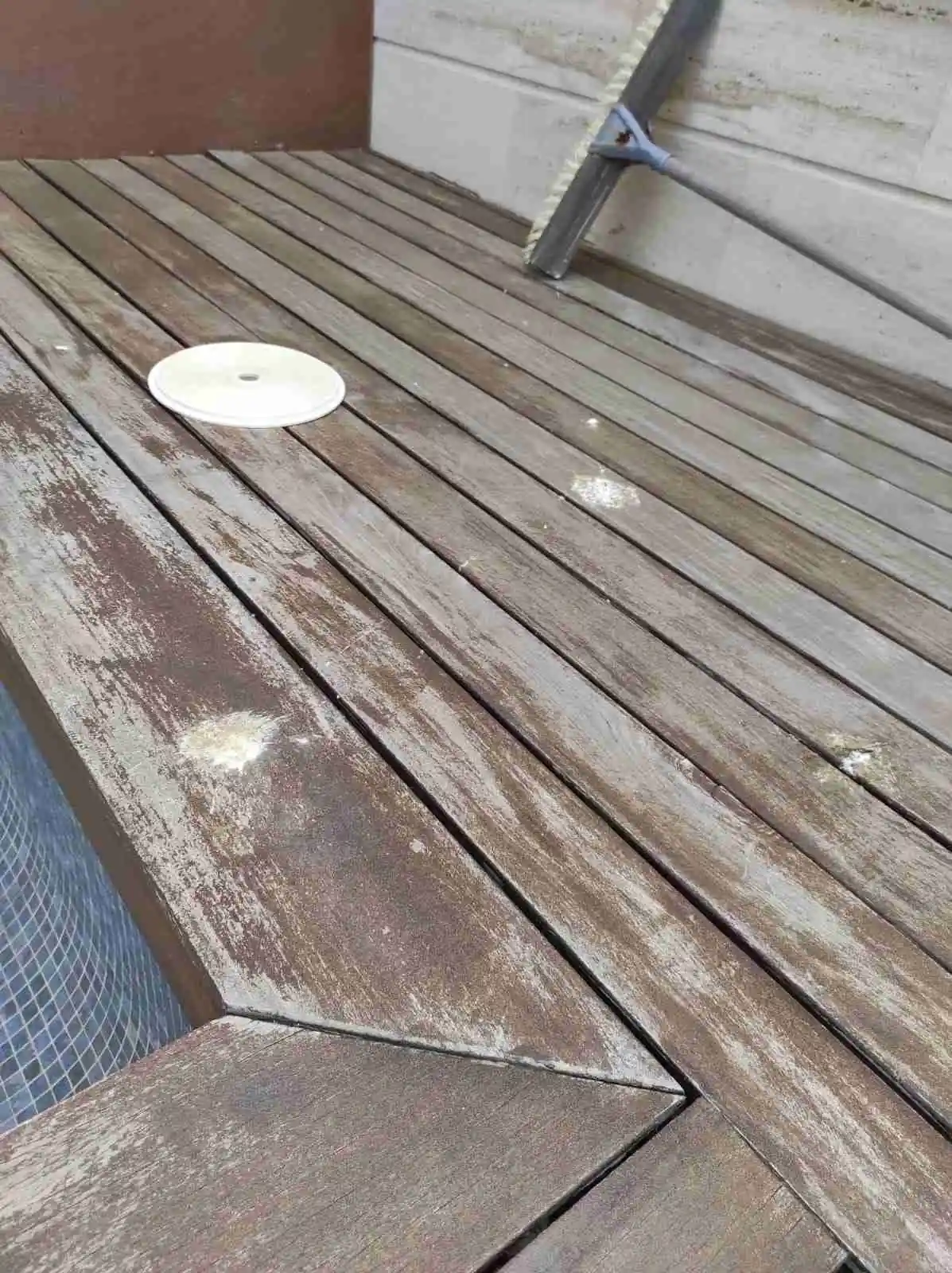
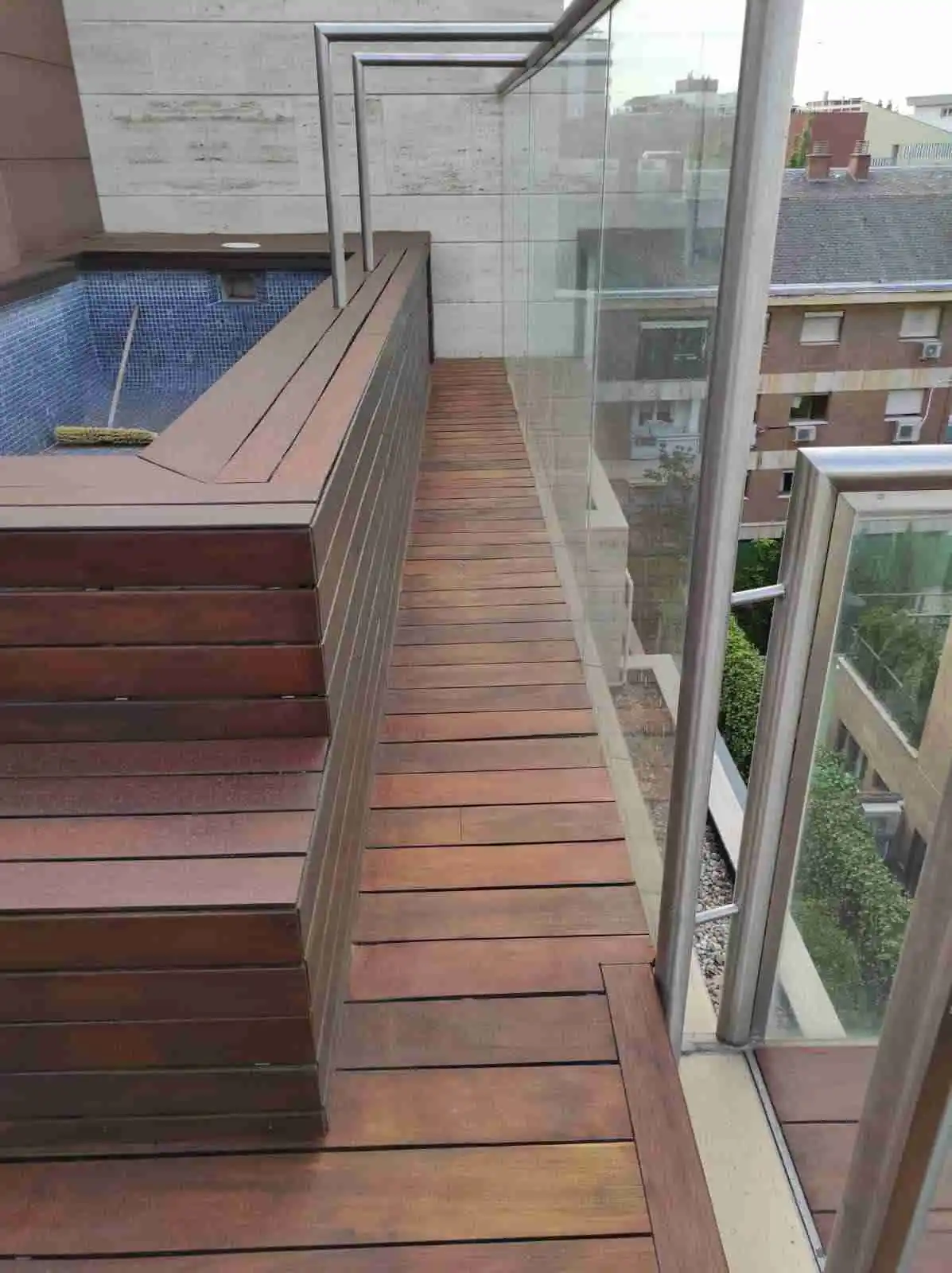
Around the pool the wood was gray and worn, with white stains along the edge. The pool is raised and clad in the same decking, which was also sanded and oiled.
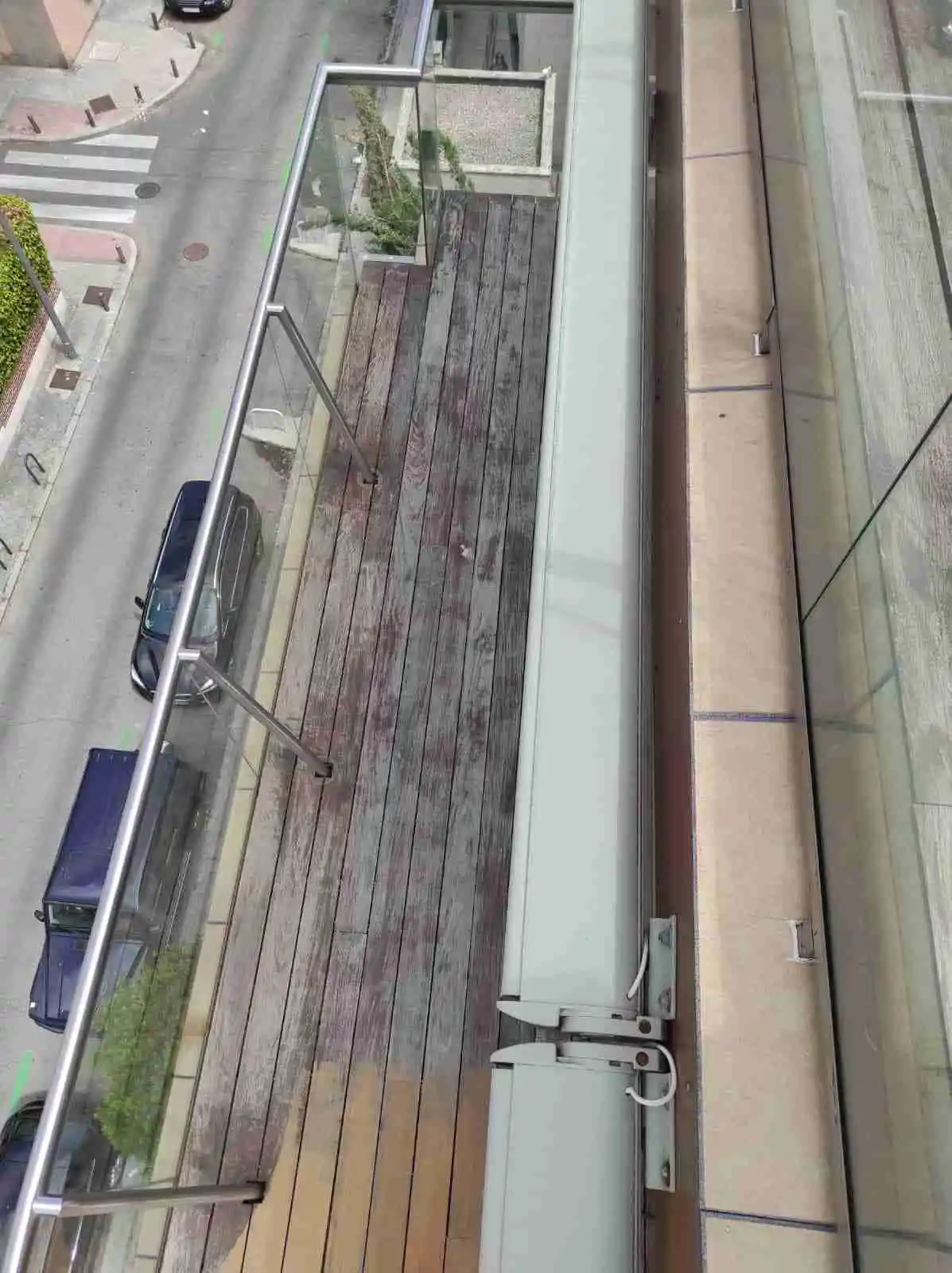
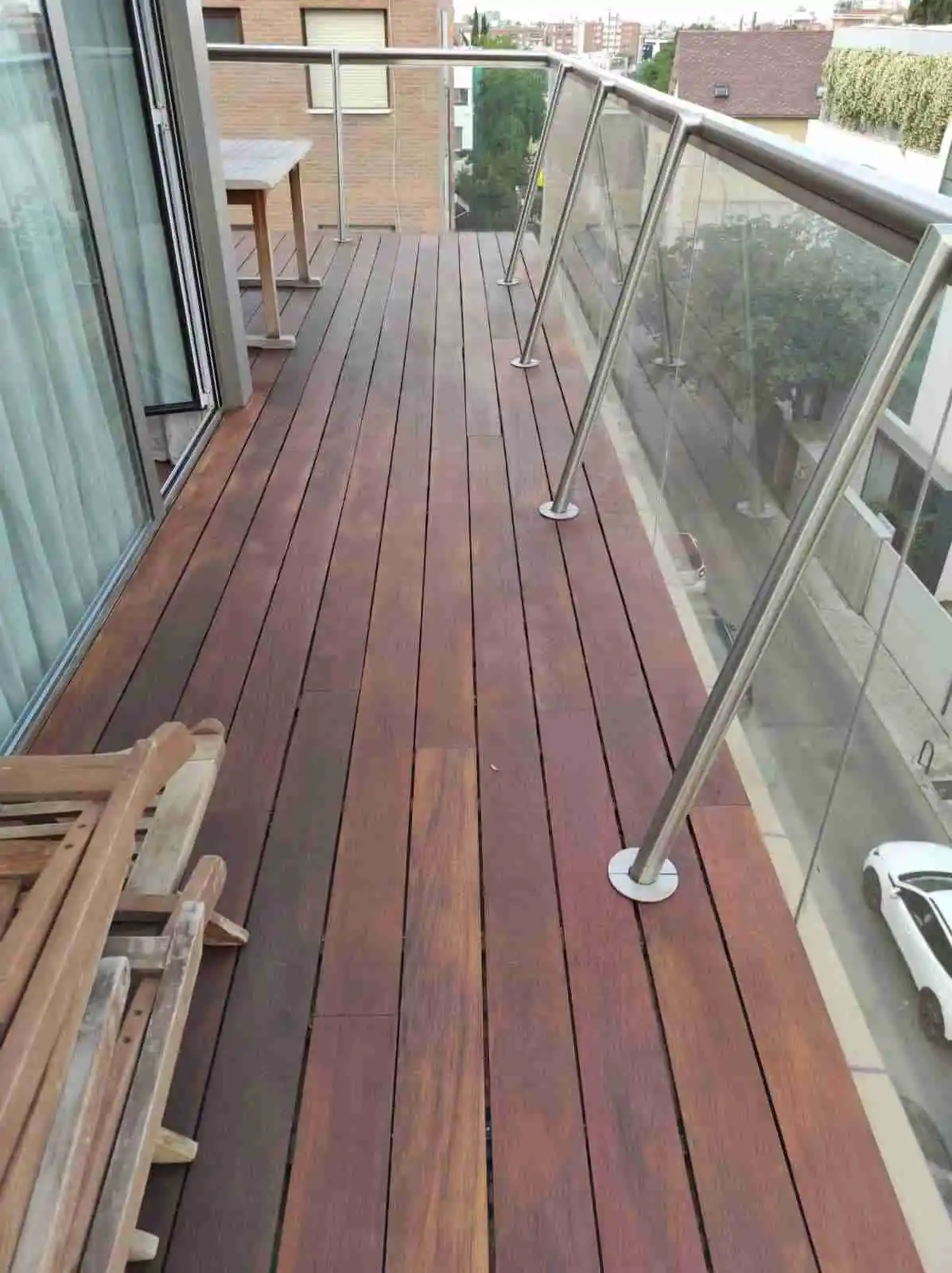
The long balcony runs along the facade behind a glass railing. The first photo shows it from above, with the boards gray; the second, finished.
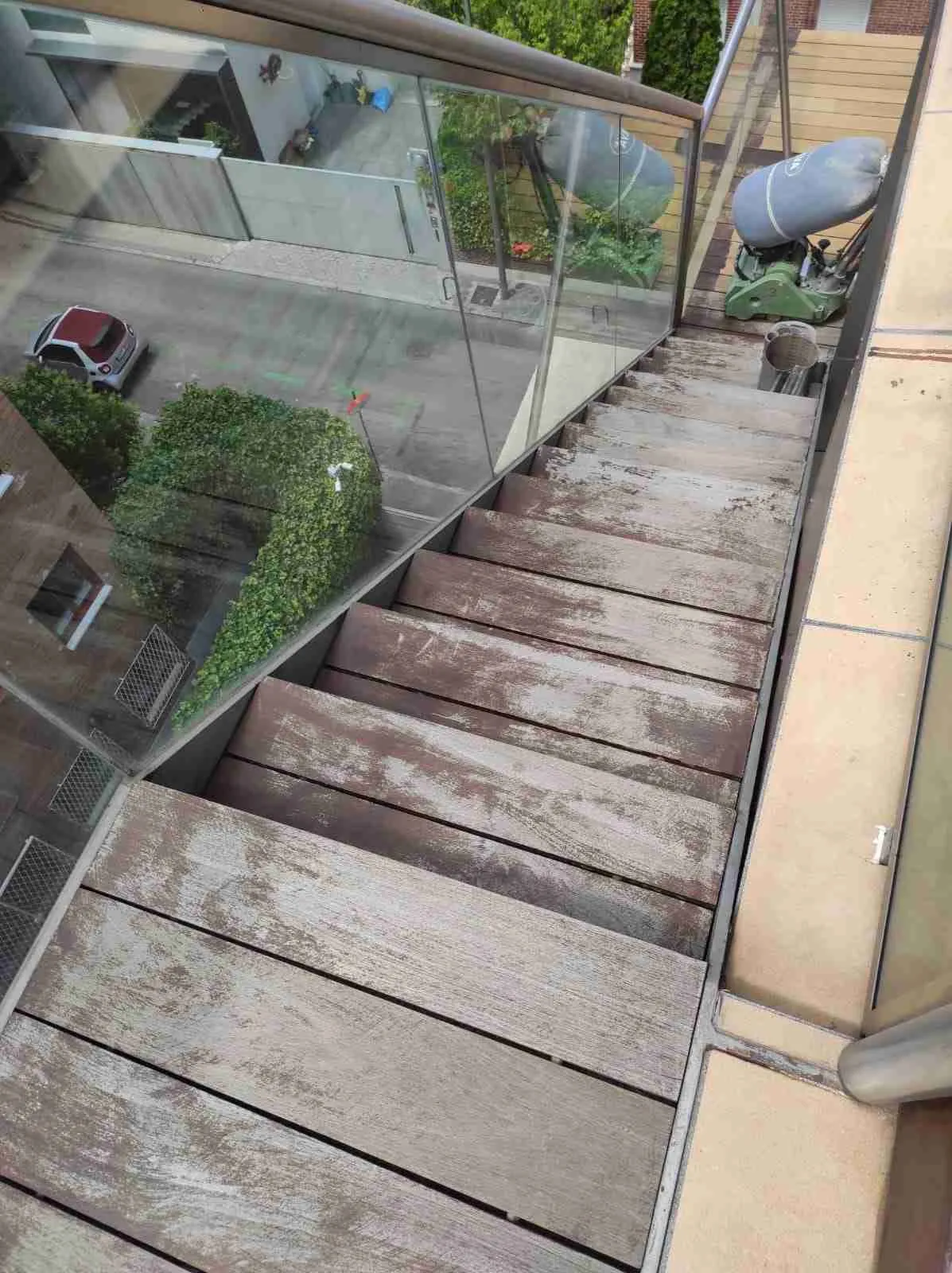
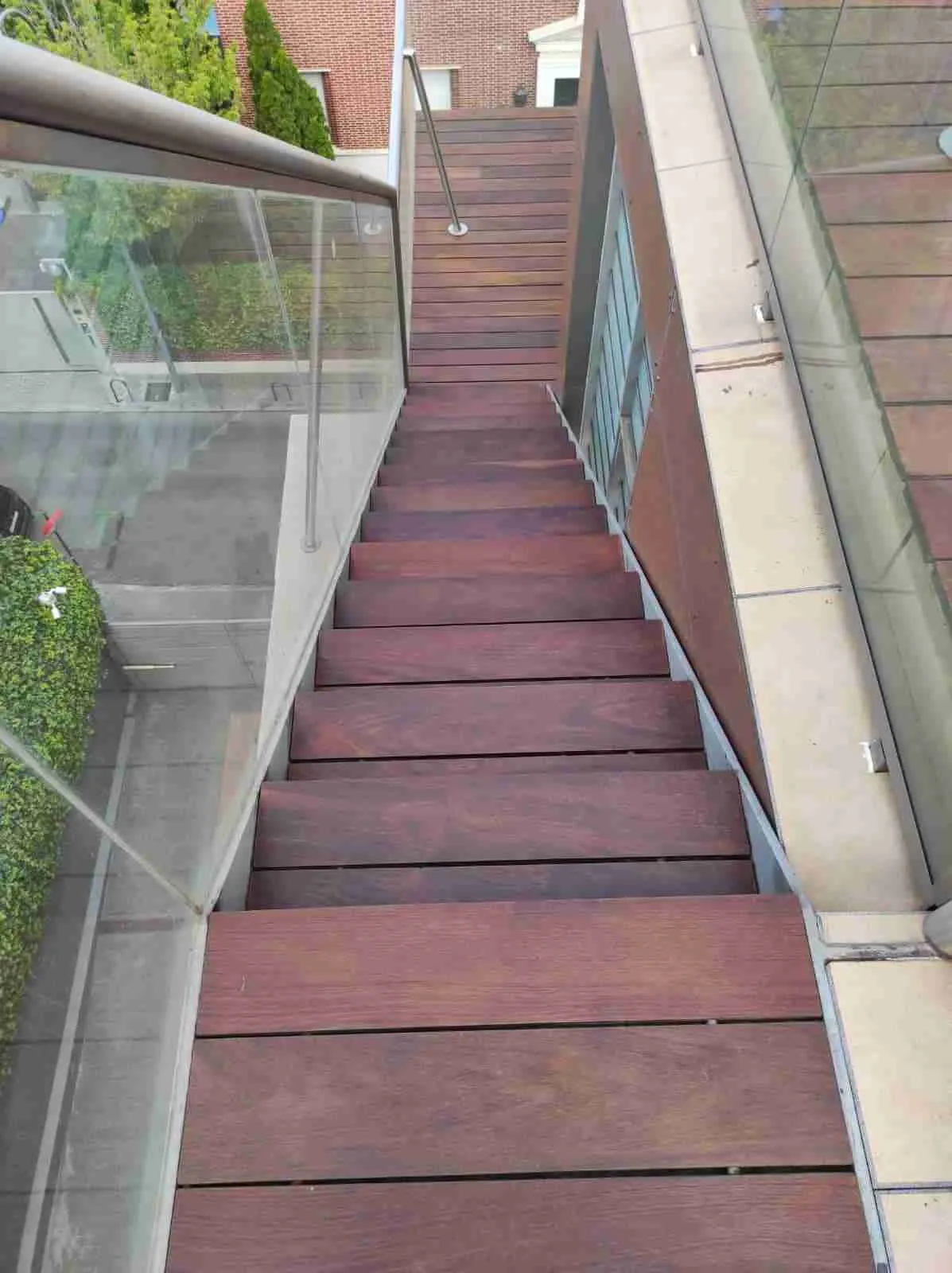
The outdoor staircase had gray, worn treads. They were sanded one by one and given the same two coats of oil as the rest of the decking.
Sunlight in Madrid: lignin breakdown and the graying of wood
Constant sun combined with Madrid’s dry air oxidizes the surface of hardwood within a few months. Ultraviolet radiation breaks down lignin, the compound that holds the cellulose fibers together. As a result of this photochemical process, the wood loses its original lively tones and turns an ash gray.
The gray is only on the surface: underneath, the wood keeps its color, as we saw when sanding the Bernabéu decking. If the decking is left unprotected, the cycles of wetting and drying open small lengthwise cracks and raise splinters. The oil protects the surface and slows that wear.
Why film-forming finishes should never be applied to outdoor decking
A mistake we see on Madrid terraces is varnishing the decking or giving it a thick-build wood stain. Unlike an indoor floor, outdoor decking swells and shrinks constantly with changes in humidity and temperature. Those movements break the rigid film of the varnish, so rainwater gets in under the clear layer.
The trapped water cannot evaporate quickly and ends up lifting the varnish in flakes that are hard to remove. Correcting a crazed varnish outdoors means sanding deep, and that reduces the usable thickness of the boards. That is why outdoors we use oils that penetrate the wood without forming a film; on this penthouse, Bona Deck Oil.
Workshop protocol: repair, sand and oil
This is the order we followed on the Bernabéu penthouse. The ipe decking around a pool that we restored in 2023 followed the same one: sanding, repairs and Bona outdoor oil.
- Repair first: boards that move and boards that have sunk are fixed. Oil does not hold down a loose board.
- Sand: the whole surface is sanded until the gray is gone and the wood is clean and free of splinters.
- Oil with the wood dry: two coats of Bona Deck Oil. The excess the wood does not absorb is wiped off with a cloth before it dries, so the floor is not left sticky.
Outdoor species: density and natural durability
Each outdoor wood has a different density and natural durability. Durability is expressed in the classes of the UNE-EN 350 standard, from 1 (very durable) to 5 (not durable), against the fungi that rot wood. The table sums up the woods most often used on terraces and around pools, with approximate values.
| Wood species | Approximate density | Natural durability |
|---|---|---|
| Ipe (lapacho) | 1,050 kg/m³ (very dense) | Class 1 |
| Asian teak | 680 kg/m³ (oily) | Class 1 to 2 |
| Tropical iroko | 650 kg/m³ (medium-heavy) | Class 1 to 2 |
| Brazilian cumaru | 1,000 kg/m³ (very hard) | Class 1 |
| Thermally modified pine | 450 kg/m³ (modified) | Class 2 |
Seasonal maintenance calendar for terraces and pools in Madrid
In Madrid we recommend doing the main treatment at the start of spring. Oiling between April and May means the wood is protected before the summer sun and heavy use.
At the end of fall it is worth sweeping gently to remove wet leaves and dust before the frosts. If the wood looks dry in the areas most exposed to the sun, a light maintenance coat will protect the pores against snow and rain.
- Oil in spring: between April and May, before the high summer temperatures.
- Avoid film-forming finishes: use outdoor oils that penetrate the wood without forming a film.
- Clean without destructive pressure: do without powerful pressure washers, which tear the surface grain of the wood.
- Remove chlorine residue and leaves: rinse pool edges with clean water to stop chemical salts building up.
Frequently asked questions about outdoor decking and oiling in Madrid
How often should ipe decking be oiled in Madrid?
There is no fixed interval: it depends on the sun and use in each area. The sign is the color. When the wood starts to go gray it is worth giving it another coat, ideally in spring and before it needs sanding.
Why does outdoor wood turn gray a few months after installation?
Graying is a natural reaction of wood caused by ultraviolet sunlight, which breaks down the lignin at the surface. The gray is only on the surface: on the Bernabéu penthouse it was removed by sanding before oiling.
Can a pressure washer be used to clean decking?
It is not recommended, because the force of the water tears out the soft fibers of the wood and leaves rough grooves. To clean without damaging the floor it is better to use specific cleaners applied with a hand brush and a gentle rinse.
What oil was used on the Bernabéu decking?
Bona Deck Oil, a Bona oil for outdoor decking, in two coats on freshly sanded wood. It is the one we recommend for outdoor use.
Outdoor decking restoration and maintenance in Madrid
Before quoting, we look at the decking on site: which boards move or have sunk and how much sanding is needed. We work in the city of Madrid and in Pozuelo.