
French Chevron Parquet (Punta de Hungría): Geometry, Installation & Finishing
A master craftsman’s breakdown of French Chevron parquetry: critical differences with herringbone, subfloor flatness tolerances, laser-guided centerline tracking, and non-yellowing ultramatt protection.
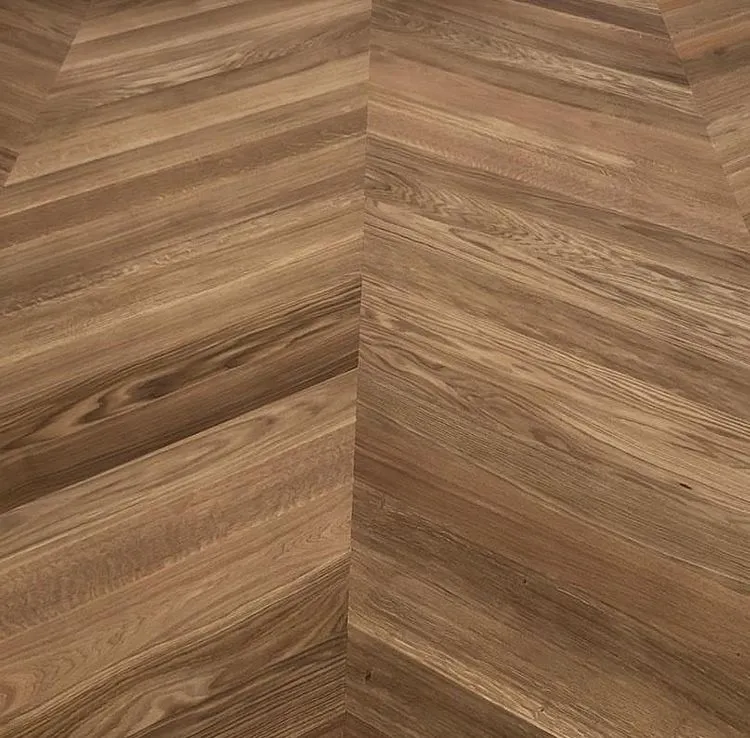
1. Geometry: Chevron vs Traditional Herringbone
In classical parquetry, precise nomenclature reflects geometric physics. While traditional herringbone (espiga a 90°) employs rectangular blocks placed perpendicular to each other at 90-degree right angles, French Chevron (Punta de Hungría) requires the ends of every individual plank to be precision-mitred at an angle—most commonly 45° or 60°.
When joined, these mitred ends form a continuous, straight central spine or axis resembling an arrow. This continuous centerline creates dramatic directional flow and optical lengthening in salons and reception galleries. However, because both left-hand and right-hand boards must align seamlessly along a single shared seam, Chevron tolerates zero cumulative error during installation.
2. Solid Timber vs 3-Ply Engineered Core in Madrid
Madrid’s continental plateau climate features extreme seasonal humidity cycles: relative indoor humidity drops to 20–25% in winter due to continuous heating, and climbs during late summer storms. Wood is naturally hygroscopic and expands or contracts tangentially.
While traditional solid chevron remains viable when planks are kept narrow and acclimatisation is rigorous, three-ply engineered chevron with a Baltic birch plywood cross-grain core offers extraordinary dimensional stability. The multi-layered construction reduces seasonal movement by more than 70%, preventing unsightly winter gaps along the mitred centerline.
3. Subfloor Requirements & Screed Tolerances
Because chevron planks form rigid geometric lines, subfloor irregularities immediately telegraph through the pattern:
- Flatness tolerance: Dips of more than about 3 mm under a 2-metre straightedge are levelled with self-levelling compound before gluing.
- Subfloor moisture: Calcium Carbide (CM) test moisture content must remain below 2.0% for cement screeds and below 0.5% for calcium sulfate (anhydrite) screeds (1.5% and 0.3% over radiant heating), per UNE 56810.
- Adhesive system: Full-surface elastic bonding with silane-modified polymer (SMP) adhesive (TKB B11 trowel notched) allows microscopic micro-flexibility while firmly restraining plank curling.
4. Precision Centerline Alignment & Installation Technique
Installation begins by establishing an exact optical centerline through laser projection. If the main salon axis is miscalculated by even 1 millimeter over 10 meters, the arrow pattern will drift conspicuously against perimeter baseboards. Off-cuts along perimeter walls must maintain a continuous 12 to 15 mm expansion gap hidden beneath perimeter mouldings.
5. Finishing: Ultramatt 2K Polyurethane vs Hardwax Oils
Contemporary interior architecture favors the natural optical clarity of raw unfinished oak without the yellowing or plasticized shine of old varnishes. We apply three coats of two-component (2K) aliphatic waterborne polyurethane with specialized raw-wood optical additives. Certified EMICODE EC1 Plus, this system guarantees zero VOC off-gassing, exceptional abrasion resistance against heels and furniture, and a completely natural tactile feel.
Explore Professional Installation
Looking to specify French Chevron for a private residence or commercial architectural project in Madrid? Review our parquet flooring installation services or consult directly with our technical director.